

A luxating patella brace for small dogs works—or fails—based on two design details that have little to do with how tight the straps are pulled. On a Chihuahua or Pomeranian, the stifle joint is roughly the diameter of a human thumb. At that scale, a hinge offset of even a quarter-inch changes whether the brace guides the kneecap along its natural track or just wraps the leg and hopes for the best.
When Hinge Alignment Determines Whether the Brace Guides or Just Squeezes
What the Hinge Actually Needs to Do on a Toy Breed
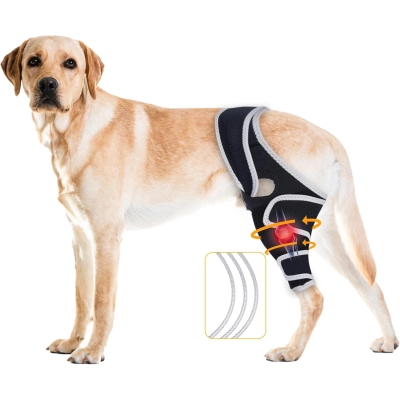
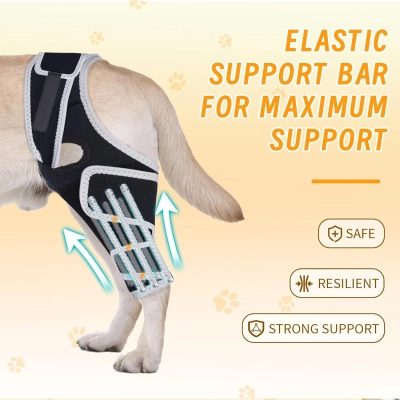
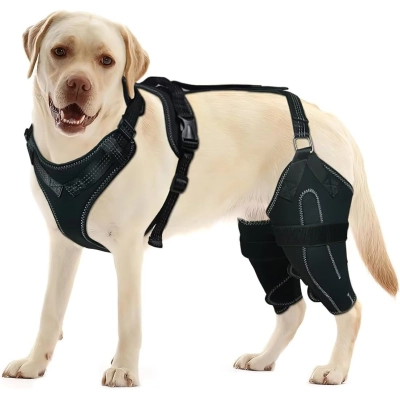
A stifle brace works by translating the hinge's axis of rotation to the dog's natural joint axis. Get the alignment right, and force travels in a straight line—from femur through tibia—with the patella tracking inside its groove. The dog's gait stays close to normal because the brace is not fighting the leg's preferred path.
Miss by a quarter-inch and the story changes. The hinge now applies off-axis force with every step. Instead of guiding the patella, it torques the joint slightly sideways. The dog compensates by shortening the stride or swinging the leg outward. That compensation can look like the brace is working because the skip might disappear. But the underlying mechanism is avoidance, not support.
This is why a luxating patella support design that prioritizes hinge-to-joint alignment over one-size-fits-most sizing produces a different result on toy breeds. The hinge must sit at the stifle's lateral pivot point—visible as a small bony prominence just above the joint line—not somewhere in the general knee area. On a 6-pound dog, "general knee area" spans maybe an inch. Precision matters at this scale in a way it does not on a 60-pound retriever.
You can verify alignment at home. After 15 minutes of leash walking, watch the dog from the side for 30 seconds. A well-aligned brace produces a symmetrical stride—both hind legs cover equal ground per step. If the braced leg consistently takes shorter steps or swings outward, the hinge is not sitting on the joint axis.
| Design Feature | Why It Matters at Toy-Breed Scale | Pass Signal |
|---|---|---|
| Hinge-to-joint alignment | Force travels along natural joint axis; off-axis torque at this scale creates gait compensation within minutes | Symmetrical stride length on both hind legs after 15 min of walking |
| Strap anchor points above and below stifle | Dual anchors prevent the hinge from migrating up or down the leg during flexion, maintaining alignment through movement | Hinge stays within a quarter-inch of original position after a 20-min walk |
| Low-profile hinge housing | Bulky hinge bodies on small legs catch the opposite limb during narrow-stance walking, common in toy breeds | No audible clicking or visible interference between brace and opposite leg |
Strap Width and Edge Clearance on Dogs Under 15 Pounds
Why Standard Strap Widths Create Problems at Small Scale
Most knee braces are patterned around medium-to-large breed proportions. A strap width that distributes force evenly across a Golden Retriever's thigh concentrates it on a Pomeranian's. The physics is straightforward: same stabilizing force applied across a smaller contact area equals higher pressure per square inch.
Narrower straps—roughly half an inch for toy breeds—spread that force across a proportionally appropriate surface. But width alone is not enough. The strap edge finishing determines whether distributed pressure stays comfortable over time. A rolled or stitched edge that feels soft to human fingers can still create a pressure line on thin toy-breed skin after 30 minutes of movement.
The second issue is clearance. On a small dog, the distance between the bottom of a knee brace and the top of the paw is often less than two inches. A strap that hangs below the brace body can interfere with paw placement—the dog steps on its own brace. On male dogs, a brace that extends too far up the thigh risks contacting the prepuce during urination. Neither issue exists on a larger dog where the proportions create natural clearance.
A dog knee brace designed for small breeds addresses these clearance constraints in the pattern stage, before the first stitch. The strap anchor points sit higher on the thigh and terminate above the hock with enough room that the paw never lands on strap material. These are not adjustments made after purchase. They are decisions baked into the cut of the fabric.
Note: After 20 minutes of supervised wear, lift each strap edge and check the skin underneath. A faint impression that fades within 30 seconds is normal. A defined red line that persists, or skin that feels warmer than surrounding areas, means the strap is creating a pressure concentration—loosen slightly and recheck after 10 minutes.
Where a Patella Brace Helps, and Where It Does Not

Conditions the Brace Design Addresses
A stifle brace for patella luxation is most effective when the kneecap can still be manually reduced—it sits in its groove at rest and only displaces during movement. This typically corresponds to grade 1 or 2 luxation, where the patella pops out under load but returns spontaneously or with minimal manipulation.
In these cases, the brace acts as a mechanical track. It does not force the patella into place. It narrows the range of possible motion so the patella has fewer opportunities to deviate. The dog's own quadriceps mechanism pulls the patella straight. The brace removes the sideways escape routes.
Post-surgery, the same design serves a different function. After a trochleoplasty or tibial crest transposition, the repaired structures need protection from sudden lateral forces while scar tissue matures. The brace limits extreme flexion and rotation during the first weeks of recovery, buying time for the surgical repair to integrate.
What the Design Does Not Address
Grade 3 or 4 luxation—where the patella is permanently dislocated and cannot be manually reduced—falls outside what a brace can meaningfully address. No amount of external strapping can relocate a patella locked outside its groove against contracted soft tissues. The structural problem sits inside the joint. A brace only adds external pressure to an already misaligned system.
Dogs with angular limb deformities present a different challenge. A brace patterned for straight-legged anatomy cannot align a joint that sits at an anatomically incorrect angle. The hinge may be positioned correctly on the joint axis, but the axis itself points in the wrong direction.
Where the line sits between these categories is not always obvious. A luxating patella brace mechanism can be evaluated by checking whether the patella stays reduced at rest. If it does, external guidance during movement has a mechanical foundation to work from. If it does not, the brace is working against a dislocation that is fixed in place.
Disclaimer: The fit checks described here assume a short-coated, straight-legged dog with grade 1–2 luxating patella. Double-coated breeds may show subtler rub marks that require hand-checking rather than visual inspection alone. Dogs with angular limb deformities—particularly femoral varus or tibial torsion—have joint axes that differ from the neutral alignment most braces are patterned for; the hinge placement and strap tension observations above may not apply predictably.
| Usage Scenario | What the Brace Can Provide | Main Limitation | Where It Fits |
|---|---|---|---|
| Grade 1–2 luxation, active dog | Mechanical patella tracking during movement; narrows range of motion so patella stays in groove | Will not prevent progression if underlying groove is too shallow; works while worn, not a permanent fix | Daily walks, supervised play, stair navigation |
| Post-surgery protection | Limits extreme flexion and rotation during tissue healing; reduces risk of acute re-injury during rehab | Does not replace controlled rehab exercises; still requires activity restriction per surgical protocol | First 4–8 weeks post-surgery during supervised activity |
| Senior dog, non-surgical candidate | Provides enough stability for comfortable daily movement; can reduce frequency of skipping episodes | Underlying laxity remains; brace manages symptoms, does not reverse structural changes | Long-term daily use with periodic skin checks |
The ACL and CCL brace category shares design principles with patella support—both rely on hinge alignment and anchor-point stability—but targets a different failure mode: forward tibial translation rather than medial patellar displacement. Understanding this distinction matters because a dog with both patella luxation and a partial CCL tear needs a brace that addresses both vectors of instability.
FAQ
How do I tell if the hinge is actually aligned with my dog's stifle joint?
Locate the stifle joint by bending the knee gently—the pivot point is where the femur and tibia meet, visible as a small bony prominence on the outer side. The brace hinge center should sit directly over that point. Mark it with a small piece of tape before fitting the brace. After 10 minutes of walking, check whether the hinge has migrated more than a quarter-inch. If it has, the anchor straps are not holding position.
Can the brace be worn on both hind legs at once?
Technically yes, if both knees are affected. But bilateral brace use narrows the dog's base of support and can make balance more challenging, especially on smooth floors. Start with the more affected leg alone for the first several sessions, then introduce the second brace once the dog's gait has adapted.
How long does it take for a dog to adjust to wearing the brace?
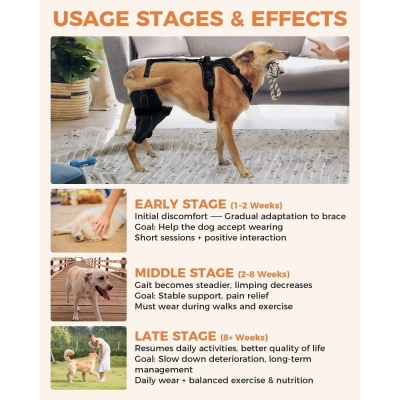
Most small dogs accept a well-fitted brace within two to three short sessions of 10–15 minutes each. Initial high-stepping or leg-shaking is normal and typically resolves once the dog realizes the brace does not restrict forward movement. If the dog refuses to place weight on the leg after the first 5 minutes, remove the brace and check strap tension and hinge position before retrying.
Does the brace replace the need for surgery?
No. The brace manages symptoms and can delay progression in mild cases, but it does not deepen a shallow trochlear groove or realign a displaced tibial crest—the two structural defects that surgery corrects. For grade 3–4 luxation, surgery addresses the root cause; a brace cannot.
What is the difference between a patella brace and a general knee sleeve?
A patella brace includes a rigid or semi-rigid hinge mechanism that controls the plane of knee motion. A sleeve provides compression and warmth but offers no mechanical guidance against lateral patellar movement. For a dog whose kneecap physically displaces during activity, compression alone will not keep it in the groove.
0 Comments