
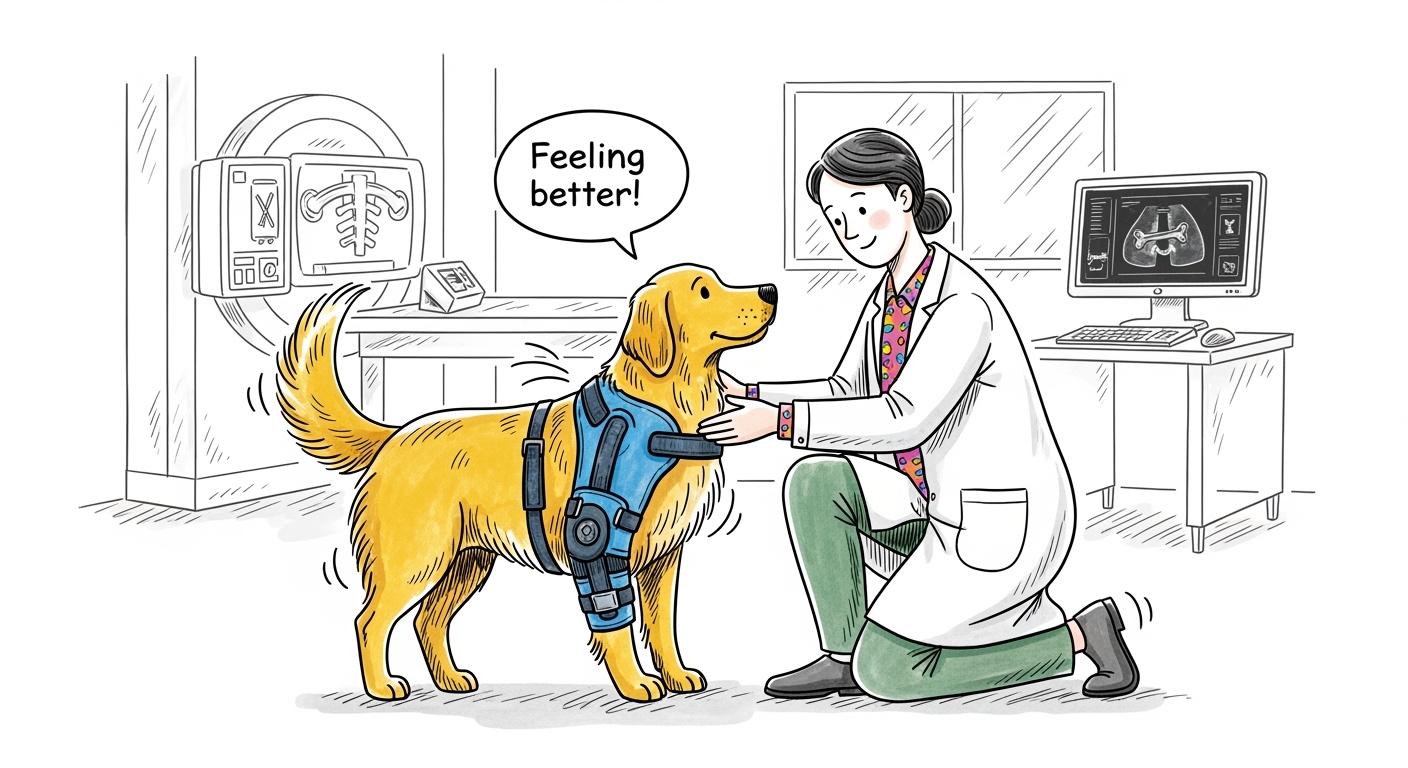
A dog with elbow dysplasia does not need a tighter brace. It needs padding that lands on the right spot and straps that hold without concentrating force. Two braces can wrap the same joint and produce opposite results — one has the dog weight-bearing comfortably within days. The other gets chewed off by day three. The difference is rarely about how tight the brace goes on. It is about where the support lands and whether the materials hold up through the hours a dog spends lying on hard floors, shifting position, and moving through a full range of elbow motion.
How an Elbow Brace Supports the Joint — Not by Wrapping Tighter
The elbow is not a simple hinge. It flexes, extends, and rotates slightly during weight-bearing. A brace that locks the joint fights the dog's natural gait. One that is too loose slips and becomes a chew toy. The effective design stabilizes without immobilizing — it limits the extremes where joint surfaces collide or separate abnormally while allowing the mid-range where muscles activate and stay conditioned.
The functional core of an elbow brace is not compression. It is targeted pressure distribution at the olecranon — the bony prominence at the back of the elbow. When a 60-pound dog lies down on a hard floor, the olecranon drives into the surface through a small contact patch. Bone presses floor through a thin layer of skin and connective tissue. Over days and weeks, that concentrated load compresses the tissue between them. Circulation slows. Callus thickens. In some dogs, a fluid-filled bursa — a hygroma — develops at that exact pressure point.
A well-positioned olecranon pad changes the physics at the contact interface. Instead of bone transferring body weight into the floor through a fingertip-sized area, the padding spreads the load across a palm-sized zone. Force per square inch drops. Tissue has room to maintain blood flow under load. This is not about adding thickness. It is about putting the padding precisely where the bone meets the floor, and nowhere else. Padding that misses the olecranon by an inch carries no meaningful load — it is dead material that adds bulk without altering the pressure mechanics at the contact point.
A canine elbow brace built around olecranon pressure distribution addresses the mechanical cause rather than just cushioning the symptom. A donut insert refines this further. For a dog with an existing hygroma, pressing directly on the fluid pocket aggravates it. The donut creates a ring of padding around the swelling — pressure transfers to the healthy tissue surrounding the hygroma while the center void suspends the fluid pocket without direct compression. This is a fundamentally different mechanism from adding more foam. One redistributes force. The other just softens it.
In practice: After the dog has been lying on a hard surface for 20 minutes with the brace on, remove it and check the skin over the olecranon. An even pink tone across the area means the padding is distributing load across the contact zone. A single pale or white circle directly over the bony point means the padding placement missed the load path — the brace is concentrating pressure, not spreading it.
Material Breathability and Strap Angles — What Decides Whether a Brace Stays On
A brace that slips during a walk does not slip because the dog moved too much. It slips because the strap angles pull in the wrong direction relative to the joint's axis of motion.
When a dog flexes its elbow during forward stride, the brace wants to migrate distally — slide down the leg. A single circumferential strap resists this migration with one narrow band of force. The entire anchoring load concentrates on a strip of skin roughly half an inch wide. High pressure. Small area. Three straps placed at different levels — below the elbow joint, across the mid-brace body, above the joint — split the same anchoring requirement across three zones. Each strap carries roughly a third of the force. Less pressure per contact zone. Lower chance of the brace shifting under repeated flexion.
The angle at which straps pull also matters. Straps that wrap perpendicular to the leg's long axis resist vertical migration poorly — they rely entirely on surface friction between the liner and the fur. Straps that angle slightly proximal, pointing upward toward the shoulder, convert some of the downward migration force into a wedging action. The brace seats against the upper arm contour instead of sliding past it. This is a small design detail that determines whether the brace is still positioned correctly after a 30-minute walk or has ridden halfway down to the carpus.
The same strap-angle principle applies broadly. A dog brace with three-point angled strapping consistently outperforms single-strap designs at resisting migration during joint flexion — the mechanics do not change with the joint being braced. Front-leg braces share this challenge. A dog wrist brace faces similar distal migration forces during weight-bearing, and the solution — multi-point strapping with proximal angling — follows the same mechanical logic.
Material breathability is not a comfort preference. The elbow brace sits in a high-contact zone — the dog lies on it, walks on it, shifts weight onto it while sleeping. Non-breathable fabrics trap moisture against the skin. Moisture softens the stratum corneum, the outer protective layer of the epidermis, making it more vulnerable to friction damage. What starts as dampness becomes maceration. Maceration becomes a skin break. A skin break means the brace has to come off, and the support cycle resets to zero.
Breathable materials — neoprene blends with moisture-wicking liner fabrics — allow vapor to escape through the brace wall. Skin stays dryer. The epidermal barrier stays intact through multi-hour wear sessions. The performance difference is not subtle. A dog that tolerates a breathable brace for six hours may start mouthing at a non-breathable one within two.
In practice: Mark each strap's position with a small piece of tape on the fur before a 10-minute walk. Walk the dog at a normal pace. Any strap that shifted more than half an inch from its tape marker signals that the strap angle or tension is mismatched to that dog's leg contour. Also check: run a finger under each strap after removing the brace. Damp skin under one strap but dry under the others points to uneven compression — the damp strap was tight enough to block evaporation under the liner.
Where the Design Works — and the Conditions It Was Not Built For
An elbow brace with targeted olecranon padding and multi-point strapping works best in specific conditions. Recognizing the boundaries of the design is as important as understanding how it works.
Where it tends to perform well. Elbow dysplasia with mild to moderate instability — the brace limits the end-range motion that triggers discomfort while allowing the mid-range movement that maintains muscle tone. Post-surgical recovery where controlled partial weight-bearing is the goal — the brace reduces the load spikes transmitted through the joint when the dog accidentally overextends. Hygroma management — the donut insert offloads the fluid pocket while the dog continues normal resting on hard surfaces. Arthritic elbows — the combination of retained body warmth and motion limitation can reduce morning stiffness and the hesitation that comes with it.
Dogs with elbow dysplasia and osteoarthritis tend to benefit most from targeted olecranon offloading because these conditions amplify the pressure-concentration problem at the joint's primary floor-contact point. The dog already has compromised joint surfaces. Adding sustained focal pressure from lying down compounds the mechanical stress.
Where the design is not the right tool. Acute fractures — a fabric-and-strap brace does not provide the rigid immobilization a healing bone requires. This is a cast scenario, not a brace scenario. Open wounds with active drainage — moisture trapped under any brace material, breathable or not, will macerate wound edges and delay closure. Severe angular limb deformities — if the dog's leg shape prevents the brace from seating against the joint contour, the straps will either be too loose to anchor or tight enough on one side to create a pressure point that forces the brace off within hours.
Disclaimer: This fit assessment assumes a short-coated dog where skin changes are visible on inspection. Double-coated breeds — Huskies, Malamutes, Chow Chows, and similar — may show subtler rub marks that need hand-checking rather than visual inspection. Run your fingers along the skin under each strap after brace removal, feeling for warmth or slight swelling. What you cannot see through a dense undercoat can still be happening. If the dog's leg conformation falls outside the breed norms this brace was patterned for — particularly dogs with angular limb deformities or very deep chests that alter forelimb loading angles — the fit checks described here may not catch every pressure point.
Design Details That Change Daily Use More Than a Spec Sheet Shows
Three design choices separate a brace that gets used consistently from one that sits in a drawer after the first week.
The donut insert versus a flat pad. Most elbow protection adds foam thickness. A donut insert changes the mechanism — it creates a void over the pressure point or hygroma while the surrounding ring carries the load. For a dog with a recurring elbow hygroma, a flat pad compresses the fluid pocket every time the dog lies down. The mechanical stimulus that drove fluid accumulation stays present. The donut suspends the pocket. Over weeks of consistent use, the hygroma often shrinks because the sustained pressure that caused the fluid buildup is removed. This is not healing in the biological sense. It is removing the physical driver.
Cleaning practicality. A brace that cannot survive a washing machine gets hand-wiped at best and skipped entirely at worst. Materials that hold their padding distribution and strap elasticity through repeated machine cycles matter because a brace worn daily collects saliva, dirt, shed fur, and skin oils. By day four or five, a non-washable brace smells. The dog licks it more. The owner hesitates to put it on. Machine-washable construction with materials that do not clump or lose elasticity after washing is not a convenience feature — it determines whether the brace stays in rotation.
Sizing at the joint line, not the leg. A brace sized by breed label or weight range will fit some dogs and fail others within the same category. Elbow circumference at the joint line varies significantly even among dogs of identical breed and weight. The measurement that matters most is taken with a soft tape wrapped around the elbow joint center while the dog stands with weight on the leg. Sizing charts that rely on mid-limb girth or body weight skip the dimension that determines whether the olecranon pad lands where it should.
A canine elbow brace earns its place through how it handles two specific problems: focused pressure at the olecranon when the dog lies down, and migration during movement when the elbow flexes. The design solutions — positioned padding, donut inserts for hygroma offloading, multi-point strapping with angled pull, breathable moisture-wicking materials — are not about being the best brace. They are about matching specific physical demands with specific mechanical answers. When the padding lands where the bone meets the floor and the straps hold without creating new pressure points, the brace does its job. When either detail is off, it does not — regardless of how tight it goes on or how thick the foam looks.
FAQ
How long can a dog wear an elbow brace continuously?
Most dogs tolerate 4–6 hours of continuous wear with a breathable brace before skin moisture builds to a level that warrants removal and inspection. The limiting factor is typically not the joint support but the skin under the straps — dampness accumulates faster in humid conditions and with dogs that run warm. Remove the brace, check the skin, and let it air-dry before reapplying. Overnight wear is generally not recommended because you cannot monitor for shifting or irritation while asleep.
Does the donut insert work for every elbow hygroma?
It works best on hygromas that are still soft and fluid-filled — the donut ring offloads pressure from the pocket itself while the surrounding tissue carries the load. Hygromas that have hardened into fibrous scar tissue over months may not respond to pressure offloading alone because the tissue has already remodeled. The insert creates a mechanical condition for improvement. It does not guarantee resolution.
Can a dog run with an elbow brace on?
Controlled trotting on even ground is typically fine. Sprinting, sharp turns, and off-leash play on uneven terrain generate forces and angles the brace is not designed to manage — the strap configuration that holds during walking can shift under the higher acceleration loads of a full run. The brace supports the joint during daily activity. It is not sports equipment.
How does elbow brace support differ from knee brace support?
The elbow carries roughly 60% of the dog's body weight during standing and absorbs landing impact differently than the knee. The olecranon is also a direct floor-contact point that the knee does not have — a knee brace does not need to solve the lying-down pressure problem. Elbow brace design has to address both the dynamic load during movement and the static compression load during rest. That dual requirement is what makes olecranon padding placement and the donut insert relevant in ways they are not for a stifle brace.
0 Comments