
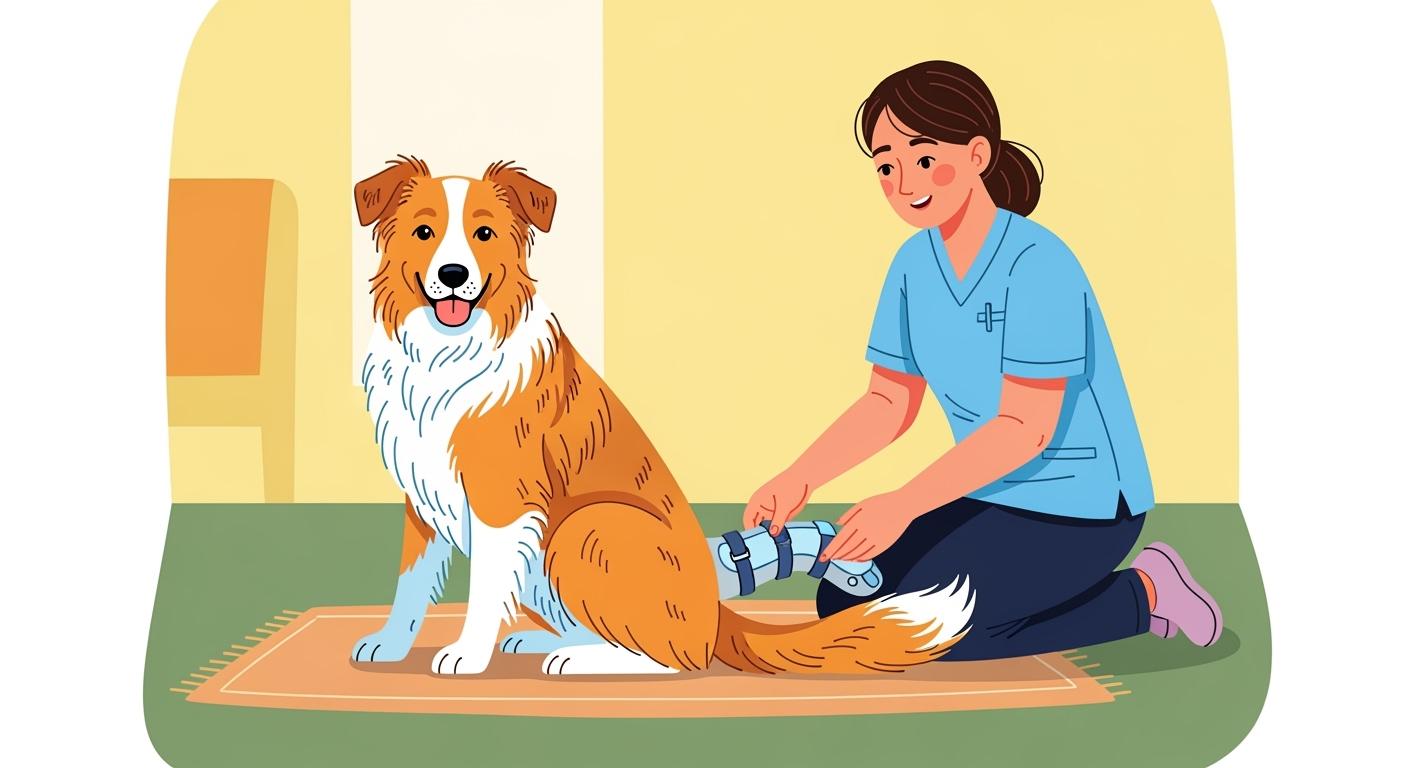
A dog limps. The owner tightens the brace straps. The dog still limps.
That scenario plays out more often than it should. The problem is rarely the dog. It is rarely the idea of bracing, either. The problem sits in a handful of design details that separate a brace that stabilizes a joint from one that merely wraps a leg.
Two details matter more than the rest: where the hinge sits relative to the joint axis, and how the straps spread force across the limb. Get those wrong, and no amount of tightening fixes the support. Get them right, and the brace does its job without needing to be cranked down.
Hinge Alignment: Why the Joint Axis Determines Whether Support Reaches the Joint
A rear leg brace is not a cast. It does not immobilize. It works by guiding the joint through its natural range while blocking the directions that cause pain or further damage.
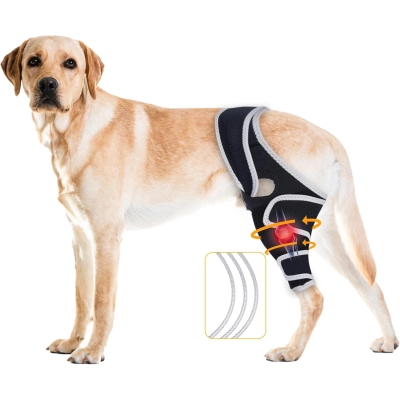
That only works when the hinge pivot sits at the same point as the joint's natural axis of rotation. Here is the causal chain: the hinge is placed at the joint center, so force transmits straight along the bone's mechanical axis, so the articular surfaces stay evenly loaded, so the dog moves with a near-natural gait, so the brace stays in position instead of fighting the dog's own movement. A hinge offset by even half an inch changes everything. The force vector tilts. The joint surface loads unevenly on one side. The brace begins to migrate — sliding down the leg or rotating around it. The dog compensates by shifting weight to the other leg. The limp persists or worsens.
This is why a dog knee brace and a hock brace cannot share the same hinge placement. The stifle rotates around a point roughly at the midpoint of the femoral condyles. The hock — the canine ankle equivalent — pivots lower, at the tibiotarsal joint. A hinge designed for one will miss the other by a wide margin. That margin is the difference between support and a sleeve with metal on the side.
You can verify hinge alignment in under ten minutes. Put the brace on. Walk the dog on a flat surface for ten minutes at a normal pace. Then check: has the hinge drifted more than half an inch from its starting position relative to the joint? If yes, the pivot is off-axis, and the brace is not delivering the support it was designed for. If the hinge stays put, alignment is within working range.
Strap Configuration: How Force Spread Changes What the Dog Feels
Most owners assume a brace works by squeezing. Tighten the straps, lock the joint, problem solved.
That logic fails fast. A joint under compression still wants to move. If the only thing holding it is strap tension, every step the dog takes creates a tug-of-war between muscle force and fabric. The strap that started snug becomes a friction point. Twenty minutes in, the skin underneath is hot. An hour in, there is a red mark. By day three, the dog flinches when the brace comes out.
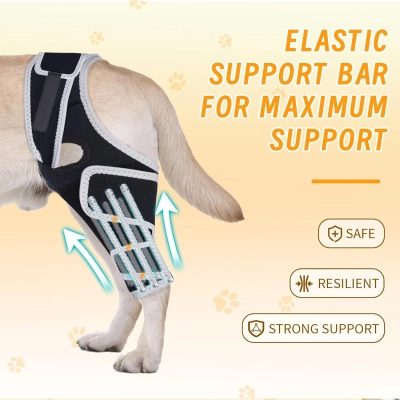
The design variable that prevents this is strap width. A wide strap — two inches or more — spreads the retention force across a larger patch of skin. More surface area means lower pressure per square inch at any given tension. The strap holds the brace in place without creating a hot spot. A narrow strap concentrates the same force into a thin band. That band acts like a tourniquet under movement. The skin breaks down faster. The dog resists wearing.
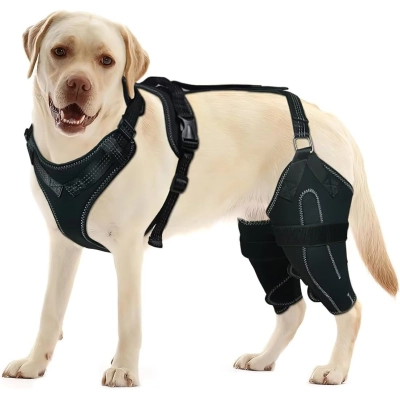
Strap spacing matters equally. Two straps placed far apart — one above the joint, one below — create a stable anchor that resists rotation. When straps sit close together, the brace has a short lever arm. The dog's leg can twist the brace around that narrow grip point. This is especially true for active dogs that pivot, jump, or change direction. A dog CCL brace with widely spaced straps resists that rotational force better than one with straps clustered near the joint line.
The observable check is straightforward. Remove the brace after a wear session. Are the contact marks on the skin uniform — a diffuse, even impression across the area the brace covers? That signals distributed pressure. Or are there concentrated red bands directly under each strap? That signals force concentration. The difference predicts whether the dog will tolerate the brace for weeks or reject it in days.
Where a Rear Leg Brace Helps — and Where It Does Not
A well-designed brace works when the joint has partial stability and the dog still bears some weight on the leg. Partial CCL tears, mild to moderate patellar luxation, post-surgical recovery where the repair needs protected range-of-motion, and arthritic joints that benefit from gentle proprioceptive feedback all fall into this category. In these conditions, the brace acts as an external ligament — taking a share of the load the damaged tissue cannot handle, while still letting the joint move enough to prevent stiffness and muscle atrophy.
The brace is not the right tool when the leg cannot bear any weight at all. A complete cruciate rupture with gross instability — where the tibia slides forward freely under the femur — needs surgical fixation, not external support. Neurological conditions like degenerative myelopathy do not respond to bracing because the problem is not in the joint. It is in the spinal cord. The leg collapses because the signal never arrives, not because the joint is unstable.
Angular limb deformities present a different challenge. These dogs have bones that grew curved or rotated. A brace patterned for a straight-leg conformation will not seat correctly. The hinge axis will not align because there is no single straight axis to align to.
Disclaimer: This check assumes a short-coated dog with standard leg conformation. Double-coated breeds may show subtler rub marks that need hand-checking rather than visual inspection. If the dog's leg shape falls outside the breed norms this brace style was patterned for — particularly dogs with angular limb deformities or very deep chests — the fit checks described here may not catch every pressure point. A brace that measures correctly by circumference can still create uneven contact if the underlying bone geometry differs significantly from the design template.
Design Details That Change Daily Wear
Beyond hinges and straps, three quieter design choices determine whether a brace becomes part of the routine or gathers dust.
Liner material. A neoprene liner holds heat and moisture against the skin. For a dog wearing the brace eight hours a day, that means a damp, warm environment under the fabric. Skin maceration follows. A perforated or moisture-wicking liner — think spacer mesh rather than solid neoprene — lets sweat evaporate rather than pool. The difference is not about comfort in the abstract. It is about whether the skin stays intact through a full wear cycle.
Adjustment range. A brace with three fixed strap positions fits three leg shapes well. A brace with continuously adjustable strap mounts — where the attachment points slide along the brace shell — fits dozens. For a rear leg brace used across different breeds, that range is the difference between a brace that matches the dog and a dog forced to match the brace. The latter never ends well.
Cleanability. A brace that cannot be fully dried between uses develops odor. Worse, it harbors bacteria. Removable, washable liners solve this. Fixed liners do not. The choice seems minor during selection. It dominates by week two.
FAQ
How do you know if a rear leg brace is helping?
Weight-bearing tells the story. If the dog places the foot more squarely and holds it longer during stance phase — observable within the first few walks — the brace is contributing meaningful support. Gait symmetry improves before pain signals resolve, because stabilization reduces the mechanical trigger for guarding.
Can a dog wear a rear leg brace all day?
Most dogs tolerate eight to twelve hours of active wear. Remove the brace at night. Skin needs a dry, unloaded interval to recover. If skin checks show persistent redness after overnight rest, reduce daytime wear by two-hour increments until the skin clears between sessions.
Does a tighter brace give better support?
No. Support comes from structural alignment, not compression. Once the straps are snug enough to prevent the brace from sliding — typically a two-finger fit under each strap — additional tightening adds friction without adding stability. It also reduces circulation and accelerates skin breakdown.

0 Comments