
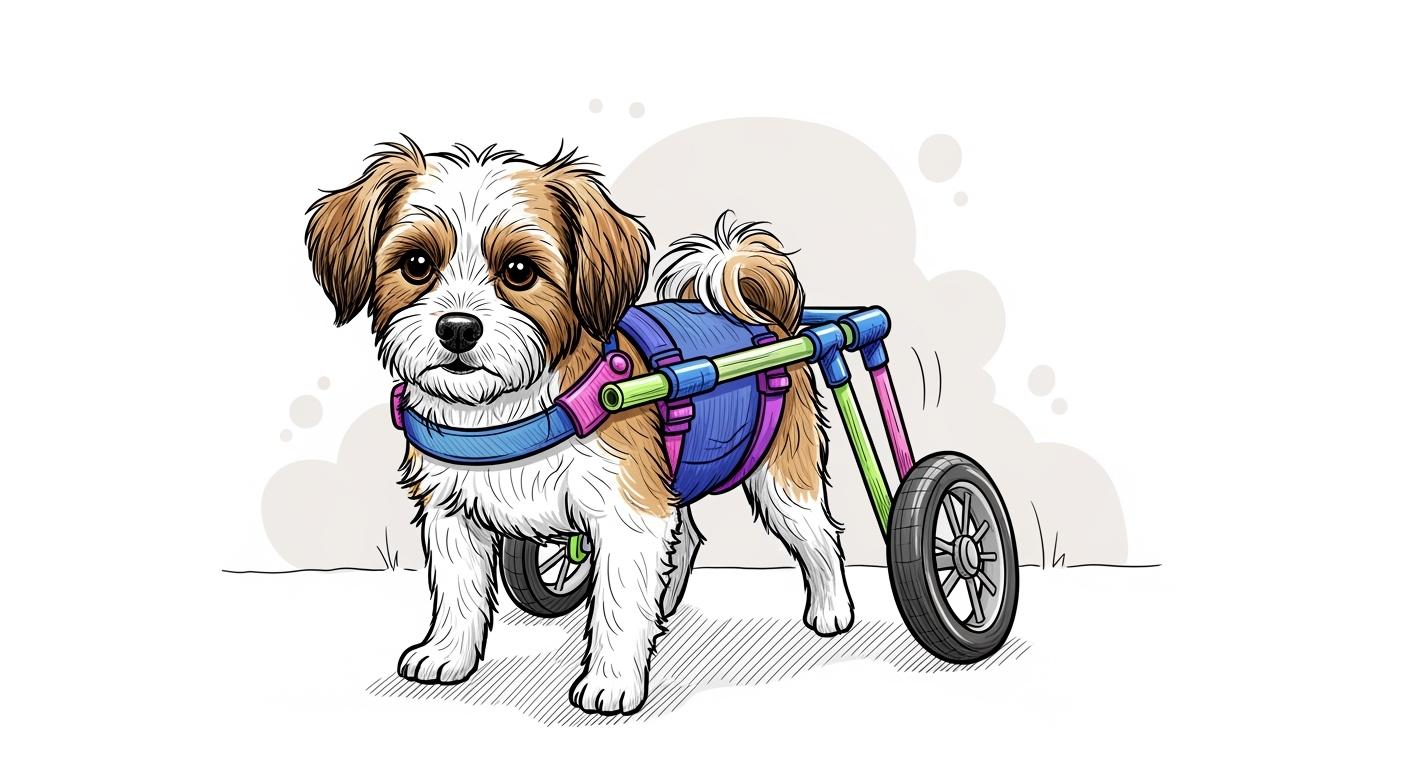
A rear-leg wheelchair that shifts half an inch with every step is not providing support. It is creating a new problem. The dog compensates for the moving frame, stiffens against the straps, and burns energy fighting the very tool meant to help. Whether a wheelchair for dogs hind legs actually supports the dog or just tags along for the ride comes down to one thing: harness geometry.
The frame carries the wheels. But the harness carries the dog. And the difference between a harness that distributes force across wide, stable surfaces and one that concentrates it into narrow bands is the difference between a tool the dog leans into and one it braces against.
Why Harness Geometry Decides Whether a Rear Wheelchair Works
A rear-support wheelchair lifts and stabilizes the hindquarters while the front legs do most of the propulsion work. That means the harness is not just holding the dog up. It is transmitting the dog's forward motion into the frame while resisting the downward pull of gravity on the rear half of the body. Two force vectors, one strap system.
When a harness wraps the rear legs with narrow webbing, the entire load of the hindquarters concentrates into a strip maybe half an inch wide. Under a 50-pound dog, that strip presses into soft tissue with enough pressure to pinch nerves, restrict blood flow, and trigger the dog's withdrawal reflex. The dog tenses. The harness shifts. Tension increases on one side, slack appears on the other, and within a few steps the whole assembly has drifted off its intended anchor points.
Wide, contoured straps solve this through surface area. A strap that is two inches wide distributes the same load across four times the contact area of a half-inch strap — quartering the pressure per square inch. But width alone is not enough. The strap also needs to follow the natural contour of the thigh rather than cutting across it at a straight angle. A contoured strap that wraps along the muscle belly, following the leg's longitudinal axis, stays aligned with the direction of pull. A straight strap pulled diagonally across the thigh creates a shear vector that slides the strap upward with every step.
Check this yourself: after 10 minutes of movement, look at where the leg straps sit relative to the dog's hip joint. If the strap has ridden up more than half an inch from its starting position, the harness geometry is working against the dog's anatomy. A well-designed dog wheelchair harness will keep its position within a quarter-inch of where it started — even after a full walk.
The chest and shoulder straps matter just as much. They anchor the forward end of the assembly. If these straps are positioned too high on the neck, they press into the trachea. Too low on the sternum, and they restrict shoulder extension during the front-leg stride. The right position sits across the breastbone, where bone provides a rigid anchor point and the strap can be tensioned without compressing soft tissue. The front anchor and rear support straps work as a single tension system — loosen one and the other loses its leverage.
Padding Geometry and Adjustment Points: Where Support Holds or Fails
Padding is not about softness. It is about contact consistency. A pad that compresses fully under load becomes functionally identical to having no pad at all — all the pressure transfers to the underlying strap edge. The padding needs enough rebound to maintain a buffer between strap and skin even after hours of compression.
Closed-cell foam maintains thickness under sustained load better than open-cell foam, but it traps heat. Open-cell foam breathes but collapses faster. The functional compromise that works in practice is a thin closed-cell base layer for load distribution with an open-cell contact layer for breathability. Run your thumb across the padding after a 20-minute wear session. If the foam stays depressed and does not rebound within a few seconds, it has bottomed out. That spot becomes a friction point.
Adjustment points are where design intention meets real-world anatomy. A wheelchair frame with only length and height adjustments forces the dog's body to conform to the frame. A frame with independent adjustment at the hip width, thigh strap angle, chest band position, and rear support height lets the frame conform to the dog.
The difference shows up in how the dog moves. A dog in a poorly adjusted cart walks with an arched back or a slumped rear — compensating for the frame rather than being supported by it. A dog in a well-adjusted cart moves with a level spine and a natural stride length. Watch for this: film your dog walking in the wheelchair from the side for 30 seconds. Play it back. The spine should trace a straight line from shoulders to tail base. A visible dip or arch means the adjustment geometry is off, regardless of how tightly the straps are pulled.
Knobs and levers matter too. Adjustment points that require tools to change are adjustments that do not get made. Quick-release levers and large-diameter knobs that can be turned with thumb pressure make daily fit checks practical. Small hex bolts that need an Allen key mean the fit drifts over weeks and nobody corrects it until a rub mark appears. The design difference is not about precision — both systems can achieve the same final geometry. It is about whether the adjustment actually happens.
Adjustable vs. Fixed Frames: When Each Design Choice Wins
An adjustable frame that can change length, height, and width covers more body types out of the box. For a dog whose weight fluctuates — recovering from surgery, gaining muscle during rehab, or aging into a leaner body composition — an adjustable frame that can be re-fit monthly keeps the harness geometry accurate as the dog changes.
But adjustability has a structural trade-off. Every adjustment joint is a potential failure point and a source of play in the frame. A telescoping tube with a locking pin has inherent clearance between the inner and outer tube. Multiply that clearance across three or four adjustment points, and the frame develops cumulative slop — small movements at each joint that add up to a perceptible wobble under load. This matters most for heavier dogs, where the force at each joint is higher and the slop expresses as visible frame flex.
A fixed-frame cart, built to a single dog's measurements, eliminates this slop entirely. Every joint is welded or molded as a single piece. The frame behaves as a rigid unit, transmitting the dog's motion directly into the wheels without intermediate play. For a dog with a stable body shape that will use the wheelchair for years, this rigidity can mean the difference between a cart that tracks straight and one that pulls to one side under asymmetric load. The trade-off is obvious: the cart fits one dog and one dog only. Weight loss, weight gain, or muscle atrophy means the fit degrades and the entire frame may need replacement.
The decision between adjustable and fixed is not about which is "better." It is about which failure mode matters more for the specific dog. A growing puppy or a dog in rehab needs adjustability because the alternative — a fixed frame that no longer fits in three months — is a worse failure than slight frame play. A stable adult dog with a long-term condition gains more from the rigidity of a fixed frame because the alternative — cumulative joint slop that alters tracking — is the worse failure. The same dog lift harness principles apply: support tools work when they match the body, not when they demand the body adapt to them.
Where a Rear Wheelchair Fits and Where It Does Not
A rear-support wheelchair assumes the dog has functional front legs capable of bearing weight and generating propulsion. When that assumption holds — dogs with hind-leg weakness from degenerative myelopathy, arthritis, or partial spinal cord injury who still have strong shoulders and forelimbs — the design works with the dog's remaining strength rather than replacing it. The cart carries the rear, the dog carries the front, and forward motion comes from a cooperation between the two.
When the front legs are also weak — dogs with four-limb involvement from advanced DM, cervical spinal lesions, or generalized neuromuscular disease — a rear-only cart becomes a dead weight the dog cannot move. The design is correct for what it is meant to do. It is incorrect for a dog whose front end cannot do the work the design relies on. A full-support four-wheel frame is the right tool for that different job. These are not failures of the rear-support design. They are mismatches between design assumptions and the dog's actual functional capacity.
The wheelchair also does not replace leg use. It supports the rear while the dog moves. If the dog still has partial hind-leg function, the cart should be adjusted high enough to keep the paws from dragging but low enough that the dog can still feel ground contact and push off if able. A cart set too high removes all ground feedback and accelerates muscle atrophy. A cart set too low lets the paws drag and creates abrasion risk. The correct height lets the dog's rear paws skim the surface — touching enough for sensory feedback, carrying no weight.
Disclaimer: The fit checks described here assume a dog with typical breed-standard proportions. Dogs with angular limb deformities, very deep or very narrow chests, or significant asymmetry between left and right hind legs may show pressure patterns that these visual checks miss. In those cases, a hand-check under the straps after every session — feeling for heat, swelling, or skin texture changes rather than relying on visible rub marks — catches fit problems before they become injuries.
Rear-leg wheelchairs solve a specific problem: the front half works, the back half does not. Within that narrow brief, canine wheelchair solutions live or die by the details. Strap width, strap angle, padding rebound, adjustment granularity, and frame rigidity each pull in different directions. Getting all of them right at once is the difference between a cart the dog accepts and one it stiffens against from the first step.
FAQ
How do you know if a rear wheelchair fits correctly?
Film the dog walking from the side for 30 seconds. The spine should trace level from shoulders to tail base — no dip, no arch. After 10 minutes, check that leg straps have not shifted more than half an inch from their starting position. The dog should take natural-length strides, not shortened steps or a stiff-legged shuffle.
Can the dog relieve itself while in the wheelchair?
Most rear-support designs leave the area behind the hind legs open. The frame supports from below and the harness anchors around the thighs and chest, leaving clearance for urination and defecation. Check after each session and clean any residue from straps promptly — dried waste stiffens fabric and creates a new friction surface.
How long does it take for a dog to accept the wheelchair?
Most dogs accept the harness within three to five short sessions when introduced without pressure. Start with the harness alone, no frame attached, for two-minute sessions with food reinforcement. Attach the frame on day three or four and let the dog stand stationary for a minute before attempting any movement. Rushing this sequence creates resistance that takes longer to undo than the patience it would have taken to prevent it.
What wears out first on a rear wheelchair?
The strap contact surfaces fail before the frame. Check the inner face of all straps weekly — the side that touches the dog. Fraying at stitch lines, foam that stays compressed after use, and fabric that has gone shiny or stiff are all signs the strap assembly needs replacement. Frame joints should be checked monthly for play by gripping the frame at both sides of each joint and twisting gently in opposite directions.

0 Comments