
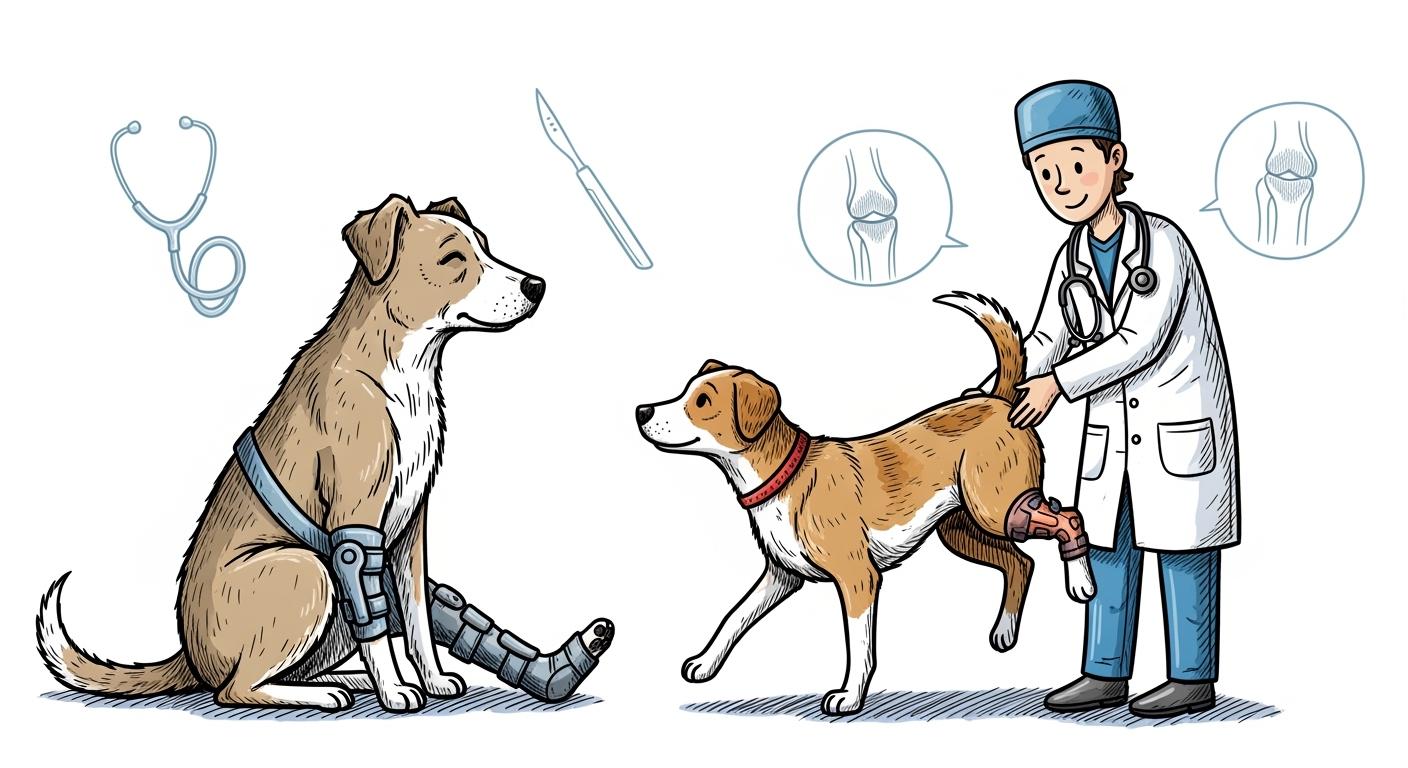
A patella brace does not work by squeezing harder. That is the fastest way to make a dog refuse to walk in one. What decides whether the brace actually helps is simpler and harder to spot: where the hinge sits relative to the stifle joint, and how the straps spread force across the leg. Get both right and the kneecap tracks better during movement. Get either wrong and the brace becomes an expensive leg wrap.
What the Hinge Has to Get Right
A stifle joint flexes around a single axis. The patella rides a shallow groove on the femur and stays centered when that axis runs straight. In a luxating patella, the groove is often too flat or the surrounding soft tissues pull the kneecap sideways, so it pops out of track during flexion.
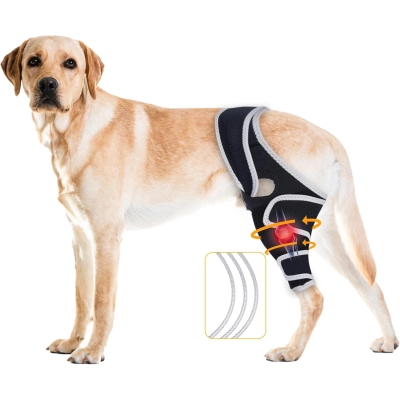
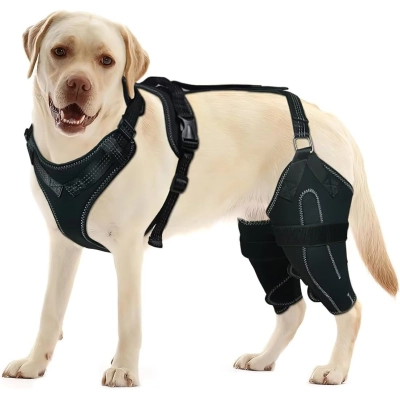
A brace hinge works by mirroring that axis. When the hinge center sits directly over the joint's rotation point, the brace arms move in the same arc as the femur and tibia. Force transmits along the joint's natural line — the patella stays in its groove because the brace is not introducing a competing pivot. Three things happen downstream: the joint surface loads evenly, the dog's gait stays symmetrical, and the brace earns more wear time because the dog does not fight it.
When the hinge sits even a quarter-inch forward or back of the joint axis, the arc misaligns. The femur and tibia want to rotate one way, the brace wants to rotate another. That mismatch turns what should be stabilizing force into torque across the joint. The dog compensates — a shorter stride, a stiffer leg, a skip step every few paces.
Pass signal: After 10 minutes of walking on a flat surface, the dog's gait stays even. No skip steps, no sudden leg lifts. Fail signal: The dog develops a hitch in its stride within the first block, or the brace rides up or down the leg by more than half an inch.
Hinge alignment is not something you adjust with a strap. It is built into the brace pattern. A brace cut for a deep-chested breed with a different stifle angle will never sit right on a straight-legged toy breed, no matter how tight the straps go. This is why the dog knee brace category includes different sizing grids for different body types — a hinge-to-limb match is the foundation. Everything else builds on it.
Straps Do More Than Keep the Brace On
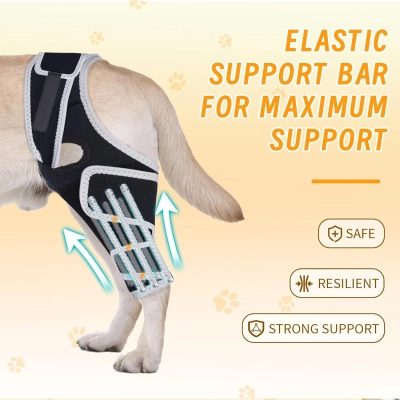
Straps are not just fasteners. They are the interface between the brace frame and the dog's leg, and their width, material, and placement determine whether pressure spreads across muscle or concentrates at a narrow band.
A wide strap — two inches or more on a medium-sized dog — distributes lateral force across a larger contact patch. Force per square inch drops. The skin underneath stays cooler and drier because circulation is not pinched off. A narrow strap, by contrast, funnels the same force into a thin line. That line becomes a pressure point within minutes. The skin reddens, the dog licks the spot, and within a few days of daily use the area turns raw.
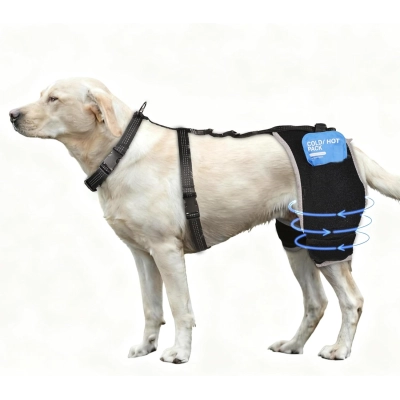
Strap placement is the second lever. A strap that crosses directly over the stifle joint fights the hinge — it compresses the soft tissues the hinge is trying to leave free. A strap placed above or below the joint, anchored on muscle bellies rather than bony prominences, stabilizes the brace frame without interfering with joint motion. The best strap layouts use at least three anchor points: one above the stifle, one below, and one wrapping the hock or lower thigh to resist rotation.
From a manufacturing standpoint, wide straps with radiused edges cost more to cut and sew than narrow straight-cut straps. The edge-radius step — routing the strap perimeter so no sharp corner digs into skin — adds a secondary operation to each strap piece. But it eliminates the single most common reason dogs reject a brace: edge irritation. A rolled or folded strap edge is a cost-cutting shortcut that shows up within a week of use.
Pass signal: After 20 minutes of wear, flip back the brace's inner liner and press a dry paper towel against the skin under each strap. The towel comes away dry — the skin is not sweating under compression. Run a finger along each strap edge. No raised red lines. Fail signal: The towel shows moisture, or red stripes trace the strap borders. The brace is trapping heat or concentrating pressure.
Strap width also interacts with coat type. Short-coated breeds show rub marks immediately. Double-coated breeds can hide early irritation under dense fur. For those dogs, the pass/fail check shifts from visual inspection to hand-feel — run fingertips under each strap after removal and feel for warmth or tenderness before any visible sign appears.
Where Bracing Works and Where It Hits the Limit
A canine luxating patella brace works within a specific mechanical window. The patella must be capable of staying in its groove under manual pressure. If a veterinarian can hold the kneecap in place with light thumb pressure while flexing the joint, a well-fitted brace with correct hinge alignment can often maintain that position during walking and light activity.
This is why mild to moderate luxation — grades where the patella pops out intermittently but can be reduced — tends to respond to bracing. The brace does not deepen the groove. It reduces the sideways forces that exploit the shallow groove. The hinge keeps the joint tracking straight, and the straps prevent the rotational drift that lets the patella escape.
The mechanical limit is the groove depth itself. A severely flat or absent trochlear groove offers no track for the patella to follow, no matter how straight the hinge keeps the limb. In those cases, the patella luxates the moment the dog loads the leg, brace or no brace. The brace becomes a soft wrap around an unstable joint — it may reduce the frequency of full dislocation but cannot hold the kneecap in a groove that does not exist.
Senior dogs with mild to moderate instability often benefit from bracing for a different reason. These dogs are not running agility courses. They need enough stability to walk to the water bowl, navigate a few porch steps, and get outside for bathroom breaks. A stifle support brace with generous strap width and a well-centered hinge can provide that functional stability without the anesthesia risk and recovery demands of surgery.
Active young dogs with high-grade luxation sit on the other side of that line. If the patella stays out most of the time and the dog is limping through daily life, the mechanical deficit is beyond what external support can compensate for. Surgery — deepening the groove, realigning the tibial crest — addresses the geometry directly. A brace used post-surgery in these cases can protect the repair during recovery, but it cannot replace the structural correction.
Disclaimer: The pass/fail checks described here assume a dog with typical stifle conformation for its breed. Dogs with angular limb deformities, very deep or very shallow chests, or significant muscle atrophy on one hind limb may show different fit behavior — the hinge may not align predictably and strap pressure may distribute unevenly. Manual checking under the brace after each wear session is more reliable than visual inspection for these dogs. If the dog's leg shape falls far outside breed norms, the fit checks in this article may not catch every pressure point or alignment error.
The question is not "brace or surgery" as a blanket choice. It is whether the specific mechanical deficit — shallow groove, loose soft tissues, rotational deformity — falls within the range that external hinge-and-strap support can meaningfully influence. Mild intermittent luxation with a reducible patella: often yes. Severe permanent luxation with a flat groove: the geometry says no.
For a deeper look at how the mechanism translates to real-world use, the patella brace mechanism breakdown walks through how external support interacts with stifle joint forces during different activities.
FAQ
What actually holds the kneecap in place — the hinge or the straps?
The hinge sets the plane of motion. The straps keep the brace frame from rotating or sliding off that plane. If the hinge misaligns, no strap tension fixes it. If the straps slip, the hinge loses its reference point and drifts off-axis. Both must work together; neither does the job alone.
Why do some dogs walk fine in the brace for 10 minutes then start skipping?
This usually points to strap creep. As the dog moves, strap material stretches slightly and the brace frame migrates down the leg. The hinge drifts below the joint axis, the arc misaligns, and the dog starts compensating. A second strap check and retighten after the first five minutes of wear often catches this before it disrupts gait.
Can a brace slow down how fast the condition gets worse?
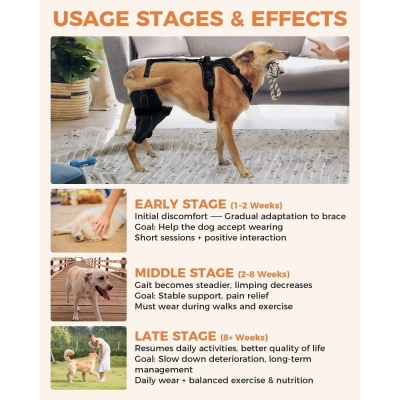
By keeping the limb tracking straighter during activity, a well-fitted brace can reduce the sideways forces that stretch joint capsule tissues and wear down cartilage over time. It does not reverse existing changes — shallow grooves stay shallow, stretched soft tissues stay stretched. But reducing the mechanical insult with each step can delay the point where daily function drops enough to require surgery.
0 Comments