

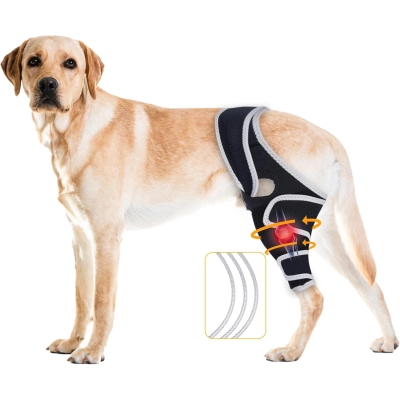
A dog carpal brace looks simple. A sleeve. Some straps. Maybe a rigid panel. But whether it actually stabilizes the wrist or just wraps it has nothing to do with how tight you crank the straps. It comes down to two things: where the hinge sits relative to the carpal joint axis, and how the strap layout spreads force across the leg.
Get those right and the brace transfers load along the skeleton's natural line. Get them wrong and the brace becomes an expensive sleeve that shifts within minutes of walking.
What Makes a Carpal Brace Actually Stabilize
Most dogs that need a carpal brace have one thing in common: the wrist joint can no longer hold its neutral standing angle under load. In carpal hyperextension, the palmar ligaments have stretched past the point where they recoil. The joint drops. The dog walks on the palmar surface instead of the pads.
A brace solves this by creating an external load path that bypasses the failed ligaments. The rigid or semi-rigid panel bridges the carpus, taking ground reaction force and routing it around the lax joint. But this only works if the panel's hinge point aligns with the dog's carpal joint axis.
Here is why that alignment matters. When the hinge sits directly over the joint center, compressive force travels in a straight line through the radius, across the carpal bones, and into the metacarpals. The joint surfaces stay evenly loaded. The dog's gait stays close to normal. The brace does not fight the leg's natural motion. When the hinge sits even half an inch too high or low, that straight force path bends. The brace introduces a lever arm at the joint. Instead of bypassing the carpus, it torques it. The dog compensates by altering its gait. The altered gait loads other joints — the elbow, the shoulder — in patterns they were not built to handle.
The difference is visible. Put the brace on and walk the dog for ten minutes on hard ground. If the dog's stride length stays symmetric and the brace has not crept down the leg, the hinge placement is close enough. If the dog shortens stride on the braced leg or the brace sleeve sits noticeably lower than when you started, the panel is fighting the joint instead of supporting it.
This is why "tighter" is not the answer to a brace that slips. A brace that fits its joint axis stays put at moderate strap tension. A brace that needs overtightening to stay in place has a geometry problem, not a tension problem.
Strap Width, Placement, and Force Distribution
A carpal brace typically anchors at two zones — above the carpus on the distal radius and below the carpus on the metacarpals. This two-point anchoring is not just about keeping the brace on. It is about how force enters and exits the external support structure.
Wide straps matter here in a way that is easy to miss on a product page. A strap exerts force on the skin and underlying tissue across its contact area. A narrow strap concentrates that force. Same total tension, smaller area, higher unit pressure. Higher pressure means faster occlusion of capillary blood flow in the skin. That means heat buildup, moisture trapping, and skin breakdown if the brace is worn for more than thirty minutes at a time.
A wide strap spreads the same holding force across two to three times the surface area. Pressure per square inch drops proportionally. The skin breathes better. The brace stays put not because it grips harder but because the wider contact patch creates more friction surface without increasing compression.
Strap placement matters just as much. The proximal strap — the one above the carpus — handles most of the vertical retention. It keeps the brace from sliding down. The distal strap controls rotation. When both straps sit on compressible soft tissue rather than directly over bone, the brace migrates. Muscle bellies change shape during contraction. A strap cinched over the belly of the flexor carpi ulnaris at rest will feel loose when the muscle fires, then tight again when it relaxes. The result is a brace that walks down the leg in tiny increments with every stride.
The straps that hold best sit just above and below the carpal joint where the underlying tissue is thinner and less mobile — closer to bone, farther from the belly of major muscles. This placement trades some padding comfort for positional stability. A thin neoprene liner under the strap can offset the comfort loss without reintroducing migration.
Check strap performance the same way you check hinge alignment. Mark the brace position with a small piece of tape on the dog's fur at the top edge. Walk ten minutes. Measure how far the brace has moved. More than half an inch of migration means either strap width, strap placement, or both need adjustment.
Support Levels, Material Tradeoffs, and Where a Carpal Brace Reaches Its Limits
A dog brace spans a range from soft compression wraps to fully rigid splints, and the design differences between them are not just about "more support." They reflect different answers to a single question: how much motion should the brace block, and how much should it permit?
Soft compression wraps apply circumferential pressure and warmth. They work for mild chronic instability where the primary deficit is proprioceptive — the dog's nervous system needs more sensory feedback from the joint to position it correctly, not a mechanical block against collapse. The warmth increases local blood flow, which can ease stiffness from mild arthritis. But a compression wrap provides no structural resistance to hyperextension. It will not stop a carpus from dropping if the ligaments are truly failed.
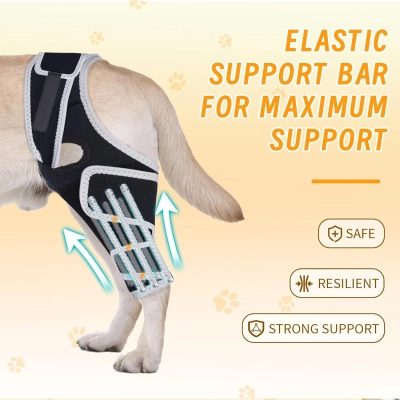
Semi-rigid braces add lateral stays or panels that resist flexion and extension past a set range. They work for partial ligament tears where some passive stability remains and the brace only needs to catch the joint at end range. The panel material matters here. Thermoplastic stays can be reheated and reshaped as swelling changes, which matters in the first two weeks after injury. Metal stays hold their shape permanently but cannot be adjusted without replacing the brace. Neither is universally better; the choice depends on whether the dog's leg shape is changing during recovery.
Rigid braces lock the carpus at a fixed angle. They are the right call for complete ligament ruptures and immediate post-surgical protection. But they introduce their own tradeoffs. A fully immobilized wrist shifts all movement demand to the elbow and shoulder. Dogs with pre-existing elbow arthritis or shoulder instability may show worsening in those joints within days of rigid carpal bracing. The brace solves one problem and can surface another. This is not a flaw in the design — it is the inherent cost of immobilizing one joint in a linked chain.
Liner material determines whether a brace gets worn consistently or gets abandoned after the first week. Neoprene liners provide padding and distribute pressure evenly, but they trap heat and moisture. In warm weather or on double-coated breeds, a neoprene-lined brace worn for more than an hour can create the conditions for skin maceration. Mesh or perforated foam liners breathe better but provide less cushioning, which matters if the brace's rigid panel edges are thin rather than rolled. A rolled panel edge with a mesh liner can outperform a flat-edged panel with thick neoprene — the edge geometry matters as much as the liner material itself.
Disclaimer: The fit checks described here assume a short-coated dog where brace migration and skin changes are visible. Double-coated breeds may show subtler rub marks that need hand-checking rather than visual inspection. If the dog's leg conformation falls outside the breed norms this brace was patterned for — particularly dogs with angular limb deformities or very deep chests where the carpus sits at an atypical angle — the alignment and migration checks described here may not catch every pressure point.
A carpal brace is not a substitute for rehabilitation and mobility work. It creates the mechanical conditions for the joint to rest in a neutral position. Whether the dog rebuilds strength and coordination during that rest period depends on what else happens — controlled exercise, gradual reloading, and attention to the upstream joints that take over while the carpus is supported. The brace opens a window. What happens inside that window is the rest of the recovery.
FAQ
How long should a dog wear a carpal brace each day?
Start with 30 to 60 minutes, three to five times daily. Increase by about 25 percent every few days if skin checks show no irritation. The goal is to reach the duration the dog needs for daily activity — not to maximize brace time. More hours do not equal better outcomes if the skin or upstream joints start to complain.
Can a dog sleep in a carpal brace?
Remove the brace during sleep and indoor rest unless a veterinarian has specifically instructed otherwise. Overnight wear multiplies the risk of pressure sores without adding meaningful support benefit, since the joint is unloaded while the dog is lying down.
What are the signs that a brace does not fit?
Redness that does not fade within ten minutes of removing the brace. Sores, swelling above or below the brace edges, or cold toes. A brace that rotates more than half an inch or slides down the leg during a short walk. Limping that worsens with the brace on. Any of these means the geometry is off — hinge placement, strap location, or panel length — and tightening the straps will not fix it.
Does a carpal brace cure carpal hyperextension?
No. A brace provides external mechanical support that bypasses failed ligaments during weight-bearing activity. It does not repair the ligament tissue itself. For some dogs, bracing combined with controlled rehabilitation allows enough functional recovery to return to normal activity without surgery. For others, the ligament damage is too extensive and the brace serves as a long-term management tool rather than a bridge back to unassisted function.
How do I clean a carpal brace without damaging it?
Disassemble removable components. Soak fabric portions in warm water with mild detergent for five minutes. Gently scrub with a soft cloth. Rinse thoroughly — residual soap against the skin under compression is a fast path to irritation. Air-dry completely before reassembly. Machine washing or heat drying can warp panel materials and degrade hook-and-loop fastener performance.
0 Comments