
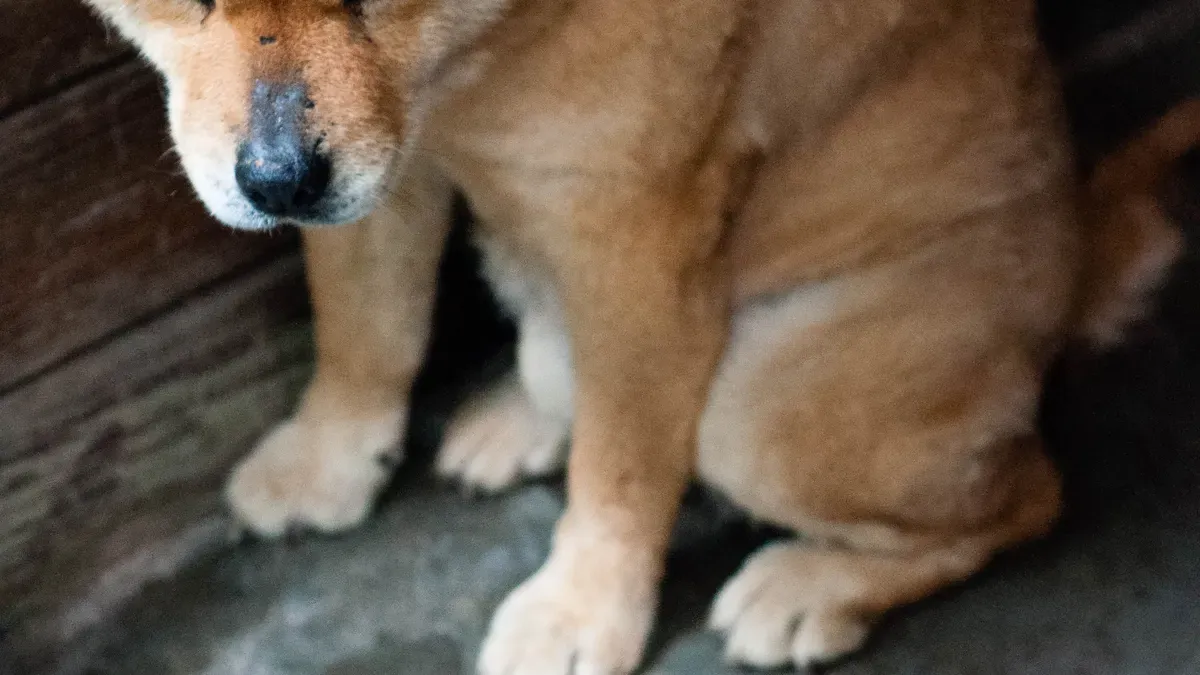
A dog favors a back leg. The ankle looks swollen. The owner searches "dog hock injury" and finds pages of first-aid instructions — rest, ice, call the vet. Useful, but it skips the harder question: when the acute phase passes and the joint still feels unstable, what makes one support solution work better than another?
The answer sits in a handful of design decisions most product pages never explain. Hinge placement. Strap anchoring geometry. The breathability of the liner material under repeated flexion. These are not abstract engineering details. They determine whether a brace stabilizes the tarsal joint during a walk or simply compresses the leg while the joint continues to shift underneath.
Joint Alignment — Why Hinge Position Outweighs Strap Tension
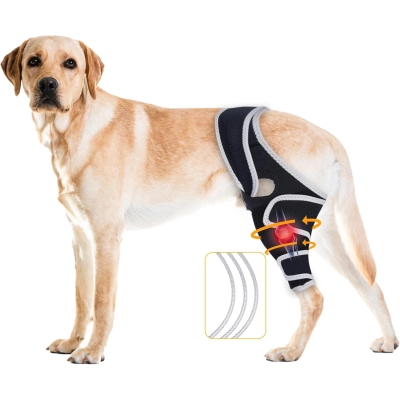
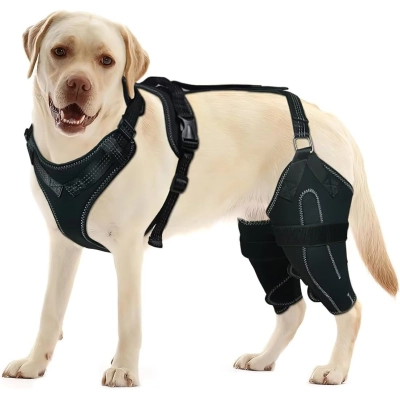
Walk behind a dog wearing a hock brace and pay attention to one thing: does the hinge stay centered over the bony bump on the outside of the hock, or does it drift forward or back with each step?
That drift is the single most reliable signal of whether the brace is working. Here is why.
The hock joint is not a simple hinge. It is a compound joint where the talus, calcaneus, and four tarsal bones articulate under the pull of the Achilles tendon and the restraint of collateral ligaments. When a dog pushes off, force travels from the femur through the tibia, across the tarsal bones, and into the paw. The joint's pivot axis runs roughly through the center of the talus.
A brace hinge that aligns with this axis allows the joint to move through its natural range while the brace shell resists side-to-side deviation — the kind of motion that stresses healing ligaments. But a hinge that sits even half an inch forward of the true pivot point creates a different dynamic: as the joint flexes, the brace shell pulls against the leg's natural arc. The dog compensates by shortening its stride or externally rotating the limb. The joint surfaces load unevenly. What was meant to be a stabilization device becomes a resistance device the dog is quietly working against.
This is why the tightness of the straps matters far less than hinge position. A moderately snug brace with a correctly aligned hinge outperforms a cranked-down brace with a hinge sitting off-axis every time. The observable check is straightforward: after a 10-minute walk on a flat surface, the hinge should still sit within a quarter-inch of where it started relative to the bony landmark on the lateral hock. If it has migrated, the brace is not stabilizing — it is sliding.
Where Hock Support Performs Best — and Where It Reaches Its Limits
A hock brace is not a cast. It does not immobilize. What it does is constrain the joint's end-range motion — the last few degrees of extension or lateral deviation where soft tissue structures are most vulnerable. This makes it useful in specific scenarios and irrelevant in others.
The conditions where a well-designed hock brace tends to make the most difference:
- Partial ligament tears and grade I-II sprains. The collateral ligaments are still partially intact. The brace limits the joint from moving into the range where those remaining fibers would be overloaded.
- Chronic instability after an old injury. Scar tissue fills the gap left by a fully healed tear, but it lacks the organized fiber structure of native ligament. A brace provides passive restraint during activity, reducing the cumulative micro-damage that leads to arthritis.
- Arthritic hocks with weight-bearing pain. By restricting the joint's end-range wobble, the brace reduces the intermittent sharp loading that triggers pain in an arthritic joint — the kind of loading that happens when the dog steps on uneven ground and the hock momentarily shifts beyond its comfortable arc.
- Post-surgical protection during controlled rehab. After a procedure like ligament repair, the repair site needs protection from sudden loading while controlled motion continues.
There are also conditions where a brace alone is the wrong tool:
- Complete Achilles tendon rupture with a dropped hock. The tendon has lost all tension. No external brace can restore the spring function of a severed tendon — surgical reattachment is the primary intervention, with bracing serving only as post-operative protection.
- Unstable fractures of the tarsal bones. A brace cannot hold bone fragments in alignment. These injuries require surgical fixation first.
- Open wounds or active skin infection over the hock. Any brace material pressed against broken skin creates a risk of deeper infection.
Disclaimer: The fit and function checks described here assume a dog with standard leg conformation. Dogs with angular limb deformities, very deep or very shallow chests that alter stance, or double-coated breeds where rub marks are harder to see — these dogs may need hand-checking under the brace edges rather than visual inspection alone. If the dog's hock structure falls well outside the breed norms the brace was patterned for, the hinge alignment check described above may not catch every pressure point.
Recognizing where a brace fits into the picture — and where it does not — is part of understanding the broader landscape of mobility rehabilitation. The brace is one tool in a sequence that may also include controlled exercise, weight management, and veterinary monitoring.
Strap Layout, Material, and Sizing — The Details That Change Daily Use
Even a brace with excellent hinge geometry can fail in daily use if three secondary design elements are wrong.
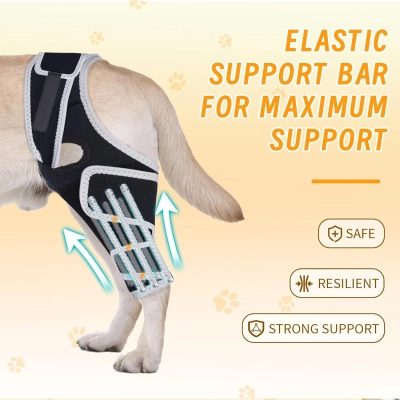
Strap anchoring configuration. The hock has minimal soft tissue coverage — skin, thin subcutaneous tissue, then bone and tendon. A brace that uses two wide straps (one proximal, one distal) concentrates pressure into two narrow bands. Over a 30-minute walk, those bands can create focal pressure points that the dog reacts to by altering gait — exactly what the brace is supposed to prevent.
Designs that use three or more anchor points, or a contoured shell that distributes contact across the full length of the hock segment, spread the same total stabilizing force over a larger surface area. The physics is straightforward: pressure equals force divided by area. Double the contact area, halve the pressure at any given point. This is why sling-style or boot-style anchor systems, when properly fitted, tend to produce fewer skin reactions than two-strap configurations.
Liner breathability under flexion. The hock flexes and extends with every step. Each flexion cycle pumps air out of the brace interior; each extension cycle draws air back in — if the liner material allows it. Non-porous neoprene liners trap moisture against skin that is already under mechanical pressure. Within 20 minutes of activity, the combination of pressure, moisture, and friction begins degrading the skin's outer layer.
An observable check: after the first 20-minute wear session, open the brace and press a dry paper towel against the inner liner. If the towel comes away damp, the liner is trapping moisture — and the wear duration should be capped at shorter intervals while the skin adapts. A liner that stays dry to the touch after moderate activity is doing its job.
Size granularity and adjustment range. A brace offered in three sizes forces many dogs into an approximation. A hock that is 4.75 inches in circumference assigned to a "Medium" designed for 4.3–5.1 inches may fit at the midpoint of the strap range — or it may sit at the extreme end, where strap tension becomes inconsistent. The worst case is a dog that falls between sizes: the smaller size over-tightens, the larger size cannot achieve adequate contact.
More size breakpoints, or designs with multi-point independent tension adjustments within each size, reduce the number of dogs that land in these gap zones. This is a manufacturing choice — more SKUs cost more to produce and inventory — but it directly affects how many dogs get a fit that holds through movement. The same principle applies across the broader category of dog braces: a design's real-world performance ceiling is set not by its best-case fit but by how many dogs fall into its fit gaps.
The differences between hock braces, wraps, and rehab solutions often come down to exactly these variables — how the device anchors, what material it uses at the skin interface, and how precisely it can be sized to an individual dog's leg.
FAQ
How do I know if the hinge is aligned correctly?
Place the brace on the dog's leg and locate the bony prominence on the outside of the hock — the lateral malleolus. The hinge pivot should sit directly over this point. Walk the dog for 5–10 minutes on a flat surface. Re-check: if the hinge has drifted more than a quarter-inch, the brace is either sized wrong or the strap tension is unbalanced between the upper and lower anchors.
Can a hock brace prevent re-injury in an active dog?
A brace can reduce the likelihood of re-injury during activity by limiting the joint's end-range motion — the zone where previously injured ligaments are most vulnerable. It does not eliminate risk. The degree of protection depends on whether the brace maintains hinge alignment through the full range of motion, which in turn depends on fit precision and strap configuration.
How long can a dog wear a hock brace continuously?
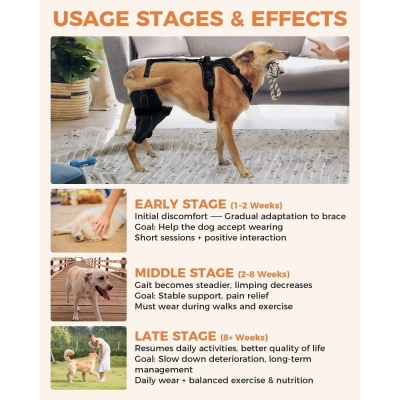
Start with 15–20 minute sessions and check skin after each wear. If the liner stays dry and the skin shows no red marks that persist beyond 10 minutes after removal, increase to 30–45 minutes. Most dogs should not wear a brace for more than 2–3 hours without a skin check. The limiting factor is almost always moisture buildup at the skin-liner interface, not the mechanical function of the brace itself.
What is the difference between a hock brace and a hock wrap?
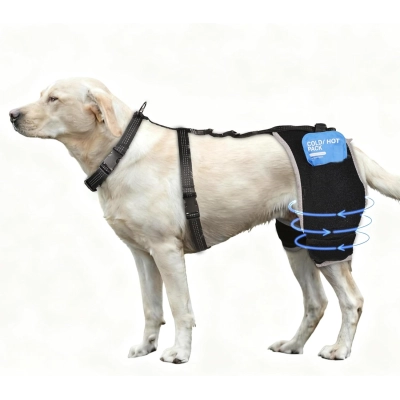
A wrap provides compression and mild proprioceptive feedback — the dog feels the wrap and may move more cautiously. A brace adds a structural element — a rigid or semi-rigid shell with an articulated or fixed hinge — that mechanically limits joint motion. Wraps can help with mild strains and swelling. Braces address instability where the joint needs passive mechanical restraint during movement.
0 Comments