
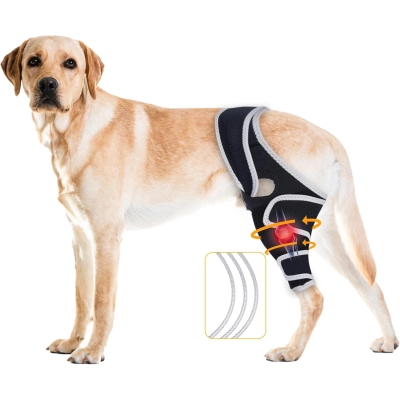
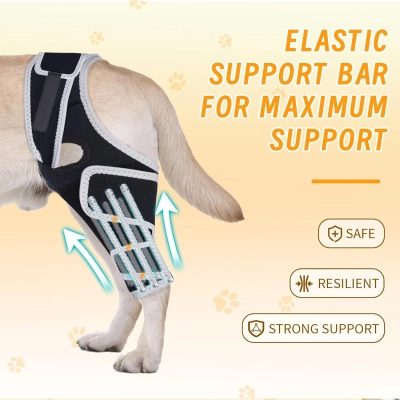
A dog puts weight on a leg it was avoiding three days ago. The difference is not that someone wrapped the knee tighter. The difference is a hinge placed where the joint actually bends, and straps wide enough to hold it there through a full stride.
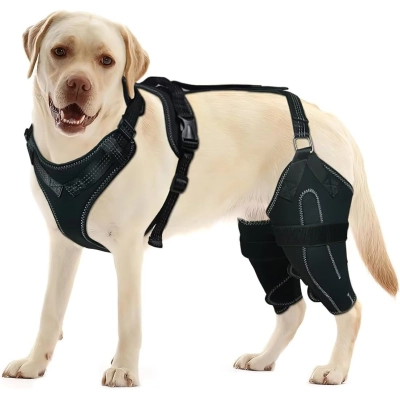
Those two design details separate a dog knee brace that stabilizes the rear leg from one that becomes dead weight within minutes. When the hinge tracks the stifle joint axis through its natural arc, the brace guides movement rather than fighting it. When strap width disperses lateral force instead of concentrating it under a thin band, the dog tolerates the brace long enough for stabilization to matter. Lose either one, and the brace fails regardless of how strong the materials are.
Hinge Alignment: What Separates a Stabilizing Brace From a Wrap
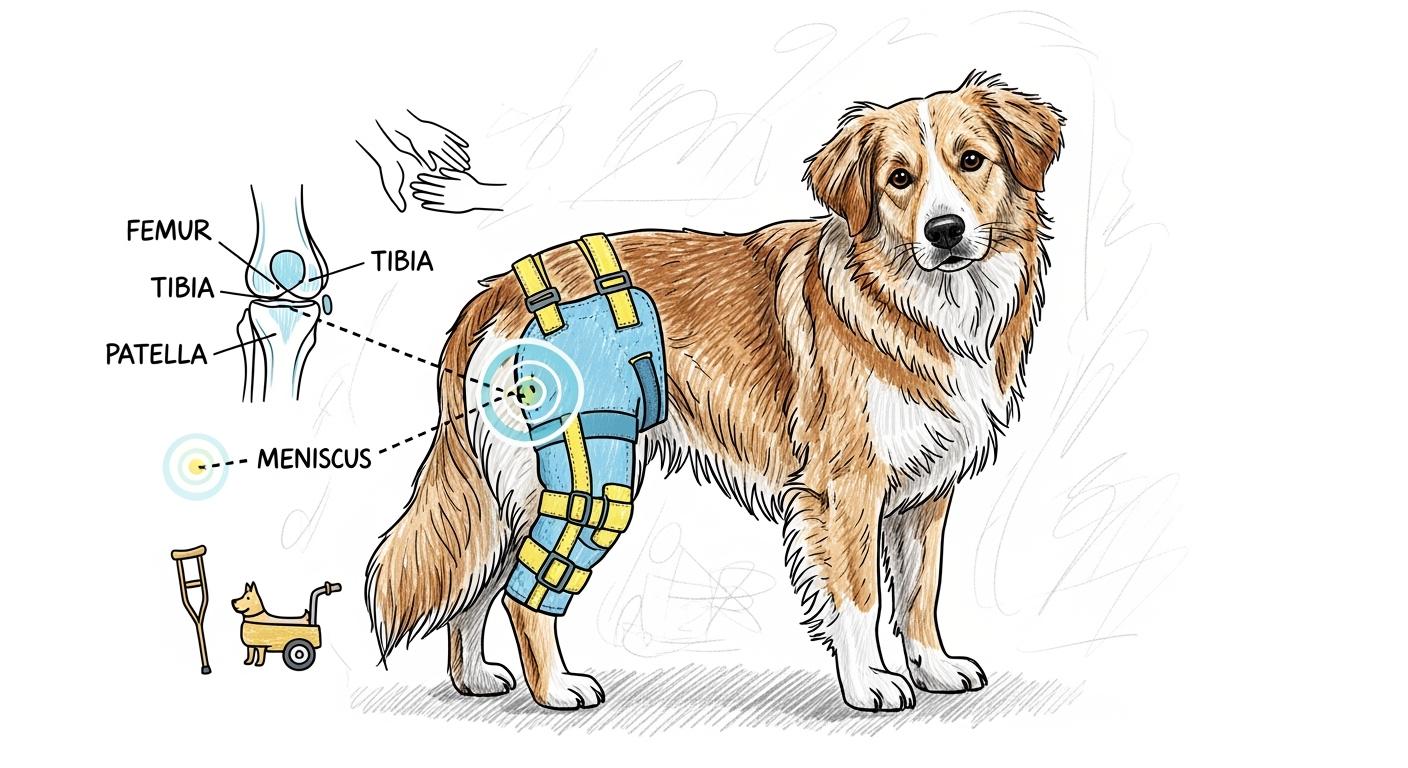
The stifle joint does not bend like a door hinge. It rolls and slides — the femoral condyles rotate against the tibial plateau while the CCL keeps the tibia from translating forward. A brace hinge placed half an inch above or below the joint axis cannot track this combined motion. Instead of guiding the joint, it fights it.
Here is the chain that matters: hinge placed at the stifle joint axis → force transmits along the femur-tibia load path → joint surfaces stay evenly loaded → the dog moves through a natural stride → the brace does not resist the movement → wearing tolerance stays high → stabilization holds through the full wear period. Break the chain at the first link and everything downstream collapses.
A hinge offset by even a quarter inch forces the dog to alter its gait to accommodate the brace — the very compensation pattern the brace is supposed to prevent. The dog shortens its stride on that side, shifts weight to the opposite leg, and the support device becomes the reason for new loading asymmetries. This is why hinge placement matters more than hinge material or hinge strength. A titanium hinge in the wrong position stabilizes nothing. A polymer hinge in the right position lets the dog load the leg normally.
You can verify alignment after a walk. Watch the dog from the side for ten strides. The hinge center should stay roughly aligned with the stifle through the full gait cycle. If the hinge drifts forward during flexion or slides backward during extension, the brace is fighting the joint's natural arc. That is not a tightness problem. It is a position problem.
| Performance Difference | Why It Matters | Pass Signal | Fail Signal |
|---|---|---|---|
| Hinge tracks stifle joint axis | Force travels along natural load path; dog maintains normal stride length | Hinge stays centered over stifle through 10+ strides | Hinge drifts forward/backward relative to joint during gait |
| Hinge sits off-axis | Brace resists natural joint motion; dog compensates by shortening stride | — | Dog limps more with brace on than off; brace migrates within minutes |
Strap Configuration: Why Width and Placement Decide Whether the Brace Stays Put
Tightening a narrow strap feels like the right move. It is the wrong one. Force concentrated under a thin band creates pressure peaks against the skin. The dog shifts weight to escape the discomfort. The brace migrates. Alignment is lost. The owner tightens the strap further. The cycle repeats until the dog refuses to move at all.
The physics are straightforward. A broad strap spreads the same stabilizing force over a larger contact area — lower pressure per square inch, less localized skin stress, less behavioral resistance from the dog. The brace stays where it was positioned because the dog is not motivated to escape it. Narrow straps pull the opposite direction: high unit pressure, skin reddening within twenty minutes, brace migration, alignment degradation, and a dog that associates the brace with discomfort.
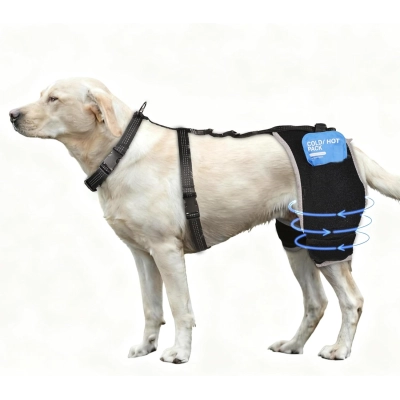
Strap placement geometry matters as much as strap width. A strap positioned above the stifle and another below it creates a three-point force triangle that resists rotation around the leg. A single wide strap with no counter-anchor lets the brace pivot. Two narrow straps placed too close together behave like one narrow strap — same pressure concentration, same migration pattern. The design question is not "how tight" but "how many anchor points, how far apart, and how wide at each point."
The observable check is simple. Put the brace on. Walk the dog for twenty minutes. Remove the brace and look at the skin under each strap. Uniform pinkness without distinct edge marks means force is distributing evenly. Sharp red lines tracing the strap borders mean pressure is concentrating along a thin band — width is insufficient for this dog's leg circumference and activity level. If the dog has been licking one specific spot under a strap, that spot experienced peak pressure regardless of how the rest of the skin looks.
Tip: A strap that stays put through a twenty-minute walk but leaves sharp red edge lines is still failing — the skin is signaling that force distribution, not strap security, is the problem.
Where a Rear-Leg Knee Brace Works — and Where It Does Not
An ACL brace for a dog's rear leg works best when the joint still has passive stability from surrounding structures and the brace is supplementing, not replacing, the ligament's restraining function. Partial CCL tears fit this profile. The ligament retains some load-bearing capacity, and the brace narrows the gap between what the damaged CCL can handle and what daily movement demands. Post-surgical recovery falls into the same category — the repair provides primary stability, and the brace restricts motion to protect the healing tissue during controlled activity.
Chronic instability from degenerative changes also falls within the brace's working range, provided the joint still tracks within a predictable range of motion. The brace limits excursion at the end ranges where instability triggers pain. For dogs where arthritis has already set in around a chronically unstable stifle, a brace that keeps the joint within a comfortable mid-range arc can mean the difference between a dog that walks and one that refuses to leave its bed.
The boundaries are equally real. A complete CCL tear in a large, active dog produces instability magnitudes that external bracing cannot fully compensate for — the forces involved exceed what straps and shell materials can redirect without the brace itself becoming so rigid that the dog cannot move naturally. The trade-off between stabilization and mobility collapses at the extremes. Neurological conditions that affect proprioception create a separate problem: the brace depends on the dog feeling where its leg is and adjusting accordingly; a dog that cannot sense limb position gains little from external guidance.
Patellar luxation involves a different mechanical problem — the kneecap slips out of its groove — and while a stifle brace may provide incidental support, the design priorities differ. A brace optimized for CCL stability is not necessarily the right tool for a patella that tracks laterally.
The observable boundary check is the ten-minute walk test. Put the brace on, walk the dog on a flat surface for ten minutes, and watch. If the dog loads the leg more evenly with the brace than without, the brace is working within its design range. If the dog limps the same or worse, or the brace has visibly shifted, the condition or the fit falls outside what the brace can address.
Disclaimer: This check assumes a dog with typical rear-leg conformation. Dogs with angular limb deformities, very deep chests, or extreme body proportions may not achieve the hinge-to-joint alignment described here regardless of strap adjustment. In those cases, even a well-constructed brace may fail the observable checks listed above — not because of a design flaw, but because the underlying anatomy falls outside the geometry the brace was patterned for.
Design Details That Shape Daily Use
Alignment and force distribution are the two load-bearing design features. But three other details determine whether the brace gets used consistently enough for those features to matter.
Material breathability versus padding thickness. Dense padding feels protective in the hand. On the dog's leg, after thirty minutes of movement, it traps heat and moisture. The skin under the brace stays damp. Over days, damp skin softens and becomes more vulnerable to friction damage — the opposite of what the padding was supposed to achieve. Open-cell neoprene with perforations trades some initial plushness for air exchange that keeps the skin dry through the wear period. Dry skin tolerates contact. Damp skin breaks down. The trade-off is not obvious until it is measured by what the skin looks like after a week of daily use.
Strap adjustment granularity. A dog's leg circumference changes over the course of a day — slightly larger after activity, slightly smaller at rest. Velcro straps with half-inch hook-and-loop overlap increments let the owner dial fit to the current state. Buckle-only systems offer fixed positions that are either slightly too loose or slightly too tight for the leg at any given moment. A well-designed brace for rear-leg use needs the fine adjustment range that hook-and-loop provides, because consistent alignment depends on consistent fit, and consistent fit requires adjustment that can track daily fluctuation.
Cleanability. A brace worn on a rear leg collects dirt, hair, and moisture. Removable, washable inner liners separate from the structural shell so the contact surface can be cleaned without compromising the hinge or strap anchors. Designs that bond the liner to the shell force surface cleaning only — effective for a few days, then progressively less so. A rear leg brace that cannot be thoroughly cleaned becomes a skin problem within two weeks, regardless of how well it fits on day one.
These three details — breathability, adjustment range, and cleanability — do not determine whether the brace can stabilize. They determine whether it gets worn long enough to find out.
FAQ
How long should a dog wear a rear-leg knee brace each day?
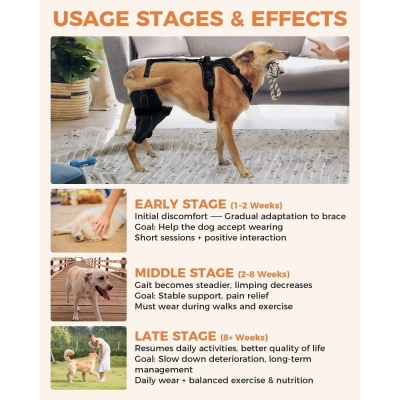
Start with 15–20 minute sessions and increase gradually as the dog's tolerance builds. Most dogs work up to wearing the brace during walks and active periods only. Remove it during extended rest and overnight — the skin needs dry periods to stay intact under prolonged contact.
Does a knee brace heal a torn CCL?
No. The brace provides external mechanical support that compensates for the damaged ligament's lost restraining function. It does not cause the ligament fibers to rejoin. Its role is to create a stable mechanical environment in which the joint can function while the body's healing processes run their course — or, in cases where the tear is complete and surgery is planned, to maintain mobility and reduce compensatory strain on the opposite leg in the interim.
What is the difference between a custom brace and an off-the-shelf brace?
A custom brace is molded to the individual dog's leg geometry. It can achieve hinge-to-joint alignment with higher precision because the shell is built around the actual limb contour. It tends to be the better option for severe instability where alignment tolerance is narrow. An off-the-shelf brace uses adjustable straps and standardized shell geometry to approximate alignment across a broader size range. It works best for partial tears and post-surgical support where the alignment tolerance is wider. The right choice depends on how precisely the hinge must track the joint axis for the specific injury — not on price or perceived quality.
What signals show the brace fits correctly?
The brace stays in position through a full walk without drifting. The dog loads the leg more evenly with the brace on than off. After removal, the skin shows uniform contact marks without sharp red lines or isolated pressure spots. If any of these three signals fails, the fit needs adjustment regardless of whether the size chart says it is correct.

0 Comments