
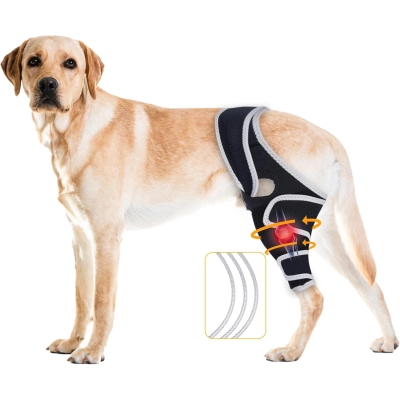
A rear leg knee brace looks straightforward — straps, a sleeve, a hinge. But whether it stabilizes the stifle joint or just occupies space on the leg turns on two design variables most product pages never explain: where the hinge sits relative to the joint axis, and how the straps distribute force across the leg. Get either one wrong and the brace works against the dog instead of for it.
Hinge-to-Stifle Alignment: The Variable That Decides Whether the Brace Stabilizes
The measurable difference between a brace that stabilizes and one that does not comes down to a single alignment question. A knee brace resists lateral and rotational forces by transferring load away from the stifle joint. But it can only transfer that load cleanly if the hinge pivot aligns with the joint's natural axis of rotation.
Misalignment by even a quarter-inch changes the physics entirely. Instead of sending force along the joint's natural load path, an off-axis hinge creates a lever arm. It pushes the stifle slightly off-center with every step. Over dozens of steps the dog compensates by altering its gait. The brace becomes a source of instability — the very thing it is supposed to resolve.
The causal chain is direct: hinge-to-joint alignment means force travels along the natural joint axis, which produces even load distribution across joint surfaces, which lets the dog move with a near-natural gait, which keeps the brace from migrating, which preserves skin tolerance because nothing rubs or shifts. Break any link and the whole system degrades. A dog knee brace built with an articulated hinge has a single alignment target. That target either gets hit or it does not.
This is also where an articulated brace separates from a general limb wrap. A dog brace without a hinge can provide compression and mild proprioceptive feedback. It cannot maintain joint-axis registration because there is no axis to register. The hinge is not a feature — it is the mechanism that makes stabilization possible at all.
How to verify alignment in real use
Put the brace on, secure the straps, and walk the dog for ten minutes on a flat surface. Stop and check: the hinge center should still sit directly over the stifle joint, with no upward drift toward the hip and no downward slide toward the hock. If the hinge has moved, the brace is migrating — and a migrating brace has already stopped doing its job regardless of how tight the straps are. This check is binary. Hinge over stifle after movement = pass. Hinge drifted = fail. No amount of strap tightening fixes an alignment problem.
Strap Count and Placement: Force Distribution Is What Matters, Not Tightness
If hinge alignment is the precision variable, strap configuration is the distribution variable. Three design choices determine whether stabilization force spreads safely across the leg or concentrates into narrow bands that break down skin: how many anchor points the brace uses, where they sit along the leg, and how wide each strap is.
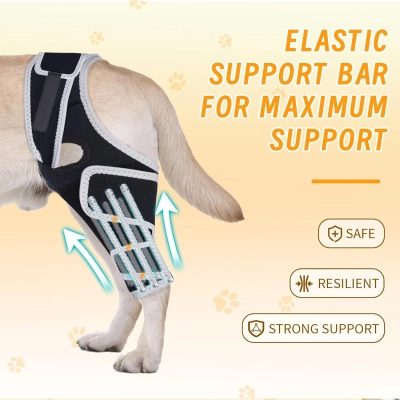
The physics is straightforward. Force per unit area drops as contact area increases. A two-strap brace concentrates all stabilization load into two narrow bands — one above the stifle, one below. Each band carries roughly half the lateral load the brace is resisting. A four-strap design distributes the same total load across four contact zones, roughly halving the pressure at any single point. Skin and underlying tissue tolerate low distributed pressure for hours. Under concentrated pressure, they break down fast.
Strap width works through the same mechanism. A half-inch strap and a one-inch strap under equal tension apply the same total force to the leg. But the wider strap spreads that force across twice the surface area. The skin under a narrow strap sees higher localized pressure. Over a four-hour wear session, that difference is the gap between mild redness and an open sore.
Placement of the top strap is particularly load-sensitive. It anchors the entire brace against gravity and against the dog's natural hip flexion during stride. Too close to the groin and it restricts hip range — the dog shortens its stride to avoid the pinch. Too far down the thigh and the brace loses its vertical anchor and slides. On most dogs the sweet spot puts the top edge of the uppermost strap roughly two finger-widths below the groin crease with the dog standing square. That position creates a stable anchor without intruding into the hip's movement envelope.
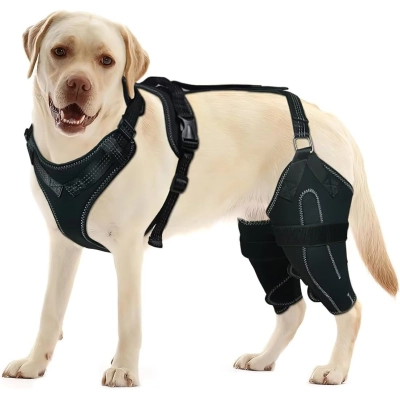
There is a meaningful design distinction between dog ACL and CCL braces built for cruciate-specific stabilization and simpler knee sleeves. Cruciate-targeted designs typically use four-point or multi-strap systems paired with an articulated hinge. The straps do more than keep the brace on — they actively control tibial translation by anchoring above and below the stifle at angles calculated to resist forward thrust of the tibia. A sleeve with one or two straps can provide compression and sensory feedback. It cannot resist anterior tibial translation the way a multi-strap articulated design can. Different strap counts serve different stabilization goals, and how a knee brace supports recovery depends heavily on which goal the design is engineered for.
How to verify force distribution
After a 20-minute wear session, remove the brace and inspect the skin under every strap contact zone. Even light pinkness under one strap but clean skin under the others signals disproportionate load — that strap is carrying more than its share of the stabilization force. It might be overtightened. The adjacent straps might be too loose to share the load. Either way, the fix is adjusting the strap balance, not cranking all of them tighter. The goal is uniform skin appearance across all contact zones. Asymmetry in post-wear skin condition is a distribution problem, not a tightness problem.
| Design variable | What it controls | Pass signal | Fail signal |
|---|---|---|---|
| Hinge-to-stifle alignment | Force path through joint axis | Hinge stays over stifle after 10-min walk | Hinge drifts up toward hip or down toward hock |
| Strap count and width | Pressure per unit area on skin | Uniform skin appearance under all straps after 20 min | Pinkness or indent under one strap, clean under others |
| Top strap position | Vertical brace anchor without hip restriction | Dog maintains full stride length; brace does not slide | Shortened stride or brace migration during walking |
| Liner material | Heat and moisture management under load | Skin dry and cool to touch after wear session | Moisture accumulation or redness after removal |
Where the Design Works — and Where It Reaches Its Limits
A rear leg knee brace performs best under a specific set of conditions. Recognizing those conditions — and their boundaries — is what separates effective use from frustration.
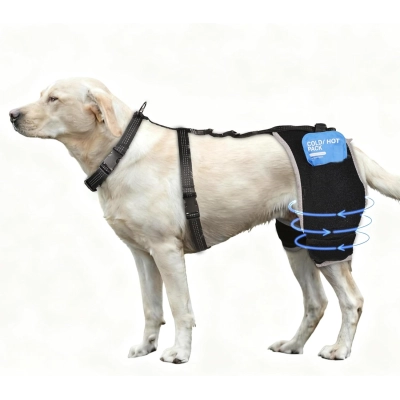
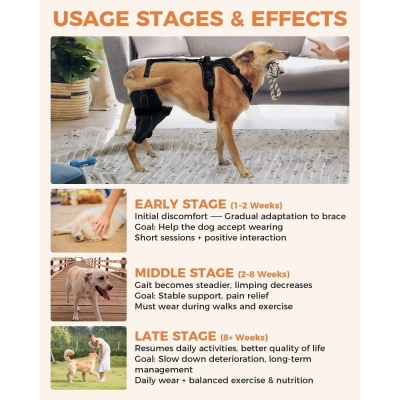
The design works when the primary need is mechanical stabilization of the stifle during controlled, linear movement. That covers post-ACL or CCL injury management where surgery is not immediate, post-surgical recovery requiring graduated external support, and chronic stifle instability from partial ligament damage or early arthritic changes. In each scenario the brace functions as a temporary external ligament: the hinge provides the rotational axis, the straps provide the anchor, and together they resist lateral and rotational forces the dog's soft tissues cannot currently handle alone. Level-ground leash walking is the movement pattern the design is optimized for.
The design reaches its limit under several conditions. A dog with significant angular limb deformity — where the femur and tibia meet at an angle that deviates from the anatomical norm the brace was patterned for — will not get clean hinge-to-joint alignment. The geometry simply does not match. Very deep-chested breeds with proportionally short femurs create a different problem: there is not enough femur length above the stifle to seat the upper strap assembly without the top edge intruding into the groin and restricting hip flexion. Dogs under roughly 10 pounds face the opposite challenge — even a small-sized brace carries enough hardware mass relative to leg weight that the dog may alter its gait just from carrying the brace, defeating the purpose.
Material choice imposes its own ceiling. Neoprene liners provide grip and moderate breathability. In hot or humid conditions, even perforated neoprene traps enough heat and moisture to shorten tolerable wear time significantly. A dog comfortable for four hours indoors at 70 degrees may show skin irritation after two hours outdoors at 85 degrees. The brace design has not changed between those two scenarios. The environmental load on the material has exceeded what it can dissipate.
Disclaimer: The alignment checks and wear-time observations described here assume a dog with standard leg conformation. Dogs with angular limb deformities, proportionally short femurs, or double coats may show different pressure patterns and fit behaviors. For double-coated breeds, visual skin inspection under straps is less reliable — hand-check for heat, moisture, and texture changes under the coat. What looks normal from above can conceal a developing pressure point that only touch detects.
FAQ
How many straps should a rear leg knee brace have?
For cruciate-level stabilization, four-point strapping is the effective minimum — two anchor points above the stifle, two below. A two-strap design can provide compression and mild support. It cannot resist rotational forces or anterior tibial translation because there are not enough anchor points to create the force couples needed for multi-axis control. Strap count maps directly to the stabilization goal the brace is designed to achieve.
Does a tighter fit produce better stabilization?
No. Tighter straps concentrate force into narrower bands, accelerating skin breakdown without improving joint stabilization. The brace stabilizes through hinge alignment and distributed anchoring, not through compression. If the only way to stop the brace from sliding is to overtighten the straps, the underlying problem is fit geometry — the brace circumference or segment proportions do not match the dog's leg. Tightening straps masks a sizing problem. It does not solve it.
How long can a dog wear the brace in a single session?
That depends on liner material, ambient temperature, humidity, and the dog's activity level. With a neoprene-lined brace in moderate indoor conditions, two to four hours is a typical ceiling before skin requires a break. In warm or humid conditions that ceiling drops. In cool, dry conditions it may extend. The observable decision signal is skin condition immediately after removal — any moisture accumulation or pinkness means the session ran too long for those conditions, regardless of what a general guideline says.
Can a dog wearing a rear leg knee brace handle stairs?
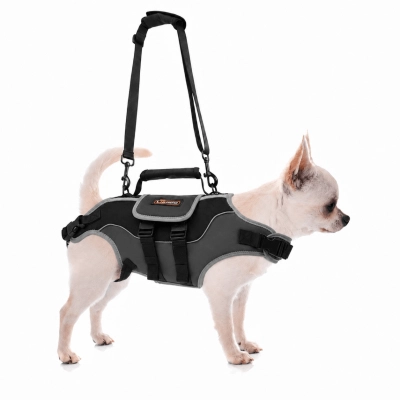
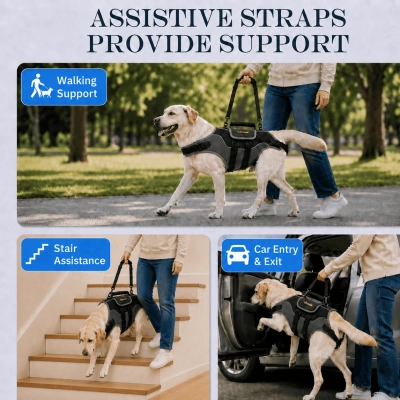
Stairs concentrate load on the stifle at an angle most braces are not engineered to fully resist. The hinge-and-strap system is optimized for linear forward movement on level surfaces, where lateral and rotational forces are predictable. On stairs the load vector shifts diagonally, introducing torque the brace was not designed to manage. Stair navigation is better handled with a lift harness that offloads a portion of body weight rather than relying on the brace alone.

0 Comments