
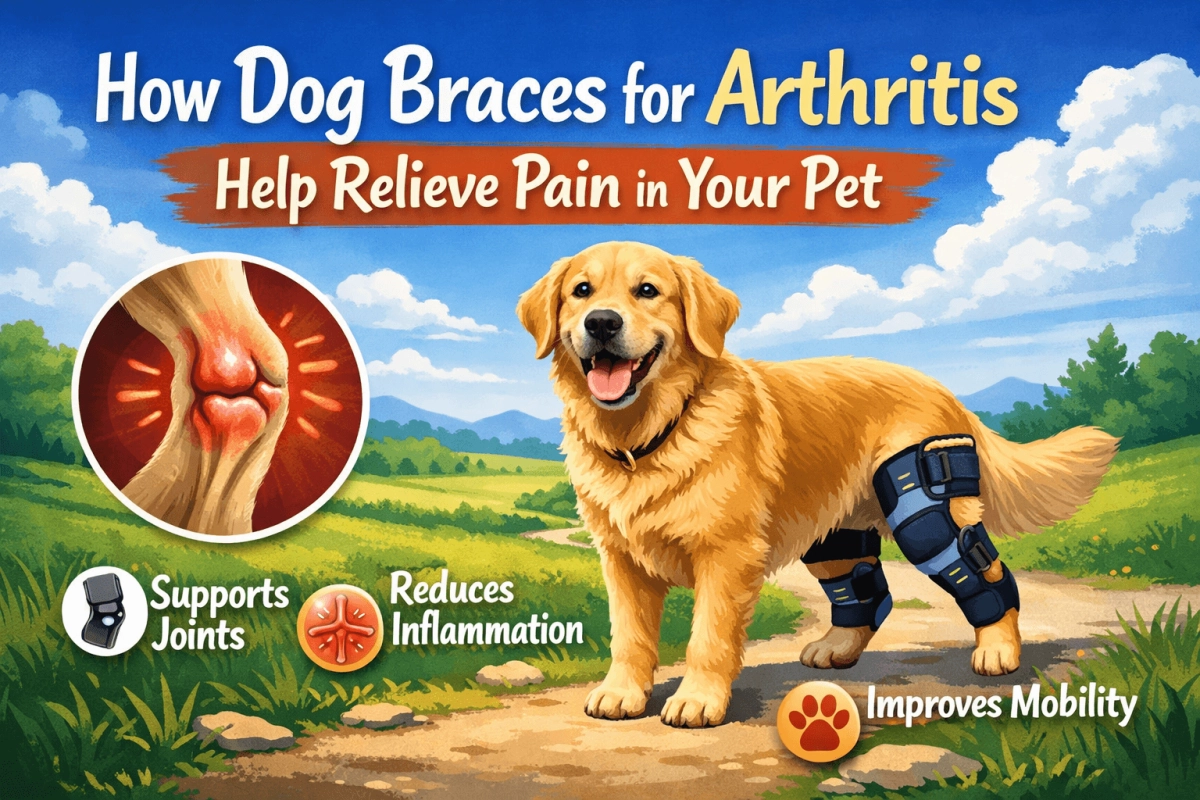
Dog braces for arthritis can really help your pet feel better and move more easily. Many people do not know how often dogs get arthritis. The numbers are surprising:
-
Up to 80% of older dogs have arthritis.
-
Some younger dogs can get it as early as one year old.
Lots of pet owners notice their dogs walk better and stand straighter with braces. These supports help dogs move and make them feel more sure of themselves. Braces are part of modern care and work with other treatments to help your dog feel good every day.
Key Takeaways
-
Dog braces give important support to dogs with arthritis. They help dogs move better and feel less pain.
-
The brace must fit well to work right. Always measure your dog's leg before you pick a brace.
-
Braces spread weight away from sore joints. This helps your dog heal and walk better.
-
Braces work best with other treatments like physical therapy. This helps your dog stay healthy.
-
Watch for signs of arthritis, like not wanting to move or limping. Try braces early to help your dog feel better.
Dog Braces for Arthritis: How They Work
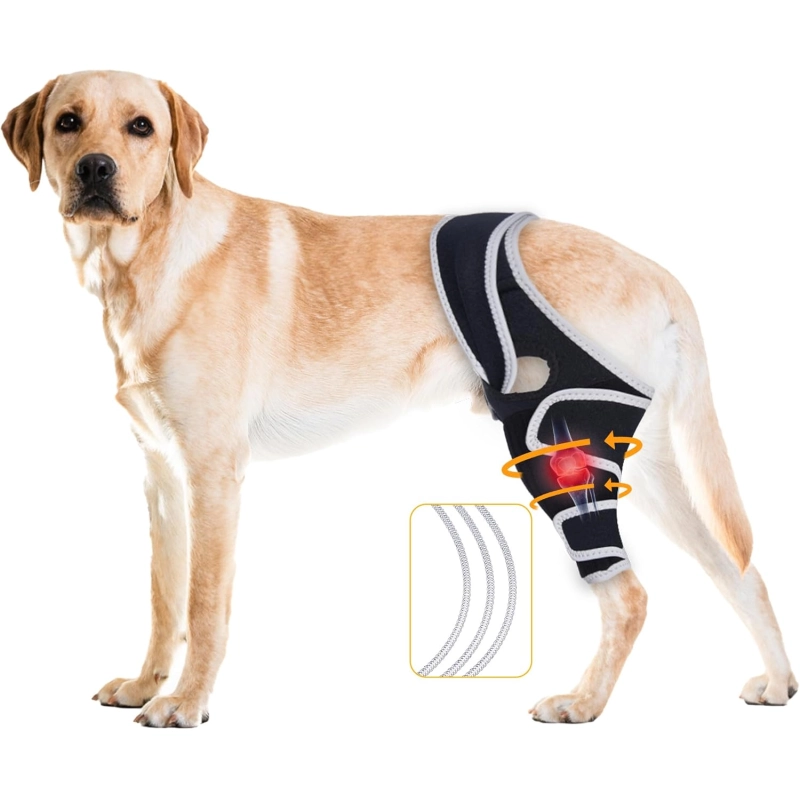
Dog braces for arthritis can make a transformative difference for your pet. You might wonder how these devices help your dog move with less pain. The answer lies in a combination of biomechanics, materials science, and rehabilitation medicine. Let's break down the science behind their multi-faceted action.
1. Joint Support & Stabilization: Rebuilding a Mechanical Foundation
With arthritis, cartilage deteriorates, leading to bone-on-bone friction, inflammation, and pain. The joint becomes weak and unstable.
-
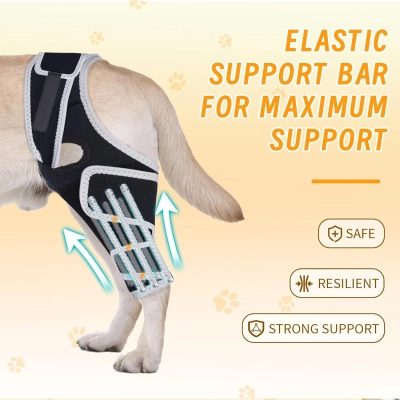
Core Mechanism: A brace acts as an external ligament and muscular aid. It provides physical constraint, limiting abnormal ranges of motion (like hyperextension or lateral sway) and helping to keep bones in a more natural alignment. This reduces the pain and further damage caused by instability.
-
Design in Action: For example, a hinged knee brace for a cranial cruciate ligament injury primarily functions to prevent the abnormal forward slide of the tibia, mimicking the ligament's role to support healing.
2. Biomechanical Offloading: Scientifically Reducing Joint Stress
This is one of the most direct ways braces alleviate pain by redistributing forces away from damaged areas.
-
Force Redistribution & Pressure Mapping: Utilizing principles of physics (Force = Pressure x Area), braces use their structure (like supportive stays or strategically placed pads) to increase the surface area over which force is applied or to redirect load through the brace's straps to healthier tissues above and below the joint. Advanced custom hip or stifle braces can employ a three-point pressure system to create a gentle moment that slightly "unloads" the joint space.
-
Clinical Evidence: A study published in the American Journal of Veterinary Research noted that dogs with elbow dysplasia using custom offloading braces showed measurable gait improvements and reduced pain scores in over 70% of cases. Research on knee arthritis indicates dogs using functional braces demonstrated an average improvement of approximately 40% in mobility assessments over a 90-day period.
3. Proprioception & Neuromuscular Re-education
This is a critical, often overlooked, advanced function of bracing.
-
The Science: Proprioception is the body's sense of its position and movement. Arthritis and pain disrupt signals from the joint's proprioceptors. The consistent, tactile input from a brace's compression stimulates the nervous system, enhancing neuromuscular control.
-
The Benefit: This helps your dog place its paw more accurately, reduces stumbling, and builds confidence. Essentially, the brace isn't just supporting the joint; it's "re-training" the nervous system to use it better.
4. Materials & Design: How Technology Enhances Comfort & Efficacy
The effectiveness of modern braces is deeply tied to their engineering:
-
Advanced Materials:
-
Memory Foam & Gel Pads: Conform to the joint's contour for even pressure distribution, preventing hot spots and improving long-term comfort.
-
Breathable & Antimicrobial Fabrics: Materials like CoolMax or silver-ion infused fibers wick moisture, keeping skin dry and reducing dermatitis risk.
-
Lightweight Composites: Carbon fiber or high-performance polymers provide strong support without adding burdensome weight.
-
-
Ergonomic Design Features:
-
Adjustability: Hook-and-loop closures with multiple straps allow for millimeter-perfect fitting and adaptation to muscle changes.
-
Anatomical Contouring: Prevents pressure on nerves, blood vessels, or boney prominences.
-
|
Design Feature |
Primary Purpose |
Best For |
|---|---|---|
|
Hinged Design |
Allows natural flexion/extension while blocking harmful lateral/rotational motion. |
Cranial cruciate ligament injuries, severe patellar luxation, post-surgical rehab. |
|
Wrap/Sleeve Design |
Provides compression, warmth, and mild stabilization. |
Early-stage degenerative arthritis, daily support for stiff joints in senior dogs. |
|
Removable Pads/Stays |
Allows customization of offloading level and support rigidity. |
Dogs with fluctuating pain levels or those in progressive rehabilitation. |
|
Breathable Mesh Fabric |
Maximizes airflow for long-term wearability. |
Active dogs, warm climates, or dogs with sensitive skin. |
Professional Insight: Bracing is not a one-size-fits-all solution. Its efficacy depends heavily on precise fitment—a professional fitting by a vet or rehab therapist is crucial. Braces are also most powerful as part of a multimodal management plan that includes weight control, medication, and physical therapy. Used together, these strategies offer the highest level of pain relief and quality-of-life improvement for your dog.
Biomechanical Offloading
Braces do more than just support the joint. They also help take pressure off the sore spots. This is called biomechanical offloading. When you use a brace, it shifts some of your dog’s weight away from the painful joint and spreads it out. This helps your dog move without putting too much stress on the injured area.
Here are some ways braces offload and protect the joint:
-
Custom fitting means the brace matches your dog’s leg shape, muscle size, and how your dog walks.
-
Braces reduce overload on the joint, so your dog feels less pain.
-
They stabilize movement, which is important for joint support.
-
Braces slow down joint damage and protect the healthy parts.
-
External stabilization lowers the forces that can hurt the joint, especially in the knee.
Braces can also reduce abnormal movement, limit painful motion, and give your dog feedback about how to move. Many studies show that braces help dogs with knee injuries and arthritis. They are not just a quick fix. They give real mechanical help that can improve your dog’s life.
Proprioceptive and Compression Benefits
Dog braces for arthritis do even more. They help your dog know where their leg is in space. This is called proprioception. When your dog wears a brace, it feels gentle pressure on the joint. This makes your dog more aware of how to move the leg safely.
Here’s what happens when your dog uses a brace:
-
The brace gives outside support to the joint.
-
It keeps the joint from moving too much.
-
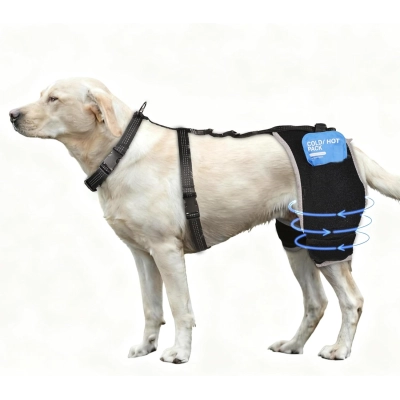
Compression from the brace can lower swelling and help with inflammation.
-
The brace spreads weight out, so the sore joint gets a break.
-
Better proprioception helps your dog walk in a normal way and avoid limping.
Compression also helps blood flow and keeps the joint warm. This can make stiff joints feel better, especially in cold weather.
Note: Braces work best when you use them with other treatments, like rehab exercises or medicine. They are a key part of a full arthritis care plan.
Dog braces for arthritis fit right into a multimodal therapy plan. They give joint support, offload pressure, and help your dog move with less pain. When you use them the right way, you help your dog stay active and happy.
Signs Your Dog May Need a Brace
Common Arthritis Symptoms
You know your dog best. Sometimes, small changes in how your dog moves or acts can mean something bigger is going on. Arthritis can sneak up on dogs, especially as they get older. If you notice any of these signs, your dog might be dealing with joint problems or dog knee pain:
-
Reluctance to move: Your dog may not want to jump, run, or even walk as much as before.
-
Protective when touched: If your dog pulls away or seems upset when you touch their legs or joints, pain could be the reason.
-
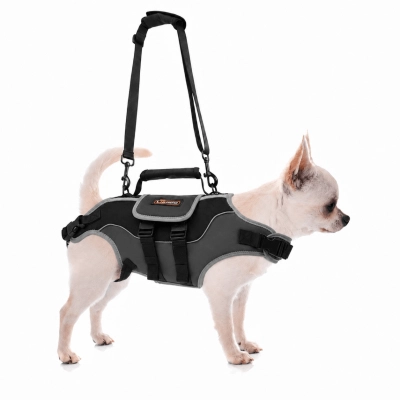
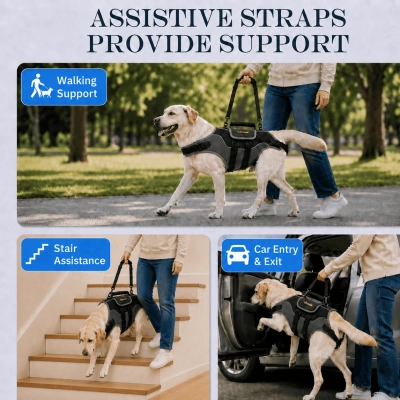
Limping or lameness: A limp that does not go away often points to dog knee pain or arthritis. For dogs showing weakness in their hindquarters, a well-fitted "dog back leg braces arthritis" can provide crucial support, helping them redistribute weight and find relief.
-
Fatigue: Dogs with joint pain may get tired quickly and rest more than usual.
-
Aggressively biting or licking themselves: Dogs sometimes lick or bite at sore spots, especially if they have dog knee pain.
-
Bad mood: You might notice your dog seems grumpy or less interested in playing.
🐾 Tip: If your dog shows more than one of these signs, keep an eye on them. Early help can make a big difference.
Understanding these signs is the first step. For dogs showing specific weakness in their hindquarters, a well-fitted Dog Back Leg Braces Arthritis can provide the crucial support needed to redistribute weight, stabilize the joint, and help them move with more confidence and less discomfort.
When to Consider Bracing
You might wonder when it is the right time to try a brace for your dog. Braces can help at different stages, but they work best when you catch dog knee pain early. Here are some times when you should think about using a brace:
-
Your dog has just started showing signs of arthritis or dog knee pain.
-
Surgery is not an option for your dog, maybe because of age or health issues.
-
Long-term medication is not possible or does not help enough.
-
You want to support your dog’s joints and help them stay active.
-
You hope to prevent more joint damage and keep your dog moving comfortably.
Braces give support, encourage movement, and help stop dog knee pain from getting worse. They fit right into a care plan that keeps your dog happy and on the go.
Types of Dog Braces for Arthritis
Dog Knee Braces for Arthritis
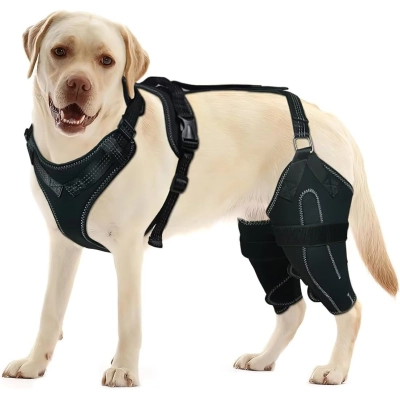
You probably hear about dog knee braces for arthritis the most. These braces specifically target arthritis in the stifle (knee) joint, a common and painful spot. If your dog limps or struggles to get up, these braces can make a significant difference. They come in various designs to match your dog’s need, from simple support sleeves to hinged braces that guide natural motion while preventing harmful movement.
Dog Front Leg Braces Arthritis
Arthritis doesn’t only affect the back legs. For dogs with pain in their elbows, wrists (carpus), or shoulders, dog front leg braces arthritis can offer vital stabilization. These braces help offload pressure from the affected joint in the forelimb, reducing pain during weight-bearing activities like standing up or walking, and allowing for better mobility.
Hip Braces for Dogs With Arthritis
For conditions like hip dysplasia or osteoarthritis in the hip joint, hip braces for dogs with arthritis are designed to provide comfort and support. These braces typically wrap around the pelvis and upper thigh, offering compression, warmth, and gentle stabilization to the hip area. This can help improve gait, reduce muscle strain, and make movement more comfortable for your dog.
Elbow, Hip, and Hock Braces
Dog knee braces are popular, but other joints need help too. Some dogs get arthritis in their elbows, hips, or hocks (the ankle area). You can use a dog leg brace for these spots. Each type has its own job:
|
Brace Type |
Key Benefits |
|---|---|
|
Knee Braces |
Joint stabilization, improved mobility, pain reduction, prevention of further injury |
|
Hock Braces |
Stabilizes tarsal joint, reduces pain, aids healing, enhances mobility |
|
Hip Braces |
Addresses hip dysplasia, improves mobility and comfort |
A dog leg brace for the elbow or hock supports the joint and helps your dog move better. Hip braces can help dogs with hip dysplasia or arthritis in the back legs.
Choosing the Right Brace
Picking the best brace for your dog matters. You want your dog to feel comfortable and get the right support. Here are some things to think about:
|
Factor |
Description |
|---|---|
|
Size and Fit |
Measure your dog’s leg carefully. A good fit means better support and less rubbing. |
|
Adjustable vs. Fixed |
Adjustable braces work for growing dogs or changing needs. |
|
Material and Durability |
Choose strong, comfy materials that last. |
|
Level of Support Needed |
Some dogs need soft support, others need a stiff brace. |
|
Comfort and Ease of Use |
Make sure you can put the brace on and take it off easily. Your dog should wear it for hours. |
Dog knee braces and other types of dog leg brace can help your dog stay active and happy. The right choice depends on your dog’s needs and comfort.
Using Dog Braces Effectively
Fit and Sizing Tips
Getting the right fit matters a lot when you use a brace for your dog. If you want the brace to work well, you need to measure your dog carefully. Here’s a simple table to help you get started:
|
Step |
Measurement Type |
Instructions |
|---|---|---|
|
1 |
Chest |
Wrap tape around the widest part of the chest, just behind the front legs. Make sure it’s snug but you can fit one finger underneath. |
|
2 |
Height |
Measure from the base of the rear paw to the top of the hip. Keep the tape straight. |
|
3 |
Thigh |
Wrap tape around the thigh, halfway between the knee and groin. Again, leave room for one finger. |
-
Always measure your dog while they stand in a normal position.
-
Use a soft measuring tape for the best results.
-
Measure both legs, even if you only need one brace.
A properly fitted dog knee brace gives the best support and helps prevent more pain. If the brace is too loose or too tight, your dog might feel uncomfortable or even get hurt. Take your time with these steps to make sure your dog gets the help they need.
Wear Time and Comfort
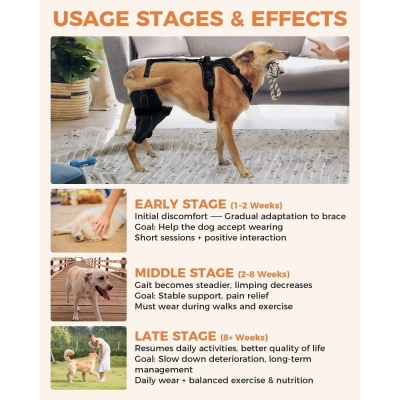
You want your dog to feel good while wearing a brace. Most dogs start by wearing their brace for 2 to 4 hours a day during the first week or two. After that, you can increase the time to 6 to 8 hours a day. For long-term use, some dogs wear their brace up to 10 or 12 hours, but not all day and night.
-
Check the fit often, especially in the first week.
-
Adjust the straps so they are snug but not too tight.
-
Watch for any signs of rubbing or skin irritation.
-
Give your dog breaks to let their skin breathe.
Braces help your dog move better, support weak muscles, and keep weight off sore joints. When you follow these tips, your dog can enjoy walks and playtime with less pain.
Integrating Braces with Other Therapies
Dog braces work best when you use them with other treatments. You can add simple habits to your daily routine to help your dog get stronger. Try gentle massage to relax muscles and improve blood flow. Physical therapy, like short walks or special exercises, can help your dog build strength. Some pet owners use laser therapy or chiropractic care to reduce swelling and keep joints healthy.
Tip: Ask your vet or rehab specialist for ideas that fit your dog’s needs. A team approach gives your dog the best chance to stay active and happy.
Benefits of Bracing in Arthritis Management
Pain Relief and Mobility
You want your dog to feel better and move with confidence. Dog braces for arthritis can give your pet real arthritis relief. These braces support the joint and help your dog walk, run, and play with less pain. Many studies show that braces lead to improved mobility and comfort. Take a look at what researchers found:
|
Study Reference |
Findings |
Sample Size |
Duration |
|---|---|---|---|
|
Rosen et al. (2022) |
Measurable improvements in weight-bearing with custom braces |
N/A |
12 months |
|
Carr (2016) |
Better pressure balance and gait in dogs using stifle braces |
N/A |
90 days |
|
Lee et al. (2021) |
Owners saw more comfort and movement in dogs wearing braces |
N/A |
N/A |
You can see that braces do more than just support. They help mitigate discomfort and give your dog a chance at a more active life. When you use dog braces for arthritis, you help your dog get the pain relief they deserve.
Preventing Further Injury
Braces do not just help with arthritis relief. They also protect your dog from getting hurt again. When you use a brace early, you help mitigate discomfort and give the joint time to heal. Braces keep the joint steady and stop it from moving in ways that can cause more damage. This support can slow down arthritis and keep your dog’s joints healthier for longer. Staying active is important for joint health, and braces make it safer for your dog to move.
Tip: Early use of a brace can make a big difference in your dog’s long-term joint health.
Enhancing Quality of Life
Dog braces for arthritis can change your dog’s daily life. You may notice your dog feels happier and more playful. Braces give arthritis relief by making movement easier and less painful. Many owners say their dogs enjoy walks again and seem more comfortable at home. Here are some things that help boost your dog’s quality of life:
|
Factor |
Description |
|---|---|
|
Custom Fit |
A brace made just for your dog’s shape and size |
|
Owner Compliance |
Wearing the brace every day as recommended |
|
Integration with Physiotherapy |
Using the brace with exercise and weight control |
|
Veterinary Oversight |
Regular check-ups and adjustments by your vet |
|
Improvements |
Noticeable gains in comfort and movement |
When you use a brace the right way, you give your dog the best chance for arthritis relief and improved mobility. Your dog can enjoy life again, with less pain and more fun.
Dog braces for arthritis can give your dog real relief, better support, and more freedom to move. You help your dog most when you pick a custom fit, follow your vet’s advice, and check the brace every day. Experts say braces work best when you use them with other treatments and keep your vet involved. If you want your dog to walk, play, and enjoy life again, a brace could be a smart choice.
-
Make sure the brace fits well.
-
Watch your dog’s comfort.
-
Always talk to your vet before starting.
FAQ
How long should my dog wear a brace each day?
You can start with 2 to 4 hours a day. Slowly increase the time as your dog gets used to it. Most dogs wear braces for 6 to 8 hours daily.
Can my dog sleep with the brace on?
No, you should remove the brace at night. This gives your dog’s skin and joints a break. Always check for any signs of rubbing or irritation.
Will a brace cure my dog’s arthritis?
A brace will not cure arthritis. It helps manage pain and supports movement. You should use it as part of a full care plan with your vet.
How do I clean my dog’s brace?
Tip: Wipe the brace with a damp cloth after each use. For a deeper clean, follow the care instructions from the manufacturer. Let it air dry before putting it back on your dog.

0 Comments