

Most knee brace fit problems are not strap problems. They are geometry problems. A brace that shifts, rubs, or gets chewed off is usually telling you something simple: the hinge is not where the joint is. Tightening the straps will not fix that. It will only squeeze the geometry error tighter against the leg. Understanding why that happens — and what design features prevent it — changes how you evaluate fit entirely.
Why Hinge Position Matters More Than Strap Tightness
A knee brace does not stabilize a joint by squeezing harder. It stabilizes by aligning its hinge axis with the joint's natural axis of rotation. When those two axes match, force travels in a straight line through the joint surfaces. The femur and tibia meet evenly under load. The brace becomes a rail — it guides motion without fighting it.
When the hinge sits even a half-inch above or below the stifle joint, the geometry breaks. As the dog bends the knee, the brace hinge and the joint hinge rotate around two different centers. One arcs around point A. The other arcs around point B. They pull against each other with every step. The result is not just discomfort. It is redirected force. Instead of traveling cleanly through the joint center, load vectors angle into cartilage edges and soft tissue. Over hours of wear, that misalignment creates pressure hotspots, skin breakdown, and a dog that unloads the leg.
This is the core mechanical problem that strap tension cannot solve. Tightness does not realign a hinge. It squeezes tissue harder while the underlying mismatch continues. A correctly positioned hinge, held in place by just enough strap tension to prevent migration, will always outperform a misaligned hinge cranked down tight. The hinge decides the support. The straps just keep the hinge where it belongs.
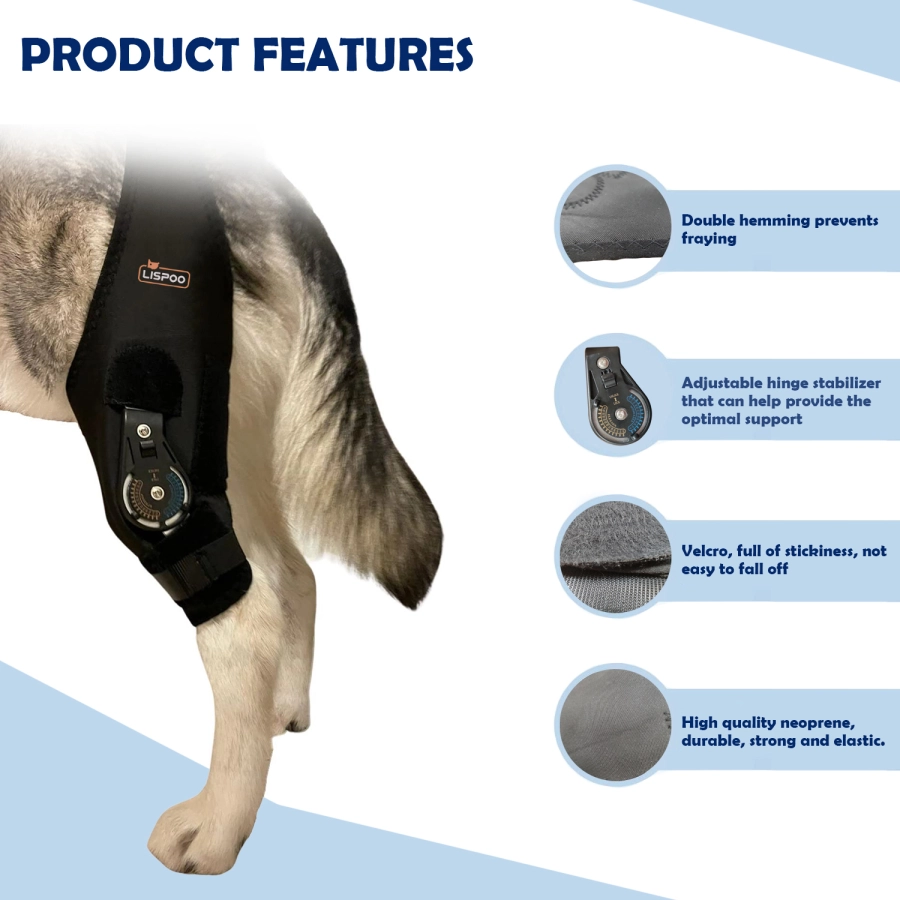
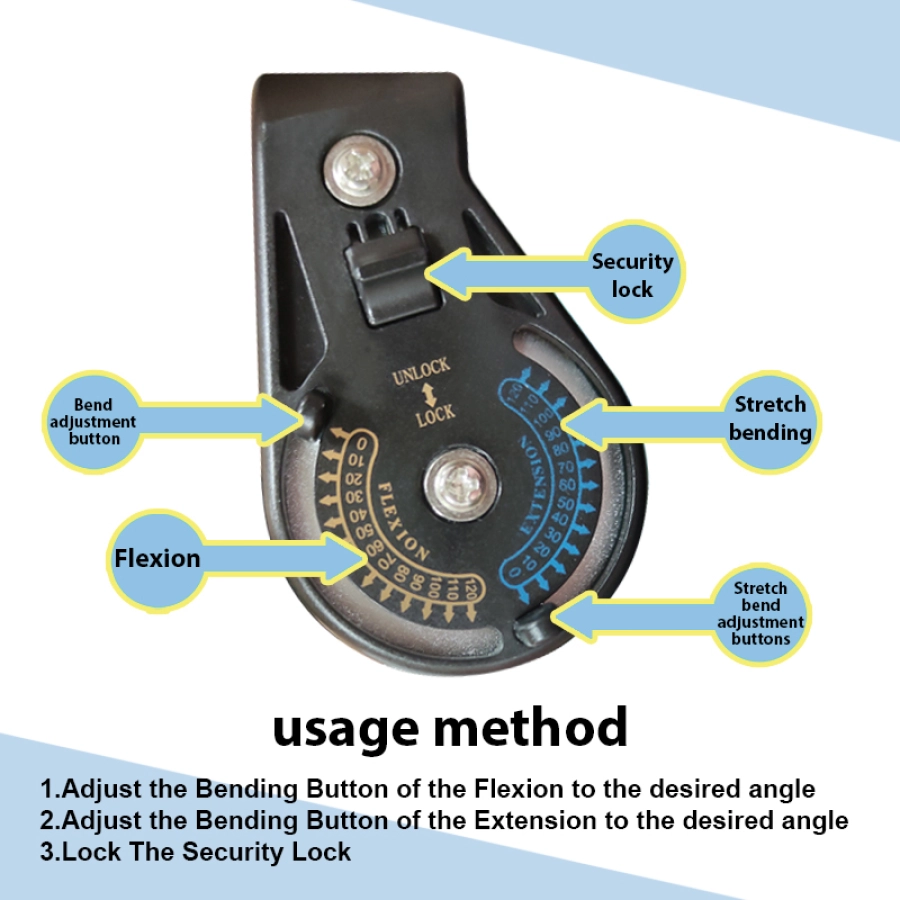
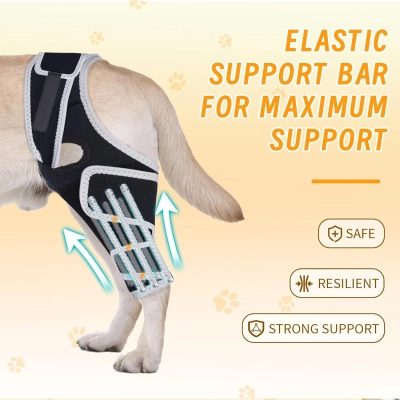
The hinge type itself shapes how well this alignment holds during movement. A polycentric hinge — one with multiple pivot points — tracks the canine stifle's natural roll-and-slide motion more closely than a single-pivot design. The stifle does not open and close like a door. The femur rolls backward and slides as the joint flexes. A single-pivot hinge approximates this as one fixed-radius arc. Close enough for most dogs during walking. The gap widens during deep flexion — sitting, stair-climbing — where the mismatch between the brace arc and the joint arc grows with every degree of bend. For a dog that spends most brace time in low-amplitude movement, correct positioning of either hinge type matters more than which type is used. For a dog that navigates stairs or gets in and out of a car while wearing the brace, the polycentric design's ability to track compound motion becomes mechanically meaningful.
In practice: After 15 minutes of walking, mark where the hinge center sits relative to the bony bump on the outside of the knee — the lateral femoral epicondyle. Have the dog sit, stand, and walk again. If the hinge center has drifted more than a quarter-inch from that landmark, the fit is a geometry failure. Do not tighten the straps. Reposition the brace so the hinge finds the joint, then resecure.
How Strap Order Shapes Force Distribution Across the Leg
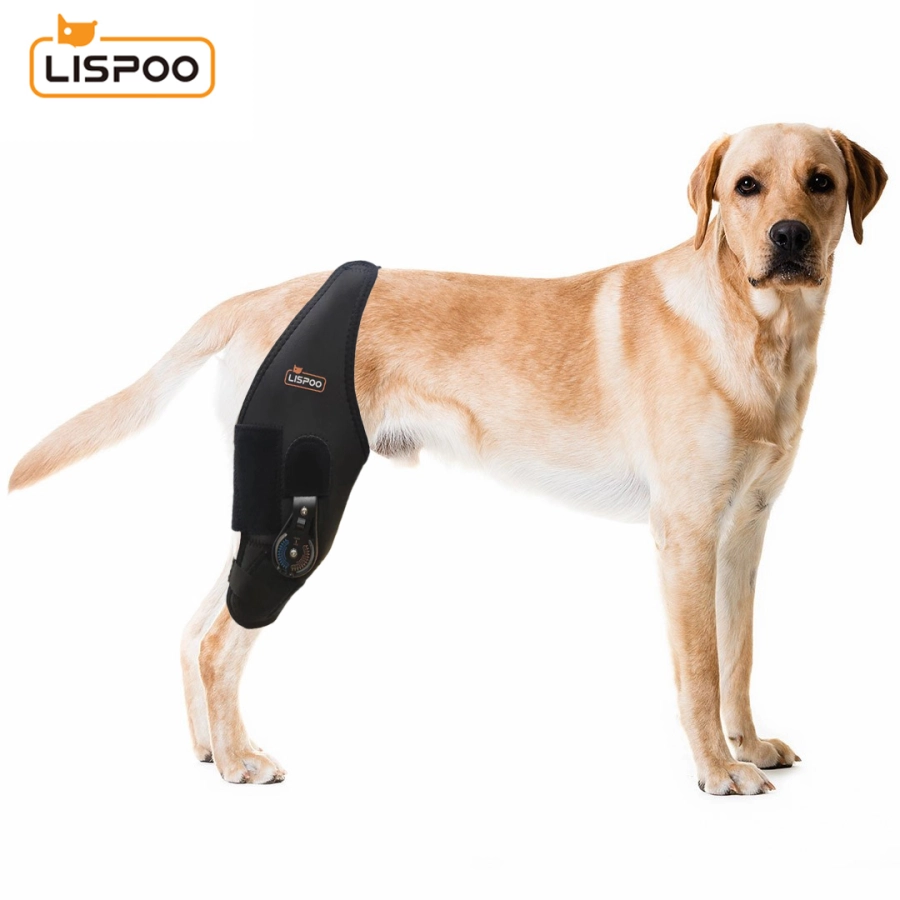
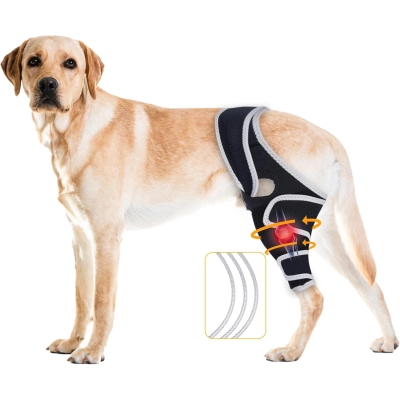
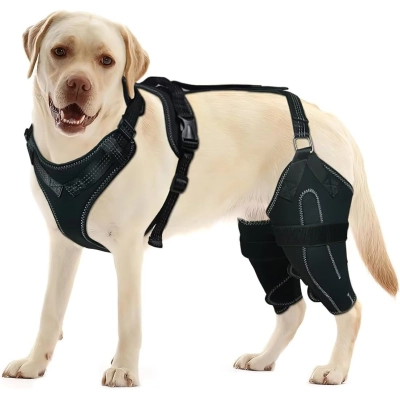
A canine ACL knee brace typically carries three strap zones: above the knee, at the knee, and below the knee. The order in which those straps are tightened is not a convention. It is the difference between force that spreads and force that pools.
Tighten the knee strap first. This locks the hinge position relative to the joint before anything else can pull the frame out of place. Everything above and below anchors to this reference point. If the thigh strap is tightened first, the brace drifts upward before the knee anchor is set — the hinge lands too high. Tighten the calf strap first, and the brace pulls downward. Either way, the hinge-to-joint alignment is compromised before the fit is even finished. A fully fastened brace with the hinge in the wrong place is a geometry error that no amount of post-hoc adjustment can correct without loosening everything and starting over.
Strap width matters for a different reason, and the mechanism is worth understanding. A narrow strap concentrates force into a thin band. The same total tension spread over a 1-inch-wide strap versus a 2-inch-wide strap halves the pressure on the skin. Pressure equals force divided by area — double the area, halve the pressure. Over an 8-hour wear day, that difference separates faint pink marks that fade in seconds from raw, broken skin. This is a pressure injury — the same mechanism behind bedsores. When external pressure exceeds capillary perfusion pressure, tissue stops receiving oxygen. Cells die from the outside in. A wider strap is not a comfort feature. It is a perfusion decision.
Strap anchor points also shape the force picture. Straps that attach to a rigid frame at three or more points per side distribute tension across the frame shell rather than pulling directly against the skin. Straps that anchor at only two points create a direct line of pull — the strap segment between the anchors acts like a tourniquet rather than a suspension element. The difference shows up in the skin imprint pattern: multiple small, diffuse imprints versus two distinct, deep grooves.
Tip: After 20 minutes of wear, remove the brace and run a finger along the skin under each strap. The skin should feel warm but not hot. The strap impression should fade within 30 seconds. An impression that stays visible after a full minute, or skin that feels noticeably hotter than surrounding tissue, signals that pressure at that strap site exceeds what the capillaries can handle. Either the strap is too narrow for the tension it carries, or the anchor geometry is concentrating force into too small a contact patch.
When the Design Works — and Where It Runs Into Limits
A hinged knee brace with sequenced strap tension works best on dogs whose stifle anatomy falls within the breed-norm range the brace was patterned for. Most retrievers, shepherds, and similar medium-to-large breeds with standard leg conformation fall into this zone. The femoral and tibial lengths, the stifle angle at rest, and the soft-tissue envelope all match the design template closely enough that the hinge can find its axis and the straps can seat without bridging or bunching.
The design hits its limits with extreme conformations. Dogs with unusually short femurs relative to tibial length — seen in some bully breeds — create a geometry where the hinge lands in soft tissue above or below the joint line rather than over it. No strap adjustment can fix a hinge that has no bony landmark to anchor against. Dogs with angular limb deformities, where the leg bows inward or outward, present a different problem: the rigid brace frame cannot sit flat against a curved leg without twisting. The frame contacts the leg at the apex of the curve and bridges across the rest — concentrating pressure at a single line rather than distributing it across a surface.
Double-coated breeds introduce a subtler limitation. The brace depends on close contact between the inner liner and the skin to maintain hinge position during movement. A thick undercoat acts as a compressible spacer — the brace feels snug at fitting but shifts as the coat compresses and rebounds with each stride. The observable fit checks still work, but fur masks the visual cues. You need to feel for what you cannot see.
None of this means the design is flawed. Every mechanical support device has a geometric envelope it was engineered for. The question is whether the dog in front of you fits inside that envelope. Standard-conformation dogs with short coats nearly always do. Dogs at the edges of the template may need a different solution — and understanding the mechanical constraints of a brace makes it clearer when that is the case.
Disclaimer: The fit checks described here assume a short-coated dog where skin can be visually inspected and bony landmarks palpated through a thin coat. Double-coated breeds may show subtler rub marks that require hand-checking rather than visual inspection — run your fingers against the grain of the fur to feel for heat or roughness that indicates underlying skin stress. If the dog's leg conformation falls outside the breed norms this brace was patterned for — particularly dogs with angular limb deformities or very deep chests — the hinge-to-joint alignment method described here may not catch every pressure point. A custom-molded option may be the safer path in those cases.
FAQ
Does a tighter brace provide more support?
No. Support comes from hinge-to-joint alignment, not compression. A brace cranked tight against a misaligned hinge still redirects force incorrectly — it just does so with more pressure on the skin. The two-finger test under each strap is a better proxy for correct fit than subjective tightness.
Why does strap order matter if the brace ends up fully fastened either way?
Because the knee strap sets the reference point for the entire fit. If the thigh or calf strap goes on first, the frame shifts before the hinge is positioned. The result is a fully fastened brace with the hinge in the wrong place — a geometry error that cannot be fixed without loosening everything and restarting from the knee strap.
Can a single-pivot hinge work as well as a polycentric one?
For most dogs with standard stifle conformation during walking, yes. The single-pivot arc approximates the knee's motion closely enough. The gap widens during deep flexion — sitting, climbing — where a polycentric hinge's ability to track roll-and-slide motion becomes mechanically meaningful. For dogs that spend most brace time in gentle movement, correct hinge positioning matters more than hinge type.
How do I know if the brace liner is doing its job?
After a wear session, turn the liner inside out and press a dry paper towel against it for 5 seconds. Moisture on the towel means the liner is trapping rather than wicking — trapped moisture against skin leads to maceration and bacterial overgrowth. A liner that feels damp but leaves the towel dry is moving moisture to the outer surface where it evaporates.

0 Comments