
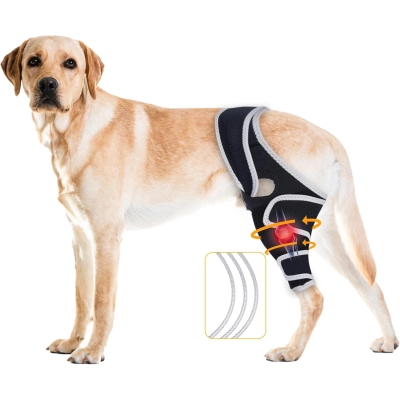
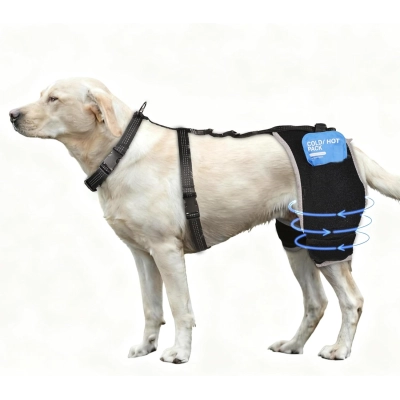
A dog with hock instability shifts weight forward, shortens the stride, and loads the opposite leg harder than it is built for. A brace can change that pattern. But only if two things are right: the hinge follows the joint's actual axis, and the straps spread force instead of concentrating it. Get either one wrong and the brace fights the leg it is supposed to help.
Hinge Alignment and Strap Configuration — The Two Features That Decide Whether a Hock Brace Supports or Resists the Joint
A hock brace is not a cast. It does not immobilize — at least, not the good ones. The point is to limit motion in the directions the joint cannot handle while letting the dog walk through the range it still has. Two design choices control whether that actually happens.
Why Hinge Placement Determines Everything
The hock — the tarsal joint — is a complex hinge. It flexes and extends through a specific rotational axis that sits roughly at the intersection of the tibia, fibula, and tarsal bones. When a brace hinge is positioned to match that axis, force travels along the joint's natural rotational path. The articular surfaces stay evenly loaded. The dog's gait remains close to normal. The limb does not have to compensate.
Move the hinge a quarter-inch proximal or distal and the mechanics shift. The brace now drives the joint through an arc that does not match its native motion. Joint surfaces load unevenly. The dog shortens the stride, externally rotates the limb, or hikes the hip to reduce the mismatch. Over hours of wear, that compensation fatigues surrounding muscle groups. The brace stops being support and becomes an obstacle — the dog tolerates it rather than benefits from it.
This is why a hock brace with anatomically placed hinges matters more than one with tighter straps. Alignment controls the force path. Strap tension only controls how firmly the brace stays on the leg. The two are not interchangeable.
The hinge also sets the range-of-motion limit. Rigid hinges with a hard stop at a specific extension angle work for hyperextension injuries — the joint physically cannot overextend past the stop. Semi-rigid hinges allow controlled flexion but block end-range instability, which suits arthritic joints where some movement preserves cartilage health. Flexible braces without structured hinges provide compression and proprioceptive feedback but little mechanical restriction — useful for mild strain recovery, not for structural instability. The hinge is not just a joint. It is the rulebook the brace enforces on the leg.
Strap Configuration and the Physics of Force Distribution
A single wide strap cinched tight feels secure. It is also a pressure point. Force that should be distributed across the leg's surface area concentrates under the strap's narrow contact patch. Over hours, that focal pressure compresses soft tissue, restricts capillary flow, and triggers the dog to lick or chew at the site — not because the brace is uncomfortable in general, but because one spot is taking all the load.
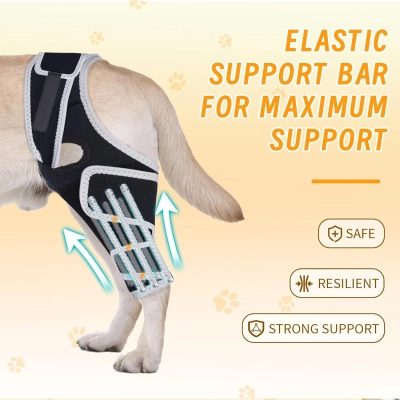
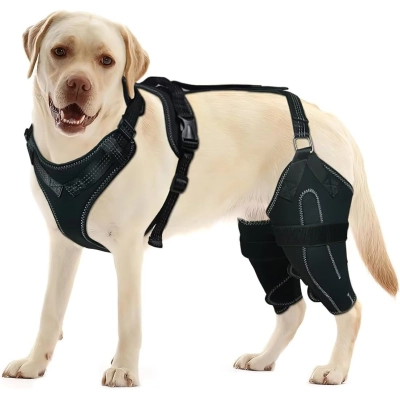
Multi-strap systems change the physics. Three or four narrower straps, each independently tensioned, spread the same total restraining force across a larger total contact area. The peak pressure under any single strap drops. The brace holds position without needing to be overtightened. And because the straps sit at different heights along the leg — proximal to the hock, directly over the joint line, and distal — they resist rotation and migration more effectively than one strap ever can. Each strap acts as an anchor point against the others.
This matters most for dogs that are active during wear. A dog that moves from standing to walking to lying down cycles the brace through different load angles. A single-strap design has one failure point. A multi-strap design has redundancy. If one strap loosens slightly, the others hold position. The same principle applies to knee braces and elbow braces — any joint brace where the limb tapers and the brace must resist sliding down the leg relies on distributed anchor points, not single-band compression.
Where Each Brace Design Performs Best — and Where It Does Not
Not every hock problem needs the same level of mechanical restriction. Matching the brace structure to the condition and the dog's daily activity pattern determines whether the brace gets used or gets abandoned in a drawer.
Hyperextension injuries — where the hock bends backward past its normal stopping point — demand a rigid hinge with a definitive extension block. The joint's passive stabilizers (plantar ligaments) are compromised. Without a hard stop, every step risks re-injury. A rigid brace removes that risk mechanically, not through the dog's awareness. The dog does not need to be careful — the hinge is careful for it.
Arthritic hocks benefit from a different approach. The joint needs to move — motion circulates synovial fluid, which nourishes the remaining cartilage. But it also needs protection from end-range loading, where bone-on-bone contact spikes pain. A semi-rigid brace with controlled flexion-extension limits hits this balance. It permits mid-range motion for joint nutrition while blocking the terminal few degrees where damage concentrates.
Post-surgical support is its own category. After a tarsal stabilization procedure, the goal is to protect the repair during early healing while preventing muscle atrophy from complete disuse. A rigid brace worn during weight-bearing activity and removed during controlled passive-range-of-motion sessions achieves this. The brace becomes a part-time mechanical safeguard, not a full-time immobilizer.
Mild strains and soft-tissue recovery sit at the low end of the support spectrum. A flexible wrap-style brace provides compression (which reduces edema) and proprioceptive input (which improves the dog's awareness of joint position). It will not stop a hyperextension. It was never designed to. Using a flexible brace for a structural instability is a mismatch — not because the brace is poorly made, but because the design target and the injury demand do not overlap.
Disclaimer: The condition-to-brace-type matching described here assumes standard canine leg conformation. Dogs with angular limb deformities, disproportionately deep chests, or fused tarsal joints from prior trauma may fall outside the conformational norms these braces are patterned for. In those cases, standard measurement points become less predictive of fit quality, and the hinge positions engineered for typical anatomy may not align with the dog's actual joint axis.
Fit Checks, Measurement Points, and What Daily Wear Reveals About Brace Quality
A brace that measures correctly on paper can still perform poorly on the dog. The difference between a good fit and a poor one shows up in two places: strap migration during activity and skin condition under the liner after sustained wear.
The Three Measurements That Control Fit
Three circumference measurements define whether a hock brace will stay put: proximal to the hock (above the joint, where the tibia narrows), directly over the joint line (the widest point around the calcaneus), and distal to the hock (below the joint, where the metatarsals begin). Each serves a different mechanical purpose.
The proximal measurement anchors the top of the brace and resists downward migration. The joint-line measurement ensures the hinge sits at the correct vertical position — if this circumference is off, the hinge rides above or below the axis and the alignment advantage is lost. The distal measurement controls rotation and prevents the brace from twisting around the leg during turns. Skip any one of these and the brace has a failure mode built in from the start
Breed and size amplify measurement sensitivity. A Greyhound's leg has a dramatically different taper ratio than a Corgi's. The same nominal size in a standardized brace may fit both in circumference at one measurement point but fail at the other two because the leg profile — the rate at which circumference changes along the limb — is different. This is why two dogs with the same joint-line girth can have opposite fit outcomes.
Two Observable Checks Anyone Can Run
Strap migration check. After a 10-minute walk on a flat surface, check whether any strap has moved more than half an inch from its original position. Mark the strap edges with a piece of tape on the brace shell before the walk if the reference point is hard to judge by eye. Minimal shift means the multi-point anchor system is working — each strap is holding its segment of the leg independently. Significant migration at one strap while others hold steady points to uneven tension or a leg taper mismatch at that specific height.
Liner breathability check. After 20 minutes of indoor wear — no running, just standing and walking around the house — lift the brace and press a dry fingertip against the skin under the thickest padded section. Dampness or tackiness means moisture is trapped against the skin. The liner is not ventilating adequately for that dog under those conditions. Dry skin that feels no different from the uncovered leg means the liner's moisture transport is working. This check matters because skin breakdown under a brace rarely starts with visible redness. It starts with a microclimate — warmth plus moisture — that softens the epidermis over hours, making it vulnerable to friction that would normally be harmless.
Material and Maintenance Realities
Liners take the most abuse. They sit against skin for hours, absorb sweat, collect shed hair, and face repeated compression cycles. A liner that wicks moisture effectively on day one can lose that property by week three if dead skin cells and oil clog the fabric's capillary channels. Wiping the liner with a damp cloth after each wear day — and letting it dry fully before the next use — preserves the moisture-transport function longer than occasional deep cleaning interspersed with neglected days.
Straps and hook-and-loop closures degrade predictably. The loop side collects debris; the hook side loses grip as individual hooks deform from repeated engagement. When a strap can no longer hold tension through a full walk without needing re-tightening, the closure has reached its functional limit — even if it still looks intact. Continuing to use it means the dog is effectively wearing an under-tensioned brace for part of every wear session.
For a deeper comparison of how hock support approaches differ — braces, wraps, and rehab-based stabilization each target different failure modes — the trade-offs are explored further in how hock support methods differ and where each one fits.
FAQ
How long can a dog wear a hock brace continuously?
That depends on the liner material and the dog's activity level during wear, not on a fixed clock. A well-ventilated brace on a sedentary dog may go 6–8 hours before skin moisture becomes a concern. The same brace on an active dog in warm conditions may need removal and a skin check after 2–3 hours. The liner breathability check described above gives a more useful answer than a universal time limit.
Does a hock brace work for a dog that runs or plays hard?
It depends on what "works" means. A rigid brace with a hard extension stop will mechanically prevent hyperextension during running — that part works regardless of activity intensity. But high-impact activity also generates more shear between the brace and the leg, which increases strap migration and skin friction. The brace's protective function and its comfort under high load are separate problems. The former is determined by hinge design. The latter is determined by strap configuration and liner choice.
Why does the brace slide down even when measured correctly?
Leg taper — the rate at which the limb narrows from proximal to distal — is often the culprit. A brace that matches all three circumference measurements may still slide if the dog's leg has a steeper taper than the brace shell was modeled for. The proximal strap lands on a wider segment than the shell's internal contour expects, and gravity does the rest. Adding a light adhesive wrap or traction sleeve under the proximal strap sometimes solves this, but only if the taper mismatch is mild. A taper that differs substantially from the brace's profile means the brace geometry — not the sizing — is the mismatch.

0 Comments