

A six-pound Chihuahua with a luxating patella does not need a smaller version of a Lab-sized brace. Shrinking dimensions change everything. On a leg that is four inches long and barely thicker than a thumb, strap width stops being a comfort preference and becomes the primary determinant of whether force distributes across muscle or concentrates into a narrow band of skin. The hinge — if there is one — has maybe half an inch of working room before it starts levering against bone instead of following the joint. These are not marginal adjustments. They are the difference between a brace that stabilizes the stifle through a walk and one that slides down within ten steps.
This is why knee support for small dogs is fundamentally a design problem, not a sizing problem. A brace pattern that works on a 50-pound dog cannot be proportionally reduced and expected to perform. The physics do not scale linearly.
Strap Width and Panel Design: Why Force Distribution Decides Everything on a Tiny Leg
The most common failure mode in knee braces sized for toy breeds is not that they provide too little support. It is that they provide support in the wrong place, through too narrow a contact patch, and the dog refuses to move in them. A narrow strap — say half an inch wide — wraps around a leg with a circumference of perhaps three inches. The force the strap applies to keep the brace in position lands on a contact area small enough that skin pressure spikes well above what the dog tolerates for more than a few minutes.
A wide-panel design changes the arithmetic. Double the strap width and the same holding force spreads across twice the skin area — halving the pressure at any single point. On a large dog, a half-inch strap already contacts enough surface area that the pressure stays below the irritation threshold. On a small dog, that same half-inch strap operates near the limit. The design feature that is adequate at 60 pounds becomes a failure point at 6.
This cascade runs deeper. When a narrow strap creates discomfort, the dog tenses the surrounding muscles. The tensed muscle changes the leg profile. The strap — originally snug against relaxed tissue — now rides over a contracted surface that is slightly narrower and harder. Grip drops. The strap migrates. Within minutes, the brace has shifted distally and the hinge no longer aligns with the joint axis. Support drops to zero.
In practice: if your dog wears the brace for 15 minutes of controlled walking and you then remove it, check for a defined red line where the strap sat. A faint, even pinkness that fades within five minutes is normal. A sharply defined welt that persists past ten minutes means the force-per-area is too high — the strap is too narrow for the leg circumference it is trying to hold.
What to Look for in the Strap Layout
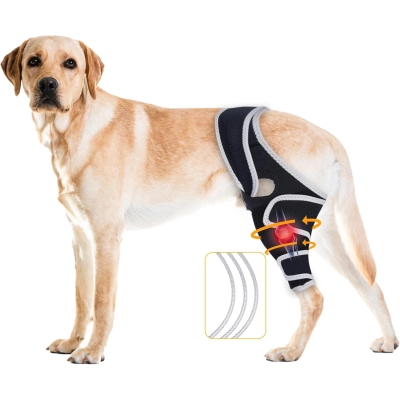
Two or more anchor points above and below the stifle, each at least one inch wide on the smallest sizes, tend to distribute holding force more evenly than a single circumferential strap. The material behind the strap matters as much as the strap itself. A neoprene panel under the strap adds compliance — the foam layer compresses slightly under tension, expanding the effective contact patch by conforming to the leg's curve. A strap sewn directly to a thin fabric shell does the opposite: it pulls the shell tight against skin with no intermediate give, concentrating load along the stitch line.
The difference is visible. With a padded panel under-strap, the brace settles into position and the dog's gait stays fluid. Without one, the dog often shortens stride on the braced side within the first few minutes — a compensation that defeats the purpose of wearing support in the first place.
Hinge Scale and Material Compliance: When Small Means Stiff
The second design variable that separates braces that work on small dogs from those that do not is hinge proportionality — and the material stiffness that comes with it. A mechanical hinge on a knee brace is designed to pivot around the stifle's natural axis. On a medium or large dog, the hinge arms span several inches, giving the joint room to flex through its range without the brace structure itself resisting. On a toy breed, the same hinge design compressed into a four-inch frame becomes a different mechanism entirely.
The shorter the distance between the hinge and the proximal/distal anchor points, the less leverage the dog's natural motion has to overcome the brace's internal resistance. A hinge that articulates freely on the bench — unloaded, in your hand — may become functionally rigid once strapped to a leg where the muscle and tendon forces cannot generate enough torque to move it through the full arc. The brace does not follow the joint. The joint follows the brace — or stops moving.
This is not a defect in the hinge. It is a scaling artifact. The same materials and pivot design that produce smooth, low-resistance motion across a six-inch frame produce meaningful resistance across a three-inch frame because the ratio of structural stiffness to limb torque is fundamentally different.
For small dogs with partial CCL tears or mild patellar instability — conditions where controlled motion is the goal — this scaling effect can actually work in the brace's favor. The inherent resistance limits the tibial translation that aggravates the injury, and the dog self-regulates to a shorter, safer stride. For dogs with arthritis where maintaining range of motion is the priority, however, the same stiffness becomes a problem: the brace restricts exactly the movement the joint needs to stay lubricated.
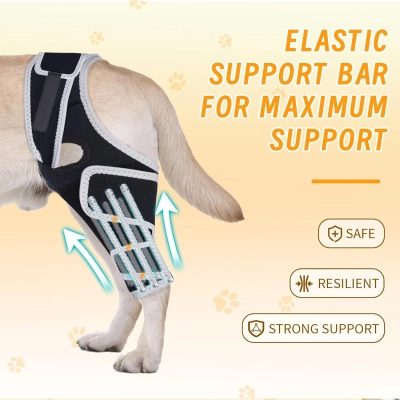
The material choice in the hinge or side-stabilizer inserts amplifies or dampens this effect. Thermoplastic stays — common in off-the-shelf braces — hold their shape under load, which means the scaling-stiffness effect is pronounced. Spring-steel stays flex and return, introducing a degree of dynamic give that can offset some of the scale-induced stiffness. Neoprene-only braces without rigid elements sidestep the hinge-scaling problem entirely but trade away the mechanical restriction that partial-tear cases benefit from. Each material path creates a different balance point on the same constraint.
Observable check: put the brace on your dog and walk on a flat surface for five minutes. Film from the side. If the braced leg swings with a visibly shorter arc than the unbraced leg — not just slower, but actually shorter — the hinge or stay stiffness at this scale is exceeding what the dog's limb can drive. That shortened arc is the brace controlling the leg, not the leg controlling the brace.
When Knee Support Works — and When It Reaches Its Limit
Knee support for small dogs performs best in a specific band of conditions. The leg is structurally intact — no fracture, no full rupture requiring surgical stabilization — but mechanically unstable enough that unsupported weight-bearing produces abnormal joint translation. Partial CCL tears, Grade 1–2 luxating patella, and mild-to-moderate stifle arthritis all fall within this band. The brace provides an external mechanical boundary that keeps joint motion within a range where the supporting soft tissues can still do their job.
Outside that band, the design constraints multiply faster than the brace can accommodate. A complete CCL rupture removes the internal stabilizer the brace is designed to supplement — at that point, external support is being asked to replace, not assist, and the forces involved exceed what a non-rigid brace can manage on a small leg without creating skin breakdown. A Grade 3–4 luxating patella that dislocates and stays out means the patella is not intermittently slipping — it is persistently displaced, and no strap configuration can re-route the quadriceps mechanism through external compression alone.
Breed conformation introduces another boundary. Achondroplastic breeds like Dachshunds have limb proportions where the standard anchor-point geometry — above the stifle, below the stifle — lands on segments that are disproportionately short and bowed. A brace patterned for a straight-legged dog with a longer femur and tibia will not seat correctly on a Dachshund's curved, short-segment limb. The proximal strap rides into the inguinal fold. The distal strap crowds the hock. Neither anchor does its job.
Disclaimer: This check assumes a short-coated dog where skin marks are visible. Double-coated breeds like Pomeranians may show subtler rub patterns that require hand-checking — run your fingers under each strap edge rather than relying on visual inspection. If the dog has angular limb deformities or a chest depth far outside breed norms, the fit checks described here may not catch every pressure point.
Skin Tolerance and Wear Duration
The inner liner is not a comfort feature. On a small dog, it is a safety feature. Thin skin, minimal subcutaneous fat, and fine hair mean the barrier between strap pressure and dermal breakdown is thinner than on larger breeds. A brushed nylon liner that feels soft to your fingers can still create friction burns if the surface texture is directional — smooth in one direction, grabby in the other — and the brace migrates slightly with each step cycle.
A liner with a looped or non-directional pile (like a low-nap spacer fabric) eliminates the directional friction component. It feels neither smooth nor plush — it feels slightly textured in all directions equally. That isotropic surface means the brace can shift a millimeter or two per step without accumulating shear on any single patch of skin. Over an hour of wear, that difference is the gap between a dog that tolerates the brace and one that starts chewing at it after 20 minutes.
Check skin after the first 30-minute session. If you see any spot where the hair is flattened in a swirl pattern — not just pressed down, but actually twisted — that spot is experiencing rotational shear. The liner surface or strap angle needs adjustment. Flat, even hair compression without swirls means the liner is sliding, not gripping, against the coat — which is what you want.
FAQ
Why does my small dog's knee brace keep sliding down?
Brace migration on small legs almost always traces to one of two design factors. Either the strap width is too narrow for the leg circumference, concentrating holding force into too small a contact patch and triggering muscle tension that reshapes the leg profile under the brace. Or the proximal anchor — the strap or cuff above the stifle — lacks enough surface area to resist the downward pull created by the dog's natural stifle flexion during gait. A wide upper panel with two-point fixation resists this pull better than a single circumferential strap.
Can a knee brace make my small dog's leg weaker?
This depends on whether the brace restricts motion or redirects it. A brace that limits tibial translation while allowing the full flexion-extension arc does not prevent muscles from working — it changes the boundary within which they work. The muscles still contract against resistance during every step. A brace that is too stiff at the hinge, however, can reduce the range of motion enough that the dog avoids driving through the full arc, which over weeks can lead to some degree of disuse atrophy. The observable test: if the dog still flexes the stifle through at least 70–80% of the unbraced range, the muscles are getting meaningful load.
What is the difference between a knee brace and a knee sleeve for small dogs?
A sleeve provides compression and light proprioceptive input — the dog feels the fabric and may move more carefully — but offers negligible mechanical restriction against tibial translation or patellar tracking. A brace incorporates rigid or semi-rigid elements (hinges, stays) that physically limit joint motion beyond a set range. Sleeves suit dogs where the goal is warmth and sensory cueing for mild arthritis. Braces suit dogs where abnormal joint motion needs an external mechanical boundary — partial tears, unstable patellas. The design difference is not cosmetic. It determines whether the device is providing thermal-and-sensory support or mechanical-joint support.
Do small dogs really need a hinge in their knee brace?
Not always. A hinge adds rotational constraint at the stifle axis — it prevents the tibia from translating forward relative to the femur during weight-bearing, which is the critical motion in CCL insufficiency. If the dog has a partial CCL tear, that constraint is mechanistically relevant. If the dog has arthritis without ligament instability, a hinged brace may add stiffness without proportional benefit — a well-padded neoprene brace with patella support may be sufficient. The hinge is a tool, not an upgrade. Whether it matters depends on which abnormal motion you are trying to constrain.
How do I know if the brace is too tight?
Slide one finger between the strap and the dog's skin after the brace has been on for ten minutes. If you cannot insert a fingertip without forcing it, the strap is too tight. If you can insert two fingers easily, it is too loose. But the more reliable check is post-wear: remove the brace and look at the skin. A dent that rebounds within 30 seconds is acceptable compression. A dent that stays visible after two minutes means the strap pressure exceeded tissue rebound capacity — loosen the fit. If the dog starts licking the brace area within the first ten minutes of each session, the pressure is almost certainly too high, regardless of what the finger test suggests.
Small dogs benefit most from knee support when the design matches the scale of the problem. A wide-panel strap layout that distributes force across enough skin area, a hinge or stay stiffness that the dog's limb can actually drive through a meaningful range, and a liner surface that slides rather than grips — these three design details determine whether ACL and CCL braces stabilize a small dog's stifle or become something the dog simply tolerates. The line between those two outcomes is thinner than most sizing charts suggest.
For small breeds with early patellar instability or mild ligament strains, support options designed for small-breed leg dimensions tend to address the scale-specific fit challenges that generic braces scaled down in size often miss.
Knee support for small dogs works when the brace is designed for the forces and dimensions of a leg measured in inches, not when a standard brace is simply offered in an XS. The design details that are cosmetic on a large dog are structural on a small one.

0 Comments