
A dog with stifle arthritis limps into the room. The brace is on. The straps are tight. But the limp is still there. The problem is rarely the tightness. It is where the hinge sits relative to the joint. A stifle brace supports an arthritic knee only when its hinge axis aligns with the dog's joint axis. Everything else — strap tension, material thickness, brand reputation — is secondary. If the hinge sits a half-inch too high or too low, the brace becomes a sleeve. It wraps the leg but does not redirect load away from worn cartilage.
Why Hinge Alignment — Not Strap Tightness — Determines Real Support
An arthritic stifle joint hurts because cartilage has thinned. The bones sit closer together. Every step sends force through surfaces that no longer have cushioning. A brace changes this equation only if it redirects that force path.
Here is the causal chain. When a brace hinge aligns with the joint's natural rotation axis, compressive force travels straight along that axis into the brace's rigid frame rather than through the joint space. The frame carries a share of the load. The joint surfaces spread what remains more evenly. Focal pressure — the kind that triggers pain signals — drops. The dog loads the leg more willingly. Over weeks, that increased loading maintains muscle tone around the joint, which adds a second layer of passive stability.
When the hinge is off-axis by even a small margin, this chain breaks at the first link. Force bends through the joint at an angle. The brace becomes an external shell that moves relative to the bone instead of with it. The dog feels the mismatch and compensates by shifting weight to the other leg. The brace is on, but the arthritic joint is still taking the full load.
This is why fit precision matters more than strap force. Cranking straps tighter cannot fix a hinge that sits in the wrong place. It only adds circumferential pressure without improving load transfer.
Strap design plays a supporting role here — not primary, but not trivial. A wide strap spreads retention force across a larger skin area, reducing the per-square-inch pressure that causes rub marks and irritation. A narrow strap concentrates that same force into a thin band. When the hinge is correctly aligned, wide straps keep the brace positioned without creating hot spots. When the hinge is off, even wide straps cannot rescue the fit.
You can verify this at home. After 15 minutes of your dog walking on a hard surface, mark the brace position with a piece of tape at the top edge. Walk the dog another 10 minutes. If the brace has shifted more than a quarter-inch from that tape mark, the hinge is likely misaligned relative to the joint axis — the brace is drifting because it is not moving in sync with the joint.
| Design Dimension | What Creates the Difference | Main Limitation |
|---|---|---|
| Hinge-to-joint-axis match | Transfers load into the frame along the natural rotation line; determines whether the brace offloads or merely wraps | Requires breed-specific hinge placement — a hinge positioned for a Labrador does not match a Dachshund's joint axis |
| Strap width and configuration | Wide dual straps spread retention force; narrow single straps concentrate it; dual-strap setups resist rotation better than single-strap designs | Wider straps cover more skin area, which matters for dogs with sensitive skin or in humid environments |
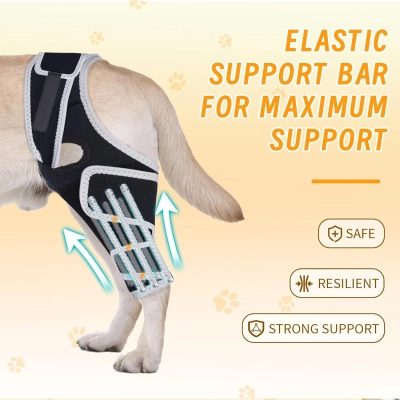
| Frame rigidity profile | A frame that is rigid in the sagittal plane but allows some lateral compliance matches how a dog's stifle actually moves during gait | Too rigid in all planes restricts natural slight rotation that occurs during turning; too flexible collapses under load |
Where the Design Advantage Shows Up in Daily Use
The hinge-alignment advantage is not theoretical. It becomes visible in specific real-world conditions.
On hard floors — tile, hardwood, concrete — an arthritic dog tends to slip. The leg slides outward on each step. A brace with correct hinge alignment resists that lateral drift by keeping the joint tracking in a straight line. The frame acts as a guide rail. A misaligned brace offers no such resistance; it drifts with the leg, and the dog's compensation patterns remain unchanged.
On stairs, the demands flip. The stifle now needs to flex and extend through a larger range. A well-aligned hinge moves with the joint through that full arc without binding. A poorly aligned hinge hits its mechanical limit before the joint reaches full flexion — the dog shortens its stride to avoid the pinch. You see this as hesitation on stairs, or a hop-skip pattern where the dog bunny-hops both rear legs together rather than stepping through individually.
Strap performance also varies by activity. During a 20-minute walk, straps that stay within a half-inch of their original position are doing their job — they are distributing retention force evenly enough that the brace is not creeping. Check strap positions at the start and end of a walk. If one strap has tightened while another has loosened, the force distribution is uneven and the brace is tilting.
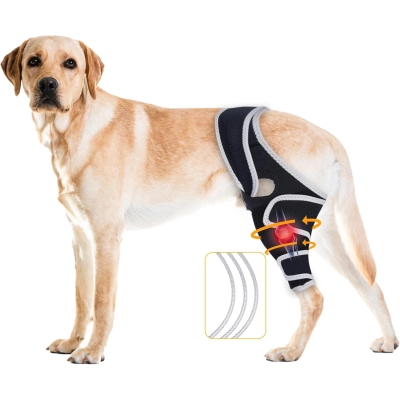
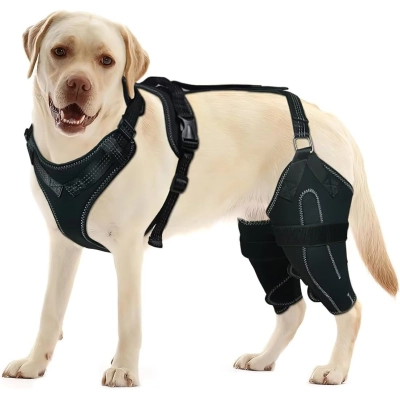
Different canine stifle brace designs handle these conditions differently. A brace built around a dual-hinge frame with independent upper and lower strap systems tends to maintain alignment better through varied terrain than a single-hinge wrap. The dual-hinge design isolates tibial and femoral movement — each bone segment gets its own anchor point — which means the frame stays put when the dog transitions from walking to sitting to stair-climbing. Single-hinge wraps rely on one pivot point to manage both segments, which works adequately on flat ground but introduces drift when the joint moves through compound angles.
When a Stifle Brace Helps an Arthritic Joint — and When It Does Not
A stifle brace for dog helps most when the arthritis is primarily mechanical — meaning pain comes from load passing through worn cartilage during movement. The brace offloads that load. The dog moves with less pain. This scenario is common in older dogs with gradual cartilage thinning and in dogs with partial ligament injuries that have destabilized the joint over time.
The brace helps less when arthritis pain is primarily inflammatory rather than mechanical. If the joint is actively inflamed — hot, swollen, painful even at rest — offloading alone does not address the underlying inflammatory process. The brace may still provide some comfort by limiting range of motion, but the benefit is smaller and less predictable. In these cases, the design features that matter shift toward material choice: breathable liners that do not trap heat against an already-warm joint, and strap systems that can be adjusted without pressing directly on swollen tissue.
Dogs with arthritis support needs that span multiple joints also present a challenge. A stifle brace addresses the knee. It does not offload the hip or the hock. If the dog is compensating at the hip because of stifle pain, bracing the stifle alone may shift the compensation pattern rather than resolve it. This is not a design failure — it is a use-boundary. The brace was built for one joint, and it performs within that scope.
Disclaimer: The hinge-alignment check described here assumes a short-coated dog where brace position can be visually tracked against bony landmarks. Double-coated breeds may show subtler drift that requires hand-checking — run your fingers along the brace edge after walking to feel for gaps or rotation rather than relying on visual inspection alone. If the dog's leg conformation falls outside the breed norms this brace was patterned for — particularly dogs with angular limb deformities or very deep chests — the fit checks described here may not catch every pressure point.
Dogs that have already lost significant muscle mass in the affected leg are also at the edge of what a brace alone can address. The frame can offload the joint, but it cannot rebuild atrophied muscle. A brace works alongside conditioning work, not as a replacement for it. The design logic is straightforward: the brace reduces pain during movement so the dog moves more, movement rebuilds muscle, and muscle adds its own stabilizing force around the joint. If the dog is too painful to move even with the brace, that feedback loop never starts.
Design Details That Influence Daily Performance
Several material and construction choices determine how a stifle brace performs across weeks and months of use — not just in a single fitting session.
Liner material matters most for dogs that wear the brace for extended periods. Neoprene liners provide good grip against the coat but trap moisture. A perforated neoprene or mesh-lined inner surface allows evaporative cooling — lift the brace after 20 minutes of wear and feel the skin underneath. Dry skin indicates the liner is breathing adequately. Damp or tacky skin means moisture is accumulating, which over hours can soften the skin and create conditions for irritation.
Strap attachment points influence how the brace handles the transition from standing to lying down. Straps anchored to rigid frame points maintain their orientation when the dog curls up — the frame keeps its shape, and the straps keep their tension. Straps anchored to flexible material may slacken when the leg bends, then re-tension when the dog stands. This cycling between loose and tight changes how pressure distributes across the skin through the day, and for dogs that alternate frequently between rest and activity, a fixed-anchor stifle support system tends to maintain more consistent contact.
The closure mechanism also introduces a practical difference. Hook-and-loop closures are fast to apply and adjust but accumulate hair and debris in the hook side over weeks, reducing grip strength. Regular cleaning of the hook surface — running a stiff brush through it weekly — restores most of the original holding force. Buckle or ratchet closures do not have this degradation pattern but are slower to put on and take off, which matters for dogs that resist handling.
FAQ
How long can a dog wear a stifle brace each day?
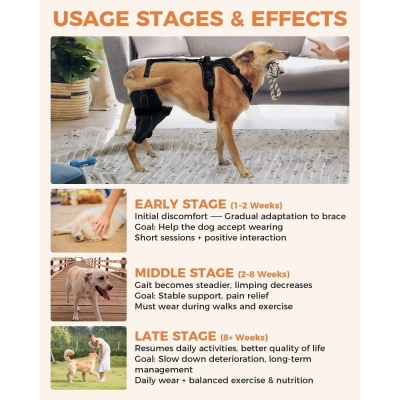
Start with 10–15 minute sessions and increase gradually. Most dogs adapt to several hours of daily wear. The limiting factor is typically skin tolerance, not joint fatigue. Check the skin under the brace after each session — pinkness that fades within 5 minutes is normal; redness that persists or any broken skin means the duration needs to be shortened or the fit checked.
Does a stifle brace cure arthritis?
No. Arthritis involves permanent cartilage loss. A brace does not regenerate cartilage. It offloads the joint during movement, which reduces pain and can slow further wear by keeping joint surfaces tracking in better alignment. The distinction is important: the brace changes how load moves through the joint, not the condition of the joint surfaces themselves.
Can a dog sleep in a stifle brace?
Generally not. During sleep, the joint is not under load, so offloading provides no benefit. Removing the brace overnight lets the skin breathe and prevents moisture buildup under the liner. The exception is when a veterinarian specifically recommends overnight bracing for post-surgical immobilization — a different use case than arthritis management.
Why does my dog's brace keep slipping down?
Slippage usually traces to one of two causes: the hinge is misaligned with the joint axis, or the strap tension is uneven between upper and lower straps. The hinge problem is structural — the brace cannot track the joint through its range of motion, so it drifts. The strap problem is adjustable — check whether the upper strap is tighter than the lower strap, which creates a downward wedge effect. Even tension between upper and lower anchor points lets the brace sit in place rather than slide.
0 Comments