
A dog with elbow dysplasia shifts weight off the sore leg. The elbow angles outward. The stride shortens. A brace is meant to interrupt that pattern, but whether it actually does depends on two things most sizing charts never mention: where the hinge sits relative to the joint axis, and how the straps distribute the stabilizing force across the leg.
A dog elbow brace that wraps tight but misses the joint axis by half an inch creates a new problem. The hinge pushes force into the joint at an angle the elbow was not built to take. The dog compensates. The limp pattern shifts rather than resolves. This is why understanding what makes one brace design work better than another matters more than comparing strap counts or material labels on a product page.
Hinge Alignment: Why Joint Axis Matching Decides Whether the Brace Works
A hinge on a dog elbow brace has one job. It must rotate around the same axis the elbow joint rotates around. When it does, the brace moves with the leg. The joint surfaces stay evenly loaded through the full range of motion.
When the hinge sits even slightly off-axis, the physics change. The hinge forces the elbow to pivot around a point that is not its natural rotation center. Each step creates a small lever arm between the brace hinge and the actual joint axis. That lever arm translates into uneven pressure across the joint surfaces. The medial side loads more than the lateral side, or vice versa.
This is not subtle. An off-axis hinge does the opposite of what a brace is supposed to do. Instead of distributing force evenly to unload damaged cartilage, it concentrates force onto whichever side of the joint the misalignment favors. Over hours of wear, that concentration can make the dog guard the leg more, not less.
Here is how to check whether a brace's hinge alignment holds up during real use:
- Pass signal: After 15 minutes of walking, the brace has not rotated around the leg. The hinge still sits directly over the elbow's bony prominence on both the inside and outside of the leg.
- Fail signal: The brace has slipped down the leg or twisted so the hinge no longer lines up with the elbow joint. You see the dog flicking the leg or stopping mid-stride to shake it.
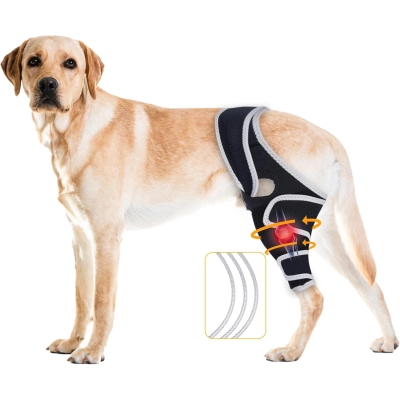
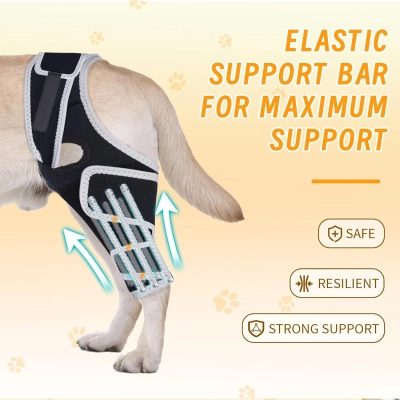
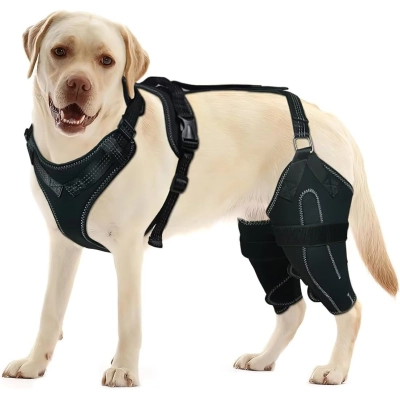
The difference between a hinge that stays aligned and one that drifts often comes down to how the brace anchors above and below the elbow. Dog braces that use rigid shells above and below the joint with the hinge connecting them tend to resist rotational slip better than single-sleeve designs. The dual-anchor approach locks the hinge's reference points in place relative to the humerus and radius, so the hinge keeps tracking the joint axis even as the dog changes gait or lies down.
But rigid anchoring has a trade-off. More structure means more material against the skin. More material means more heat build-up and more places where edge pressure can concentrate. A brace that never slips but is too uncomfortable to wear for more than 30 minutes solves one problem by creating another.
Strap Width and Material: What Determines Whether a Dog Tolerates All-Day Wear
Strap width is not a comfort feature. It is a force-distribution feature. A half-inch strap tightening around a dog's leg concentrates the clamping force into a narrow band. The pressure under that band, measured in pounds per square inch, is high even at moderate tension. A one-and-a-half-inch strap spreads the same tension across three times the surface area. The pressure per square inch drops by the same factor.
Why this matters beyond comfort: concentrated pressure under a narrow strap compresses the superficial blood vessels in the skin. Over time, that compression reduces local circulation. The skin under a narrow strap gets less oxygen. It breaks down faster. The dog starts licking that spot. The owner tightens the strap to compensate for the dog fussing with it. The cycle accelerates.
Wide straps short-circuit that cycle. Lower peak pressure means better perfusion under the strap. Better perfusion means the skin tolerates longer wear sessions. Longer wear sessions mean the joint gets more cumulative support through the day.
Here is a simple check for strap pressure distribution:
- Pass signal: After removing the brace following a 30-minute wear session, the skin under each strap looks the same as the surrounding skin. No deep indentations. No color difference.
- Fail signal: Strap marks remain visible more than 5 minutes after brace removal. The skin under the straps is pinker or paler than the surrounding area. The dog licks or mouths at a specific strap line.
Material choice interacts with strap width in one specific way that changes daily wear outcomes: breathability versus moisture retention. Neoprene provides consistent compression and conforms well to leg contours. But it traps moisture. Under a wide neoprene strap, the skin underneath gets damp within 20 to 40 minutes of walking. Damp skin under pressure macerates. Macerated skin breaks down under half the friction load of dry skin.
A knit or mesh outer layer bonded to a thin foam or spacer-fabric inner layer changes this equation. Moisture moves through the knit face and evaporates. The inner layer stays drier. The skin stays intact longer. The trade-off is that knit-faced materials provide less rigid compression than neoprene. For a dog that needs mild support and will wear the brace for extended periods, that trade-off favors the breathable material. For a dog that needs maximum joint immobilization for short sessions, the neoprene's compression advantage may matter more.
This material-compression-wear-time triangle is where dog arthritis support products often diverge in design philosophy. Some prioritize compression at the expense of breathability. Others prioritize all-day tolerance at the expense of maximum stabilization force. Neither approach is wrong. They serve different use conditions.
Where an Elbow Dysplasia Brace Helps — and Where It Does Not
An elbow dysplasia brace is not a universal elbow solution. It works within a specific set of conditions, and outside those conditions, it can underperform or create new problems.
Conditions a brace can support effectively
Joint instability from stretched or partially torn collateral ligaments responds well to external stabilization. The brace provides the lateral and medial constraint that the damaged ligaments no longer supply. This reduces the sideways wobble in the joint during weight-bearing. Less wobble means less repetitive micro-trauma to the already-damaged cartilage surfaces.
Elbow hygromas — fluid-filled swellings over the elbow point — benefit from a brace that pads and protects the area while distributing pressure away from the fluid pocket. Here the brace functions less as a stabilizer and more as a pressure-redistribution device.
Mild to moderate osteoarthritis secondary to elbow dysplasia is the most common use case. The brace does not reverse cartilage loss. What it can do is reduce the mechanical stress on the remaining cartilage by limiting the end-range motion where bone-on-bone contact is highest. This is a load-management strategy, not a structural repair.
Conditions where a brace does not help
Loose cartilage fragments or bone chips floating in the joint space — common in fragmented medial coronoid process — are not addressed by external bracing. A brace cannot retrieve or stabilize a loose fragment. If the fragment intermittently catches between joint surfaces, the dog will continue to experience sharp pain episodes regardless of how well the brace fits.
Severe joint deformation where the elbow joint surfaces no longer approximate each other creates a situation where no external hinge can track a meaningful axis. The joint itself has lost its geometric pivot. A brace hinge trying to track a destroyed axis generates unpredictable force vectors. The dog may be better served by other supportive strategies.
Disclaimer: The fit checks described here assume a short-coated dog where strap marks and skin changes are visible on inspection. Double-coated breeds may show subtler signs — you may need to part the coat and feel for heat, moisture, or indentation rather than relying on visual inspection alone. If the dog's forelimb conformation falls outside typical breed norms, particularly in dogs with angular limb deformities or very deep chests, the hinge alignment checks described may not catch every pressure point.
For a more detailed breakdown of what elbow braces can and cannot do across different elbow conditions, the design logic is covered further in discussions of elbow brace benefits and limitations for dysplasia and arthritis management.
Frequently Asked Questions
How does hinge placement affect whether a dog elbow dysplasia brace actually works?
The hinge must sit directly over the elbow's rotation axis on both the medial and lateral sides. When the dog bends the elbow, the brace hinge and the joint should move as one unit. If you watch from the side during a slow walk and the brace hinge moves forward or backward relative to the elbow's bony point, the alignment is off. That offset creates a lever that redirects force into the joint at the wrong angle, which can increase rather than decrease uneven cartilage loading.
Why do some dogs tolerate a brace for hours while others reject it after 20 minutes?
The difference usually comes down to strap pressure concentration and material breathability, not the dog's temperament. A dog that rejects a brace quickly is often responding to a specific physical signal — a pressure point under a narrow strap, damp skin under non-breathable material, or edge friction at a seam. Check for these mechanical causes before concluding the dog simply will not accept bracing.
Can a brace replace surgery for elbow dysplasia?
It depends on what is happening inside the joint. A brace can manage instability and reduce mechanical stress on remaining cartilage. It cannot remove a loose bone fragment, smooth a damaged joint surface, or correct a severe angular deformity. The brace addresses mechanical loading. Surgery addresses structural defects. They serve different purposes and are sometimes complementary rather than alternatives.
What is the single most important fit check before a walk?
Run your finger along the edge of every strap and the top and bottom edges of the brace shell after the dog stands up and takes five steps. Any edge that digs in or leaves a sharper indentation than the rest of the contact surface is a pressure point waiting to become a skin problem. Adjust that strap or edge before the walk, not after the dog starts licking the spot.

0 Comments