
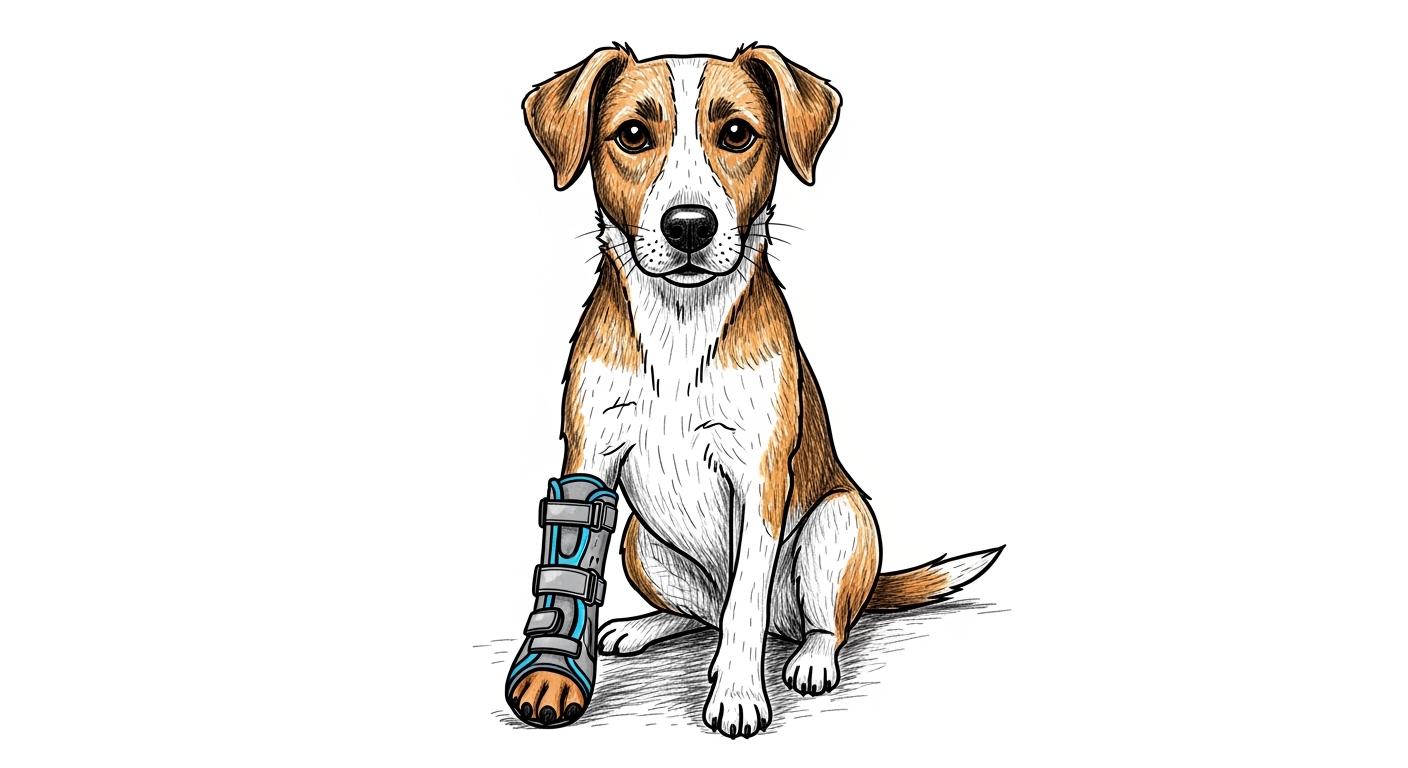
A dog drags the top of a paw across concrete. The nails scrape. The skin over the knuckles thins with each step. Most owners reach for something that wraps the paw. Wrapping covers the wound. It does not change where the paw lands.
That distinction separates a functional dog foot brace from a protective sleeve. A brace that corrects knuckling has to lift — at a specific angle, with adjustable tension, through a mechanism that follows the dog's own joint motion. A wrap cannot do that. Understanding which design details produce lift, and which just add material around the paw, determines whether the brace changes anything at all.
Why Toe-Up Dorsiflexion Changes Paw Placement
Knuckling happens when the paw folds under during the swing phase of a step. The dog brings the leg forward, but the paw does not clear the ground. The toes curl. The top of the paw strikes first.
Most braces approach this by wrapping the paw and lower leg in padded material. That protects the skin. It does not reposition the paw. The paw still lands wrong — it just lands wrong inside a cushioned shell.
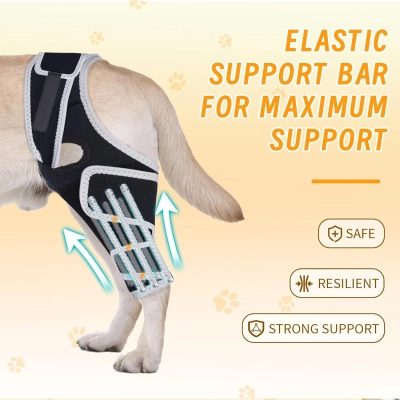
A toe-up dorsiflexion assist works differently. An elastic cord runs from a strap anchored below the hock or carpus, across the front of the ankle joint, and attaches to a toe cap or loop near the digits. When the dog lifts the leg, the cord tension creates an upward force vector that pulls the paw into dorsiflexion — toes up, pads down. The elastic stretches during the stance phase so the paw can flatten naturally against the ground. As the leg enters the swing phase and the dog's own flexor muscles relax, the elastic recoil lifts the paw clear.
This matters because it preserves the dog's proprioceptive loop. When paw pads contact the ground in the correct orientation, pressure sensors in the pads send normal signals back through the nervous system. The dog knows where the paw is. Gait confidence improves because the brain receives consistent feedback. A wrapped paw that still lands on its knuckles sends scrambled signals — the dog feels pressure on the wrong surface of the paw and compensates with an altered, often stiffer, gait pattern.
In practice: After 15 minutes of walking on pavement with a dorsiflexion brace, check the wear pattern on the toe cap or the paw pads. Even pad contact with light scuffing on the undersurface means the lift angle is working. Heavy scuffing on the top or side of the toe cap means the elastic tension is set too low — the paw is still rolling before the cord engages.
The angle of the elastic pull is the design variable that separates effective lift from cosmetic lift. If the cord anchors too low on the leg, the force vector points mostly backward instead of upward — the brace tugs the paw rearward rather than lifting it. If the anchor sits too high, the cord slackens during mid-swing and produces intermittent lift. The anchor point must sit at a height where the cord stays under consistent light tension throughout the full stride cycle, which is why a toe-up brace with an adjustable anchor position lets you match the tension zone to the dog's specific leg proportions rather than accepting a fixed geometry that may not align.
This design directly affects whether the brace works across different surfaces. On carpet, a poorly angled cord might still produce enough lift because friction is higher and the paw resists dragging. On wet tile or polished concrete, the same cord angle fails — the paw slides backward before the cord can engage, and the dog knuckles anyway. The outsole compound on the toe cap becomes the second critical variable: a cap with a high-friction tread pattern grips the floor during the brief moment between paw contact and weight transfer, preventing the backward slide that would defeat the lift mechanism.
Strap Placement and Tension — Why It Decides Stability
Lift solves the paw-position problem. It does not solve the stability problem. A brace that lifts the paw but shifts position on the leg during movement creates a new set of issues: the lift angle changes mid-stride, the tension zone migrates, and the dog compensates by altering hip or shoulder motion to brace against the slipping brace.
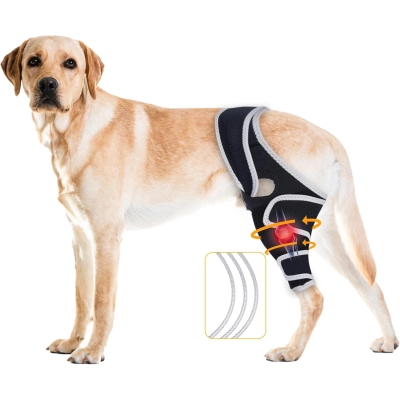
Strap configuration determines whether the brace stays where it was put. Two straps spaced too close together concentrate retention force in a narrow band. That creates high unit pressure on a small patch of skin — the dog tolerates the brace for shorter periods, and the skin under the straps reddens faster. Two straps spaced wider apart distribute the same total retention force across a larger contact area. Unit pressure drops. The brace holds position with less compressive force on any single point.
The material that contacts the skin under the straps also determines how long the brace can stay on before irritation develops. A knitted composite fabric with moisture-wicking structure pulls sweat away from the skin surface. When sweat pools between strap liner and skin, friction coefficient rises — the strap grips skin instead of gliding, and every micro-movement of the brace tugs at the hair follicles. Over hours, that tugging produces the reddened, irritated patches that force owners to remove the brace early.
Tip: After 20 minutes of walking, slip a fingertip under each strap. A flat finger should fit without forcing. If the skin under the strap is redder than surrounding skin, or if you cannot insert a fingertip at all, the strap tension is too high relative to the contact area — the brace is gripping by compression instead of by distributed retention.
Hook-and-loop strap systems add another design variable: whether the closure can be set independently for each strap. A single continuous wrap that cinches both straps together forces the same tension on upper and lower leg — but the leg tapers, so identical strap tension means higher unit pressure on the narrower lower segment. Independent strap adjustment lets each strap match the circumference and tissue compliance of its specific contact zone, which reduces the likelihood that one zone becomes the early-failure point for skin tolerance.
The toe cap attachment also affects stability. If the elastic cord connects to a narrow toe loop that sits between two digits, lateral paw movement can cause the loop to migrate toward one toe, pulling the paw off-axis. A broader toe cap that spans the full width of the digits distributes the lift force across the entire paw front, so the paw rises straight rather than tilting to one side. The difference is visible: a dog wearing a narrow-loop brace may compensate by externally rotating the leg to counteract the tilt, which shifts load to the opposite limb and creates a new gait asymmetry.
When a Foot Brace Helps and Where It Reaches Its Limit
A dorsiflexion brace works best under a specific set of conditions: the dog can still flex and extend the knee or elbow, the paw folds under primarily during swing phase, and the skin over the dorsum of the paw is intact enough to tolerate strap contact. Under those conditions, the brace changes the mechanical outcome of each step — the paw lands pads-down instead of knuckles-down.
The brace does not change the neurological signal that caused the knuckling. If the underlying issue is a progressive spinal cord condition that is actively reducing nerve conduction, the brace manages the symptom while the disease follows its own course. The paw placement improves while the brace is on. It does not stay improved when the brace comes off. That distinction is important because it sets realistic expectations: the brace is a mechanical intervention, not a neurological one.
Dogs with rear leg weakness that affects the entire limb — not just the paw — may need more than a foot brace. If the dog cannot bear weight through the leg at all, a toe-up assist cannot create stance stability; it can only reposition the paw. The brace works when the primary deficit is paw placement during gait. When the deficit extends to weight-bearing capacity in the proximal joints, a foot brace alone leaves the larger stability problem unaddressed.
Fit also has hard boundaries. A brace patterned for a standard leg profile will not match a dog with angular limb deformities or a very deep chest that changes the angle at which the leg meets the body. In those cases, the strap anchor points shift relative to the joint axis, and the elastic cord may pull at an angle that rotates the paw rather than lifting it.
Disclaimer: If the dog's leg conformation falls outside the breed norms this brace was patterned for — particularly dogs with angular limb deformities, very deep chests, or disproportionate leg-to-body ratios — the fit checks described here may not catch every pressure point. In these cases, standard strap placement may create pressure zones that a hand-check after wear can detect but that visual inspection alone will miss. Run a finger along the full strap path after the first 10-minute wear session; any spot that feels warmer than surrounding skin is a pressure zone that needs strap repositioning or padding adjustment.
Breed and coat type also shift how the brace fits in practice. Short-coated dogs show rub marks and redness sooner, which makes fit problems easier to catch early. Double-coated breeds may show no visible skin changes even when strap pressure is too high — the undercoat masks the signal. For dense-coated dogs, the hand-check under each strap after wear is the only reliable verification method, because visual inspection alone can miss pressure that the coat hides.
A foot brace also cannot substitute for managing contributing factors. A dog carrying excess weight places more load on every step, which means the elastic tension needed to lift the paw increases — and so does the strap retention force needed to anchor the brace. Weight management and mobility rehabilitation work that maintains proximal joint strength create conditions where the brace can function at lower, more tolerable tension settings. The brace and the conditioning work together; neither replaces the other.
FAQ
Does a toe-up brace work for both front and rear leg knuckling?
The dorsiflexion mechanism is the same regardless of which leg is affected — an elastic cord lifts the paw against gravity during swing phase. But the anchor geometry differs between front and rear legs because the carpus (wrist) and hock (ankle) bend in opposite directions during gait. A brace designed for a rear leg anchors above the hock and runs the elastic cord along the front of the leg; a front-leg version anchors above the carpus and routes the cord along the back of the leg. Using a rear-leg brace on a front leg reverses the pull direction and can actively worsen the knuckling by pulling the paw into plantarflexion instead of dorsiflexion.
How long can a dog wear a foot brace for knuckling in one session?
Session length depends on skin tolerance, which depends on strap contact area, liner material, and tension level. With wide straps over moisture-wicking liner at moderate tension, most dogs tolerate 1–2 hours before a skin check is warranted. The first week should start with 30-minute sessions, with a full skin check after each one. If no redness or warmth develops, session length can increase in 15-minute increments. The limiting factor is almost always the skin under the proximal strap — that strap anchors the entire lift force and carries the highest load.
Can a foot brace prevent knuckling from getting worse?
A brace addresses the mechanical consequence of knuckling — the paw dragging and folding — but does not alter the underlying cause. If the cause is a progressive condition like degenerative myelopathy, the disease advances independently of brace use. What the brace can do is reduce secondary injuries: the scrapes, sores, and nail damage that come from repeated paw dragging. Those injuries, if left unchecked, create pain that further reduces the dog's willingness to move, which accelerates muscle loss. The brace interrupts that secondary cascade even when it cannot stop the primary condition.
What is the difference between a toe-up brace and a boot-style brace for knuckling?
A boot-style brace encases the paw and lower leg in a rigid or semi-rigid shell that holds the ankle at a fixed angle. It prevents the paw from folding under by immobilizing the joint that would allow that motion. A toe-up brace uses elastic tension to actively lift the paw while still allowing the ankle to move through its full range during stance. The boot immobilizes; the toe-up brace redirects. For a dog that still has some ankle mobility, the toe-up brace preserves that motion and uses it. For a dog with no ankle control at all, the boot provides the positional certainty that an elastic mechanism cannot guarantee.

0 Comments