
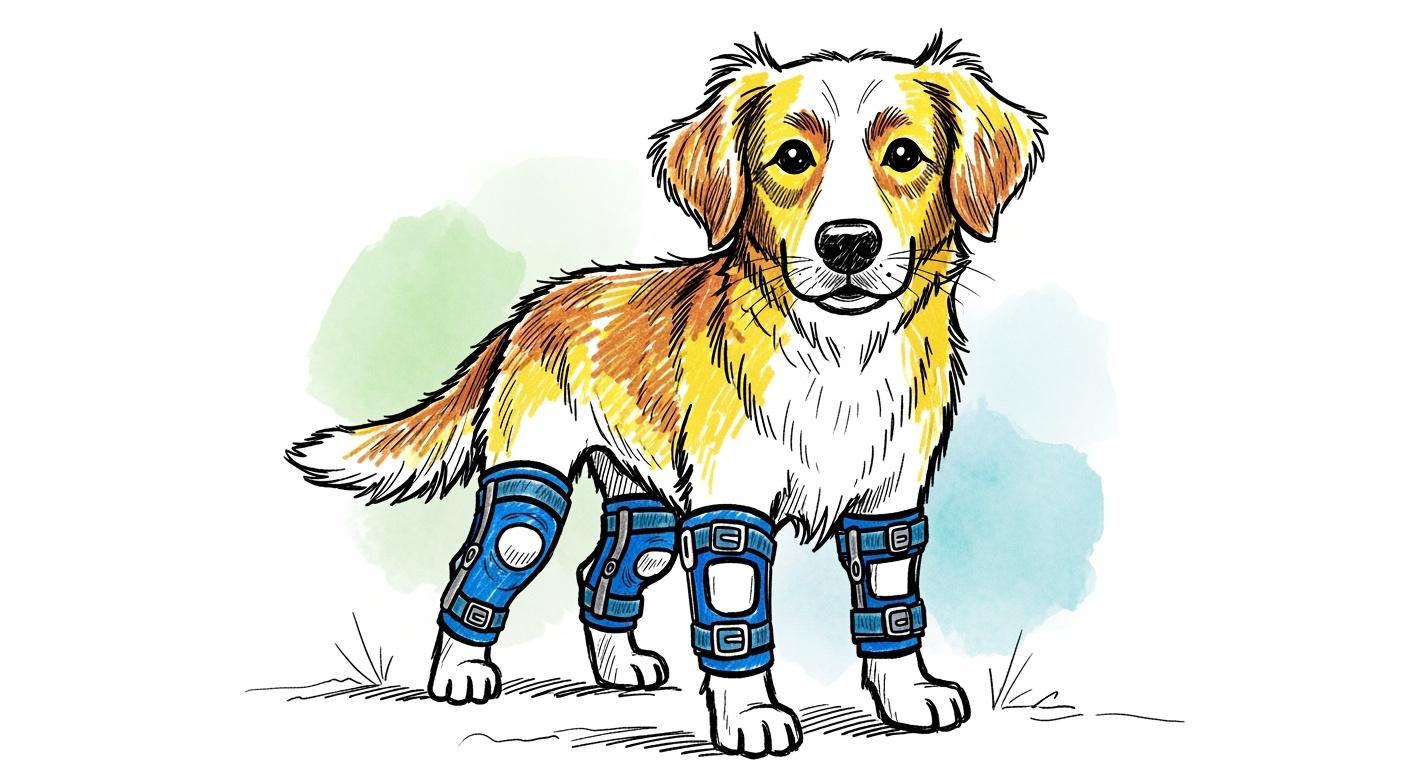
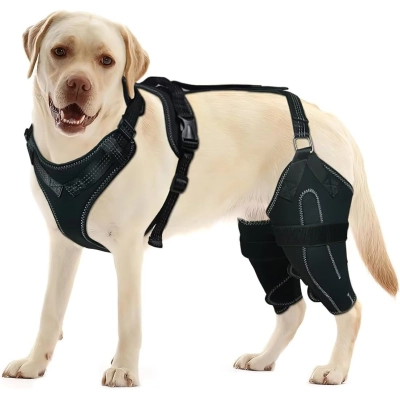
A dog injures one CCL. The healthy leg takes the extra load. Within a year, that leg fails too. This is not bad luck. It is mechanics. A double knee brace for dogs exists to interrupt that cascade—supporting both knees at once so neither becomes the overloaded compensation limb.
But "supporting both knees" is not the same as "strapping two single braces onto two legs." The difference between a brace that stabilizes and one that just adds bulk comes down to two things: whether the hinges align with both joint axes simultaneously, and whether the left and right sections work as one connected system or two independent pieces.
How a Double Knee Brace Stabilizes Both Knees—and Why Hinge Placement Decides Whether It Works
Each knee joint rotates around a specific axis. The femoral condyles roll and glide across the tibial plateau along a predictable arc. A hinge that sits correctly on that axis moves with the joint. Force travels in a straight line through the mechanical axis of the leg. The dog walks with something close to its natural gait.
A hinge that sits half an inch forward or backward of that axis fights the joint. Instead of transferring force along the bone's load path, it creates shear at every strap contact point. The dog pushes against the brace with each step. Strap tension rises. Skin gets irritated. The dog starts compensating around the brace instead of moving with it.
That half-inch is the difference between a functional dog knee brace and an expensive sleeve.
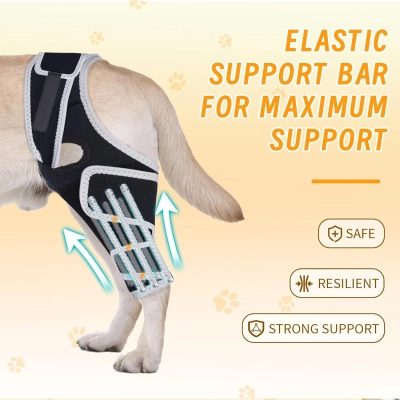
When both hinges in a double brace align correctly, the strapping system performs a fundamentally different job. It keeps the brace in position—it does not create support through compression. Compression-based support from overtightened straps restricts blood flow, creates hot spots, and makes the dog want the brace off. Alignment-based support transfers load without the dog registering pressure.
This becomes more demanding in a double brace because both hinges must track their respective joint axes at the same time—on two legs that may differ slightly in circumference, muscle mass, and stance angle. A design that locks both hinges to a fixed spacing assumes perfect symmetry. A design that allows independent hinge positioning per leg can accommodate the real-world asymmetry most dogs have.
In practice: After 10 minutes of walking, mark the hinge center on each leg with a small piece of tape on the fur. Walk another 5 minutes. If either hinge has drifted more than half an inch, alignment is off—the brace is fighting the joint, not supporting it.
When a Double Knee Brace Performs Better Than a Single Brace—Even With Two Bad Knees
Not every dog with bilateral knee damage needs a double brace. The question is how the dog loads its legs.
A dog that distributes weight evenly between both hind legs—even with discomfort—tends to respond well. The simultaneous support keeps the load balanced. Neither leg becomes the designated sacrifice limb. This pattern is common in dogs with early-stage bilateral CCL degeneration, where both knees show laxity but neither has fully ruptured. A dog ACL/CCL brace designed for bilateral use keeps the dog moving without letting one side take over.
A different scenario: the dog has already spent months favoring one leg. The compensation pattern is baked in. The dog leans hard onto the stronger side and barely loads the weak one. Putting both legs into braces at once can backfire—the dog fights the brace on the stronger side while still underloading the weaker one. In this case, a single brace on the worse knee, paired with a gradual reloading program, often works better than going straight to bilateral bracing.
The clearest performance window for a double brace is prevention. When one knee is already injured and the other is at risk—a common situation in young, active large-breed dogs—bracing both knees removes the overload mechanism that drives the second injury. The brace does not repair the torn ligament. It alters the loading equation enough that the intact ligament on the other side has a chance to stay intact.
Disclaimer: These loading-pattern observations assume a dog with standard hind-limb conformation. Dogs with angular limb deformities, very deep chests, or breed-specific stance deviations—Bulldogs, Basset Hounds, Dachshunds—may distribute force across the brace's contact surfaces in patterns that visual inspection alone will miss. Hand-checking under straps after wear is more reliable than looking for visible rub marks in these breeds.
Strap Configuration, Material Choices, and the Design Details That Change Daily Wear
What makes a brace a dog tolerates versus one it accepts comes down to details invisible in a product photo.
Multi-point strap placement versus single-band compression. A brace using two or more independent strap points per leg spreads retention force across more square inches of tissue. A single wide band concentrates it all on one ring of contact. Spread force means lower pressure per square inch, less skin irritation, less sliding when the dog flexes its knee. Same principle as a wide snowshoe floating where a narrow boot sinks.
Ventilation is about perforation geometry, not material labels. Neoprene is often called breathable. Solid neoprene is not. Perforated neoprene—with a grid of punched-through holes—allows moisture vapor to escape. Unperforated neoprene traps it regardless of marketing language. The only reliable test: after 20 minutes of indoor wear, slide a finger under the inner lining. Damp skin means ventilation is insufficient for that dog at that activity level. Dry skin means it is working.
Hinge housing edge finishing. The hinge mechanism sits inside a housing that presses against the side of the dog's leg. If the housing edge is sharp or the padding over it thinner than 3 millimeters, the dog develops a rub mark directly over the bony knee prominence within the first few wear sessions. A well-designed housing has a rolled or beveled edge and closed-cell foam thick enough to distribute pressure across the surrounding soft tissue rather than concentrating it on the bone.
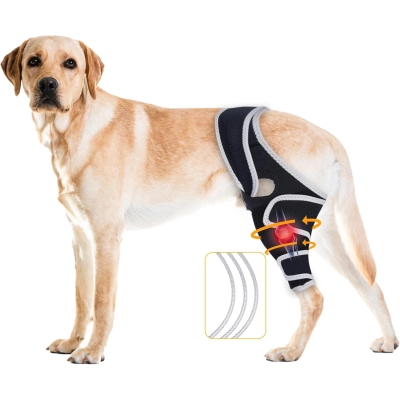
Suspension, not just straps. Some double braces use an overhead element connecting the two leg sections across the dog's lower back. This transfers part of the brace's weight off the legs and onto the body core. Without suspension, gravity pulls the brace downward with every step and the straps creep. With suspension, position holds longer between adjustments. For dogs with sloping backs or low body fat over the hips, this detail often determines whether the brace stays on during a full walk.
Some knee conditions require different stabilization priorities. A dog with luxating patella needs medial-lateral containment that a standard double CCL brace may not prioritize. The design must match the condition, not the other way around.
Tip: After 15 minutes of walking, run three checks. Check strap positions against their starting marks. Check skin under hinge housings—redness that persists beyond 2 minutes after removal signals too much pressure. Check under the inner lining for trapped moisture. Three passes mean the brace fits well enough for extended daily wear.
Where a Double Knee Brace Works—and Where It Reaches Its Design Limit
A double knee brace is a mechanical support device. It is not a surgical alternative when surgery is indicated. It is not a treatment for degenerative joint disease. It changes how force moves through two knee joints at the same time. That is the full scope.
The brace operates within these conditions:
- Partial CCL tears where some ligament integrity remains and the joint is not grossly unstable
- Early bilateral degeneration where both knees show laxity without full rupture
- Post-surgical protection of the uninjured leg while the operated side heals
- Conservative management for dogs that are not surgical candidates due to age, health status, or owner circumstances
It reaches its functional limit when:
- A full-thickness CCL rupture produces tibial thrust that overpowers the brace's external stabilization
- Leg circumference falls between standard sizes, creating a geometry mismatch no strap adjustment can close
- A wound or skin condition exists at any brace contact point
- The dog's activity demands unrestricted sprinting or sharp cutting movements beyond what any external brace can stabilize
A brace that needs constant readjustment, leaves persistent red marks, or makes the dog unwilling to walk has reached its design boundary for that specific animal. Cinching straps harder does not solve a fundamental fit mismatch.
Disclaimer: If a dog shows increased lameness, vocalization, or movement refusal while wearing the brace, the fit or brace type is likely wrong for that dog's joint mechanics. Continuing use under these conditions risks creating compensatory movement patterns that take longer to correct than the original problem.
FAQ
Does a double knee brace work for dogs with visibly different-sized legs?
Standard double braces are built on symmetrical sizing—both legs are expected to fall within the same size bracket. Dogs with muscle atrophy on one side often have measurable circumference differences between legs. Some designs compensate with independent strap adjustment per leg, but the underlying shell geometry still assumes symmetry. A circumference difference greater than 1–2 centimeters between legs may exceed what a standard double brace can accommodate without compromising fit on one side.
How long can a dog wear a double knee brace at a time?
The limiting factor is skin health, not joint tolerance. Even well-ventilated braces trap some moisture against the skin over extended periods. A practical rhythm: 2–3 hours on, remove for a skin check, reapply if skin is dry and unmarked. During hot or humid weather, shorten the interval. The signal to watch is not the clock but the skin condition at each check. The recovery support a knee brace provides depends as much on consistent skin integrity as on mechanical stabilization.
What makes a double knee brace different from using two single braces?
Two single braces operate independently—each with its own hinge, straps, and positioning. They can drift out of alignment relative to each other during movement. Nothing forces symmetrical loading. A purpose-built double brace includes a structural element—either a physical bridge between leg sections or a suspension system—that coordinates movement between sides. That connection addresses the compensation cascade. Without it, the dog can still shift weight onto the stronger leg even with both knees technically braced.
Can a dog wear a double knee brace after surgery on one knee?
It can, and this is one of the stronger use cases. The operated leg is protected by the surgical repair and post-op restrictions. The unoperated leg—suddenly bearing more weight during the recovery period—is the one at highest risk for a new CCL tear. Bracing both knees during the post-surgical period distributes load more evenly and reduces the overload on the intact side. The brace on the surgical leg should be applied only after the incision is fully closed and the veterinarian confirms the skin can tolerate brace contact.

0 Comments