
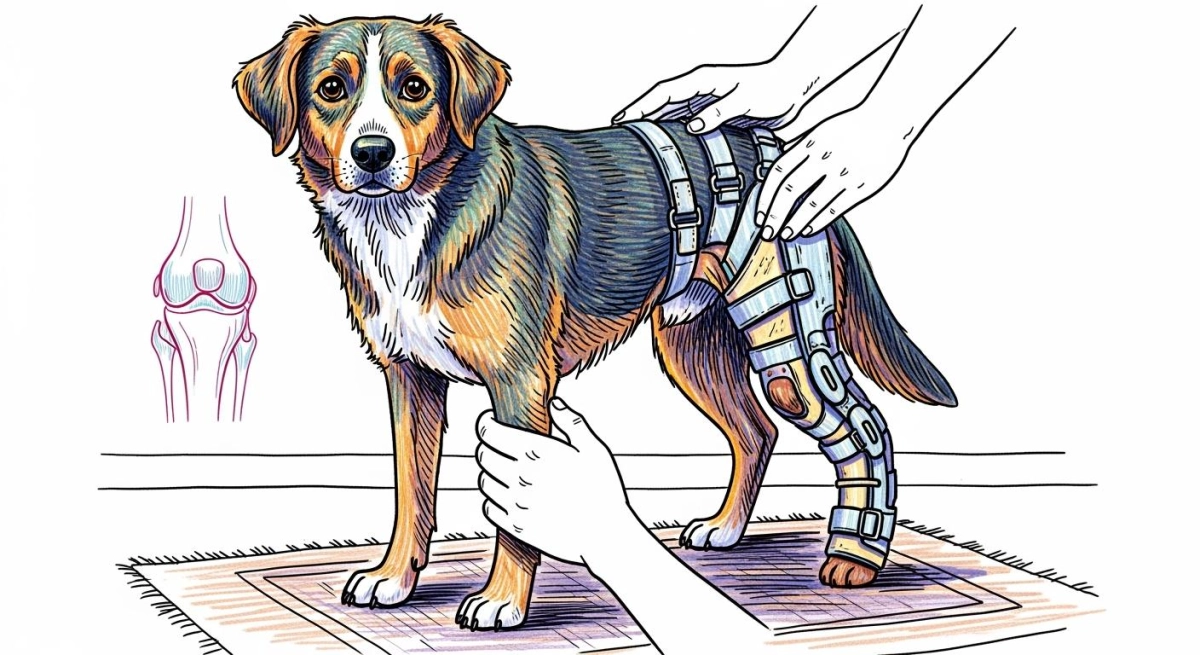
A dog limping after a torn ACL is not struggling because the knee hurts in the way most people assume. The knee is unstable. The tibia slides forward every time the dog plants the leg. The joint does not stay stacked. Pain comes from that mechanical instability — structures around the stifle absorbing forces they were never meant to handle.
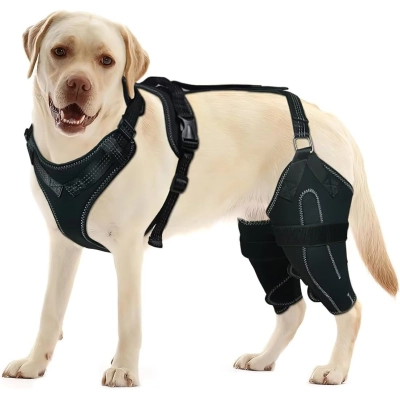
That is what a dog knee brace is designed to address. Not by squeezing the joint into submission. By restoring a mechanical boundary the torn ligament can no longer provide.
Which design details make that boundary hold up during real movement — and which ones fall apart the moment the dog breaks into a trot — is what this article walks through.
Hinge Position and the Mechanics of Joint Stabilization
Every knee brace claims to stabilize. But stabilization is not a binary feature. It is a mechanical outcome that depends on one design decision: where the hinge sits relative to the stifle joint axis.
The canine stifle is a hinge joint rotating around a roughly horizontal axis through the femoral condyles. When the cranial cruciate ligament tears, the tibia loses its anterior stop. The femur slides backward on the tibial plateau during weight-bearing. That abnormal translation — not the ligament tear itself — produces the characteristic limp.
A brace hinge aligned with the stifle axis does something mechanically precise: it converts the brace frame into a secondary load path. When the dog bears weight, compressive force travels from the femoral shell, through the hinge pin, into the tibial shell, and into the ground. The hinge routes force the way the ligament used to. The joint surfaces stay stacked because the brace geometry holds them there — not because the straps are cranked down.
Shift that hinge a half-inch forward or back. The entire force diagram changes. Instead of routing load axially, the misaligned hinge creates a lever arm. Weight-bearing force multiplies through that lever and dumps into the soft tissue under the strap anchors. The brace still looks like it is on the leg. Mechanically, it has become a fulcrum for joint distraction, not a stabilizer.
This is why hinge position is the most consequential variable in a knee brace. Strap quality, liner material, shell rigidity — all secondary if the hinge sits in the wrong place. A brace with an accurately placed hinge and mediocre straps will outperform a brace with premium straps and a hinge that misses the joint axis.
| Design Variable | Why It Matters | Pass Signal | Fail Signal |
|---|---|---|---|
| Hinge-to-joint axis alignment | Determines whether force travels axially through the hinge or creates a lever arm that distracts the joint | Brace does not migrate vertically during strides; stifle stays centered between hinge arms | Brace rides up or down within the first few steps; hinge drifts visibly above or below the joint line |
| Hinge range-of-motion stop | Limits tibial translation at the endpoint where the ligament would engage, without blocking the natural gait arc | Dog reaches full extension without the brace bottoming out; no abrupt mid-stride stop | Dog shortens stride to avoid hitting the stop; visible hesitation at terminal stance |
| Shell contour around femoral and tibial profile | Prevents the brace from rotating around the leg when lateral forces hit during turns or uneven ground | Brace orientation stays consistent through direction changes; straps remain at original angles | Shell rotates visibly after a sharp turn; straps end up skewed relative to their starting position |
Strap Width, Pad Contour, and the Problem of Dynamic Fit
Static fit is easy. Wrap the brace on a standing dog. It looks correct. Dynamic fit is the test — and most braces fail it within ten minutes of walking.
The failure mechanism is predictable. A narrow strap concentrates stabilization force onto a thin band of tissue. Under load, that band compresses. The skin and muscle underneath deform. The strap loosens. Once one strap loosens, load shifts to the remaining straps. They now carry more force than designed for. They deform. The brace migrates.
Wide straps solve this through simple physics. Force spread across a larger surface produces lower pressure at any single point. Lower pressure means less tissue compression. Less compression means the strap-to-leg interface stays closer to its original geometry throughout the gait cycle. The brace stays where it was placed.
Pad contour is the second half of the equation. A dog's leg is not a cylinder. The thigh tapers. The stifle has bony prominences — the tibial crest, the femoral condyles. A flat pad bridges across these landmarks and leaves air gaps. Those gaps are dead zones where no force transfers. The contact area shrinks to the high spots. Pressure spikes there. Hot spots, rub marks, skin breakdown follow.
A contoured pad works differently. It follows the leg's topography, filling the valleys around bony landmarks instead of bridging over them. Contact becomes nearly continuous across the pad surface. Force distributes evenly. The brace feels less intrusive because no single spot takes a disproportionate share of the load.
Tip: After 10 minutes of walking, mark each strap position with tape on the shell. Walk another 5 minutes. If any strap has drifted more than half an inch, the force distribution design on that ACL knee brace is not holding up under dynamic load — no matter how tight the straps were at the start.
Multi-point strapping adds another layer. A three-point or four-point system creates a force triangle or rectangle around the joint. Each strap anchors at a different angle. When the dog turns, lateral force that would rotate a two-strap configuration gets countered by the off-axis strap. The geometry resists rotation without needing more tension. Four straps at moderate tension routinely outperform two straps cranked to maximum — because configuration, not tightness, controls brace position during movement.
Where Bracing Works and Where It Reaches Its Limits
A knee brace is a mechanical solution to a mechanical problem. It works within a definable range. And it has a clear boundary.
Partial CCL tears sit inside that boundary. The ligament retains some structural continuity. The brace takes over the portion of load the damaged fibers can no longer carry. The remaining intact tissue gets a chance to heal without being repeatedly stretched past its failure point during daily movement.
Complete ruptures sit at the edge. The ligament ends have pulled apart. No amount of external bracing reconnects them — ligament tissue does not reattach across a gap without surgical intervention. What the brace can do is control tibial translation mechanically, letting the dog move with less pain while periarticular fibrosis develops. That fibrosis — the body's scarring response — can eventually provide passive stability. But it is not a ligament. It lacks the organized collagen architecture and tensile strength of native tissue. Outcomes vary substantially by dog size, activity level, and fibrosis pattern.
Small dogs tend to get more consistent results from bracing than large dogs. The scaling is not linear. Joint force scales roughly with body mass. But the surface area available for strap contact scales at a lower rate. A 90-pound dog generates roughly triple the stifle force of a 30-pound dog without having triple the strap contact area. The design must compensate — wider straps, more rigid shells, additional anchor points — to keep pressure within tolerable limits.
Dogs with angular limb deformities, significantly asymmetrical leg conformation, or very deep chests often fall outside what an off-the-shelf shell geometry can accommodate. When the actual leg deviates too far from the profile the shell was patterned for, the hinge can no longer align with the joint axis regardless of strap adjustment. At that point, the brace cannot perform its primary mechanical function. For these dogs, the limits of bracing become apparent quickly — the shell-to-leg mismatch is visible within the first wear session.
Disclaimer: The fit checks described here assume a short-coated dog where strap position and skin condition are visible during inspection. Double-coated or heavy-coated breeds may show subtler rub marks that require hand-checking under the coat rather than visual inspection alone. If a dog's leg conformation falls well outside breed norms — particularly angular limb deformities or dramatically asymmetrical stifle profiles — the fit verification methods described here may not catch every pressure point. A canine rehabilitation practitioner can assess whether the shell-to-leg interface distributes force evenly for that specific dog.
This same mechanical logic — hinge alignment dictating force-path quality, strap geometry determining dynamic stability — applies across the broader category of dog braces. What changes from joint to joint is the axis orientation, the range-of-motion envelope, and the soft-tissue landscape the shell must contour around. The principles stay consistent. The specific design demands shift with anatomy.
FAQ
How tight should a knee brace be?
Tight enough that the brace does not migrate during a 10-minute walk. Not tighter. If you can slide two fingers under any strap with moderate effort, the tension is in the right range. If you have to force them under, the strap is compressing tissue unnecessarily. Tight straps do not compensate for poor hinge alignment. They just create skin problems faster.
Can a brace replace surgery for a fully torn ACL?
A brace does not reconnect torn ligament ends. It controls tibial translation mechanically while the body forms periarticular scar tissue. That scar tissue can provide some passive stability over months. Results vary significantly by dog size, activity level, and how the fibrosis develops. Large, active dogs with complete ruptures typically place demands on the stifle that exceed what external stabilization alone can manage.
Why does the brace slide down even when straps are tight?
Strap tightness is rarely the cause of brace migration. The usual culprit is hinge misalignment or a thigh taper that does not match the shell profile. If the hinge sits above or below the stifle axis, every stride produces a vertical force component that walks the brace down the leg. Tightening straps fights the symptom, not the cause. It often worsens migration by creating a piston effect — compressed tissue rebounds and pushes the brace downward.
How long before a dog adjusts to wearing a knee brace?
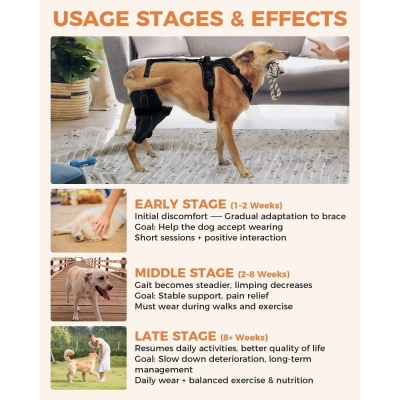
Most dogs adapt within three to five short, graduated wear sessions when the fit is correct. A dog that has not accepted the brace after two weeks of consistent introduction is usually reacting to a fit problem, not a training problem. Check hinge position relative to the joint line and strap pressure distribution before assuming more time will fix it.
0 Comments