
A dog plants the injured leg, shifts weight forward, and the knee wants to slide. That moment, the transition from swing to stance, is where an ACL knee support brace either earns its purpose or becomes dead weight. Two broad structures exist for handling that moment: hinged braces with rigid side stays that lock the joint axis, and soft rehabilitative wraps that trade mechanical control for compression and comfort. Neither is universally better. Each matches a different phase of loading, a different stage of tissue healing, and a different set of daily demands.
Hinge Alignment and Stay Design: What Actually Controls Knee Stability
A stifle joint does not hinge like a door. The femoral condyles roll and slide across the tibial plateau through a changing axis of rotation. A hinge on a brace can only approximate that path. It picks one average axis and commits to it.
That commitment is what separates functional from rehabilitative designs.
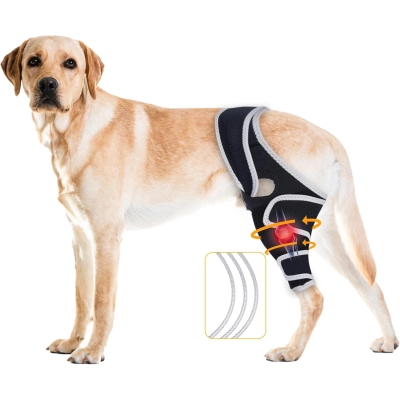
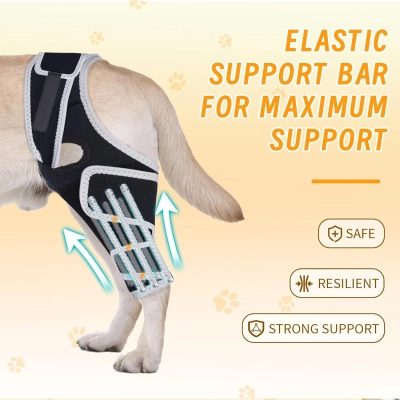
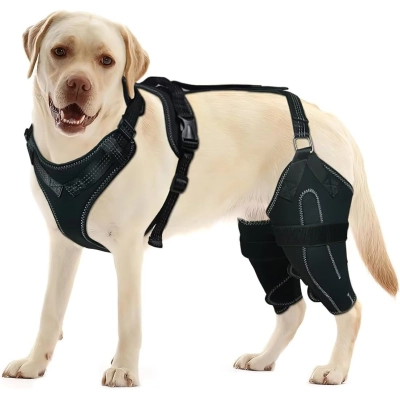
Functional braces embed rigid side stays, typically aluminum or reinforced polymer bars, that run parallel to the femur and tibia. A monoaxial or polycentric hinge connects them at the estimated joint center. When the hinge sits within roughly a quarter-inch of the true joint axis, compressive and shear forces traveling up from the ground pass straight through the stay instead of torquing the knee into anterior tibial translation. The stay becomes a bypass beam: load goes through metal, not through the compromised ligament. The joint surface sees less shear because the stay redirects force along a linear path, and the cruciate remnant is spared the repetitive microtrauma that would otherwise accumulate with every step.
A hinge offset by half an inch changes everything. The forces no longer run axial. Instead they generate a lever arm, a rotational moment that the stay cannot cancel because it is pushing at the wrong angle. The brace still looks like it is on. It still wraps the leg. But it is no longer controlling the vector that matters.
Something to check: after ten minutes of leash walking, look at the hinge position relative to the bony landmarks marked during fitting. If the hinge has migrated more than half an inch up or down the leg, it has drifted off-axis. The brace is now adding a bending load the joint was not designed for.
This is why dog knee brace designs that include indexed hinge placement, with reference points tied to the tibial crest and femoral condyle rather than just leg circumference, tend to maintain alignment longer. The index gives the hinge a fixed anatomical anchor. Without one, every strap adjustment resets the hinge position from scratch. Most owners will not re-find the joint axis by feel after the first week.
Strap Configuration: Why Force Distribution Matters More Than Tightness
A brace strap does two things at once. It anchors the brace to the leg, and it applies inward pressure to the skin and underlying tissue. Those two functions compete. Tighten for better anchoring and you raise local pressure. Loosen for comfort and the brace migrates.
The difference between a strap layout that works and one that fails comes down to contact area. A single wide strap, say two inches, spreads its anchoring force across a band of skin roughly equal to the strap width times the leg circumference at that point. Two narrower half-inch straps separated by an inch of open fabric spread the same total anchoring force across two bands plus the unstrapped zone between them. The wider total footprint reduces peak pressure under any single strap edge. Lower peak pressure means less focal compression of dermal capillaries, which is what causes the red indentations that persist after brace removal.
Functional braces typically use three to four anchor points: a proximal thigh strap, a distal shank strap, and one or two intermediate straps that bridge the hinge area. This multi-point layout distributes anchoring demand so no single strap carries the full load of stabilizing the joint. When one strap loosens slightly during movement, the others maintain position.
Rehabilitative wraps often use a continuous spiral or sleeve design. Fewer discrete anchor points. Less peak anchoring force per strap, but also no redundancy. If the wrap slips, the whole support shifts.
Verifying strap performance is straightforward. Mark the edge of each strap with a small piece of tape on the fur after fitting. After twenty minutes of normal walking, not a structured rehab session but just the dog moving around the house, check whether any strap edge has moved more than half an inch from the tape mark. A strap that consistently drifts is concentrating force at its new position, not distributing it across the original contact zone.
The dog ccl acl brace category reflects this trade-off explicitly: designs that add more straps gain anchoring redundancy but add steps to the fitting routine. Designs that use fewer straps fit faster but leave less margin for movement-induced loosening. Neither approach is wrong. The choice depends on whether the dog's daily activity involves sustained walking, where migration accumulates, or short supervised sessions where the owner can reset the brace between uses.
Where Each Brace Structure Works, and Where It Fails
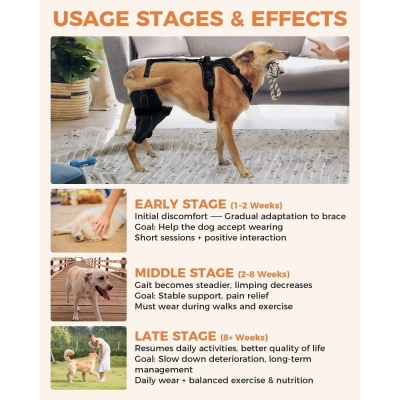
A hinged functional brace does its best work when the dog is loading the leg. Walking. Standing up from a down. Navigating a step. The stay-and-hinge assembly resists anterior tibial translation during weight-bearing, exactly when the cruciate ligament would normally carry the highest strain. For a dog with a complete tear managed conservatively, or a dog in the strengthening phase weeks after surgery, this mechanical barrier matters.
But hinged braces have a hard floor. A dog that spends most of the day lying down, the early post-injury or immediate post-surgical period, is not generating the loads the hinge was designed to resist. The brace's bulk becomes a liability: the rigid stays press into the resting leg, the hinges catch on bedding, and the dog's primary need is not motion control but swelling management and comfort.
That is where the rehabilitative wrap structure fits. Soft neoprene or elasticized fabric provides circumferential compression. Compression reduces extracellular fluid accumulation, which means less swelling, less joint capsule distension, and less pain signaling. No hinge means the dog can rest with the leg in any position without a rigid bar digging into the thigh. The trade-off is that compression alone provides negligible resistance to tibial translation once the dog stands up. It keeps the joint warm and compressed. It does not stop the femur from sliding forward over the tibial plateau under load.
Disclaimer: this brace-type comparison assumes a dog with standard leg conformation, a straight limb axis and body-condition score in the typical range. Dogs with angular limb deformities, very deep chests that alter stance width, or heavily muscled bully breeds may distribute brace pressure differently. The fit checks described here rely on visual and tactile landmarks that shift when the underlying anatomy deviates from breed-typical proportions. Hand-check for hot spots at each strap edge rather than relying on visual inspection alone.
For mobility and rehabilitation planning, the practical decision is not which brace is better. It is whether the dog is in a load-management phase that needs a hinge, or a tissue-rest phase that needs compression. Some recovery paths need both structures at different points. Some dogs never need the hinge at all.
Material and Fit Details That Shape Daily Performance
A brace that fits in the morning may not fit by afternoon. Soft tissue changes throughout the day. Muscle tone shifts with activity, mild swelling fluctuates, and fur compresses under sustained pressure. The materials and closure systems a brace uses determine how much that diurnal shift matters.
Neoprene liners conform well to leg contours but trap moisture. After thirty minutes of wear on a warm day, the skin under a neoprene panel is typically damp. Damp skin under sustained pressure softens and becomes more susceptible to friction damage. Perforated neoprene or dual-layer liners with a moisture-wicking inner face reduce this effect by allowing vapor to escape before it condenses. The perforation pattern matters too. Larger holes breathe more but reduce the liner's ability to distribute pressure evenly. Smaller, denser perforations preserve surface-area contact while still lowering humidity inside the brace.
Hook-and-loop closures degrade predictably. Pet hair, dirt, and repeated cycling reduce grip strength over weeks of daily use. A brace that uses wider closure panels, two inches versus one inch of hook engagement surface, loses grip more slowly because the same amount of debris occupies a smaller fraction of the total contact area. Narrow closure strips reach the point of functional failure faster.
How a brace handles the gap between measurement and daily reality shapes the fitting and recovery outcome for an ACL knee brace as much as the initial measurements do. A perfectly measured brace with a liner that traps moisture will be removed early by an uncomfortable dog. A brace with narrow closures that lose grip after two weeks will need replacement before the recovery timeline ends.
Something to verify: after removing the brace, run the back of your hand along the skin under each strap and stay. Warmth is normal. Sustained contact generates heat. Actual dampness means moisture is not escaping fast enough. A defined red line that does not fade within ten minutes means that edge was concentrating pressure above what the skin can tolerate for the duration worn. Shorten sessions before increasing them.
| Design Feature | Functional Brace | Rehabilitative Brace | Why the Difference Matters |
|---|---|---|---|
| Load path | Rigid stay bypasses joint | Compression only, no mechanical bypass | Determines whether tibial translation is resisted during weight-bearing |
| Hinge alignment | Monoaxial or polycentric, requires anatomical indexing | No hinge | A misaligned hinge adds torque; no hinge means no joint-axis control at all |
| Strap layout | 3 to 4 discrete anchor points with redundancy | Continuous spiral or sleeve, single anchor zone | Redundancy prevents full brace migration when one strap loosens |
| Moisture management | Depends on liner perforation density | Typically breathable fabric, lower heat retention | Damp skin under pressure softens faster and tolerates less wear time |
| Best phase | Weight-bearing activity, strengthening | Early recovery, tissue rest, swelling management | Using the wrong structure for the phase adds bulk without benefit or leaves the joint unguarded under load |
FAQ
What separates a functional brace from a rehabilitative one structurally?
Functional braces use rigid stays, metal or reinforced polymer bars, with a hinge aligned to the stifle joint axis. This creates a mechanical bypass that resists anterior tibial translation during weight-bearing. Rehabilitative braces use soft fabric compression without a rigid frame. They manage swelling and provide proprioceptive input but offer negligible resistance to joint translation under load.
Can a dog transition from a rehabilitative wrap to a hinged brace during recovery?
Yes. That is the intended progression for many recovery paths. The switch point comes when the dog begins consistent weight-bearing activity and needs mechanical joint-axis control rather than resting compression. A measurable signal: the dog is placing the foot reliably during slow walks, and the soft brace is no longer showing signs of migration after those sessions.
How can someone tell if the hinge is actually aligned with the joint?
Mark the tibial crest and the lateral femoral condyle with a small dot of water-soluble marker before fitting. After the brace is on, the hinge center should sit within a quarter-inch of the midpoint between those two marks. Re-check after ten minutes of walking. If it has drifted, the anchoring straps are not holding position and need adjustment or a different strap configuration.
Why do some dogs tolerate a hinged brace poorly even when it fits?
Hinge tolerance is not only about fit. It is about phase. A dog in the early inflammatory stage after injury or surgery has a joint capsule that is distended and sensitive to lateral pressure. The rigid stay presses against tissue that is already signaling pain. The same dog, two weeks later, with reduced swelling and a less reactive joint capsule, may tolerate the same brace without issue. The brace has not changed. The tissue state has.
0 Comments