
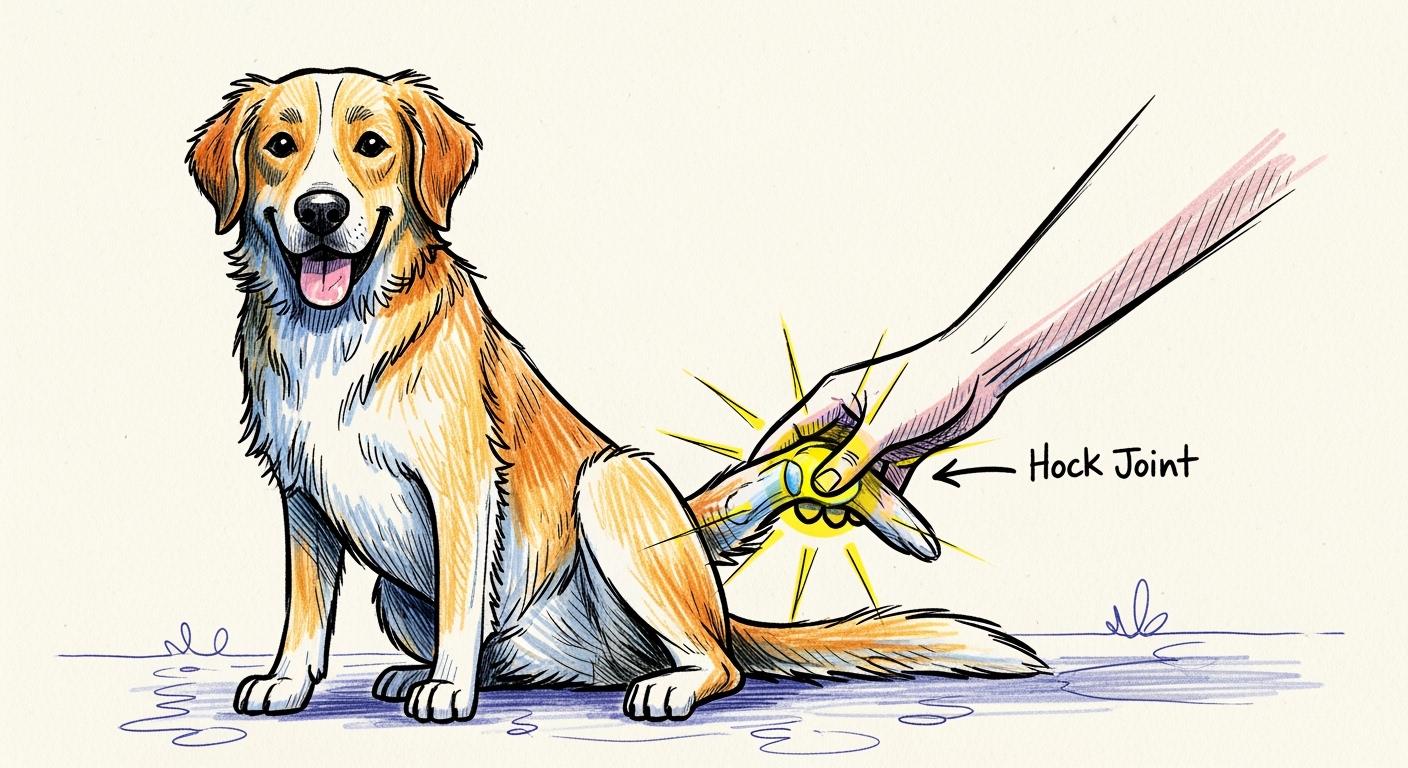
The hind leg angles sharply just above the paw. That bend is the hock — also called the tarsus — and it works like a highly loaded hinge. Knowing its shape matters because an angle this pronounced creates a very specific problem for any support product meant to wrap it: the joint's natural pivot axis is a narrow target, and a brace hinge that misses it does not simply provide less support. It redirects force in a direction the joint was never designed to take.
Hock Joint Structure — What the Angle Means for Brace Function
Where the Hock Sits and Why Its Shape Creates a Design Constraint
The hock sits below the knee (stifle) and above the paw on the hind leg. It forms a distinct backward angle where the tibia and fibula meet the tarsal bones — the talus, calcaneus, and several smaller bones packed into a tight capsule. Ligaments crisscross the joint on all sides. Cartilage cushions the bone ends.
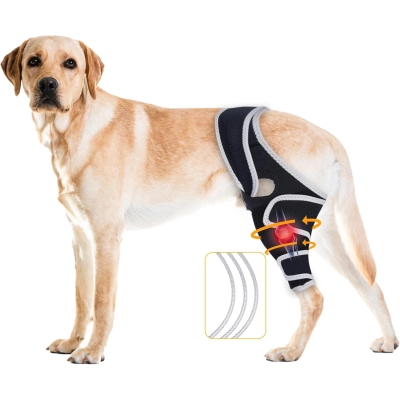
From a design standpoint, the defining feature is not the number of bones. It is the pivot axis. The hock rotates around a single lateral-to-medial line that passes through the talus. Every stride hinges on that line. A hock brace that places its hinge anywhere else creates a mismatch: the brace pivots around one point, the joint pivots around another, and the dog's leg becomes the battleground where those two arcs fight each other.
The causal chain is straightforward. When the hinge aligns with the anatomical axis, compressive force travels along the tibia through the talus into the paw — a straight load path through bone. When the hinge sits half an inch high or low, the brace lever arm generates a bending moment at the joint line. Soft tissue around the hock tenses to resist that moment. After a few minutes of walking, the muscles fatigue, the brace shifts, and the hinge-to-joint gap widens further. Support degrades with every step rather than holding constant.
Note: Run your thumb along the outside of the hock while the dog stands. Find the bony knob on the outer ankle — the lateral malleolus. That is the landmark a hinge should center on. Walk the dog for 15 minutes with the brace, then check. If the hinge has drifted forward or back from that point, the brace axis and joint axis are fighting each other.
Dual-Hinge Versus Single-Hinge — Why It Matters at the Hock
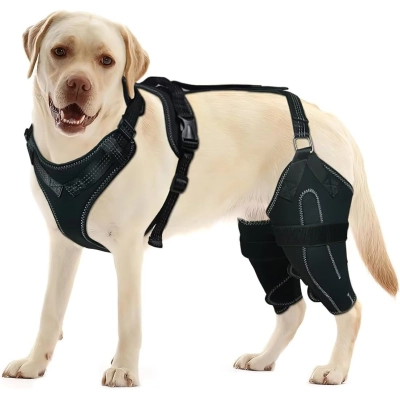
The hock does not move in a single plane. It rotates slightly during stance and swings through a compound arc as the dog pushes off. A brace built with a medial-lateral hinge pair — one hinge on each side of the joint — lets each side pivot independently while both share the same anatomical center. A single posterior hinge sits behind the joint and resists that natural rotation. The dog compensates by altering stride length or hip drop, which shifts load to the other hind leg.
This is not about more features being better. A dual-hinge design simply matches the joint's actual movement pattern. A single hinge fights it. In breeds with especially straight hock angulation — Greyhounds, for instance — the rotation component is small enough that a single hinge may track adequately. In breeds with deeper angulation like German Shepherds, the rotation component is larger, and a dual hinge becomes functionally necessary for consistent alignment through a full gait cycle.
Strap Configuration Across an Angled Joint
Why Strap Path Determines Pressure Distribution
The hock is not a cylinder. It tapers from the calf down to the paw, and its cross-section changes shape as the joint flexes. A strap that runs straight across the joint's apex presses hardest at the first point of contact — the bony prominence — and makes looser contact everywhere else. Force concentrates into a narrow band. The skin under that band gets the full load. Skin an inch away gets almost none.
Straps routed to cross above and below the joint rather than directly over the apex create a broader contact patch. This spreads the same total retention force across more square inches of skin. The per-unit pressure drops. The brace stays in position without needing to be cinched tighter — and tighter strapping is the variable that most reliably turns a brace from a support tool into a skin problem.
The difference between a brace and a wrap at the hock often comes down to this strap-path decision. A wrap provides uniform compression. A brace provides targeted motion control. But if the brace's strap layout creates its own pressure concentrations, the product loses the distinction — it becomes an expensive, uncomfortable wrap.
In practice: After 20 minutes of brace wear, unbuckle and check the skin. A single deep red crease that mirrors one strap edge means force concentrated there. Faint diffuse marks across a wider band mean the strap configuration distributed the load. The dog's skin reports the strap design more honestly than any specification sheet.
Attachment Points and Material Behavior Under Load
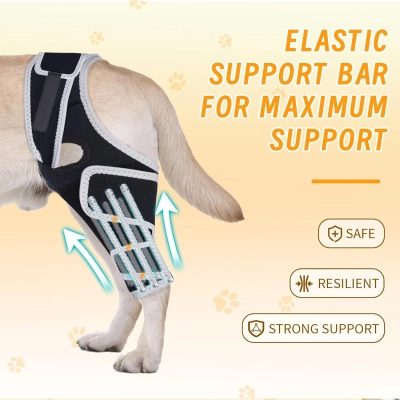
Where a strap anchors changes what it does. Straps sewn directly to rigid hinge plates transmit tension straight to the joint line — every pound of strap pull becomes a pound of force acting on the hinge axis. This is what you want when the goal is limiting flexion range after a ligament injury. The brace and the joint move as one unit because the load path is direct.
Straps anchored to flexible neoprene panels behave differently. The neoprene deforms under tension before the force reaches the joint. Some of the strap's pull gets absorbed as material stretch rather than transmitted to bone. This produces milder stabilization — useful when the goal is proprioceptive feedback that reminds the dog not to overextend, rather than hard motion blocking. A well-designed brace chooses one anchor strategy or the other depending on what the joint needs, rather than mixing both and getting half of each.
When Hock Support Design Makes the Difference
The hock's shape makes alignment-sensitive bracing more important in some dogs than others. Short-coated breeds with visible hock contours — Dobermans, Boxers, Weimaraners — give clearer fit feedback because skin rub marks appear quickly and unambiguously. You can see whether the strap path is working. Double-coated breeds with dense undercoat — Huskies, Malamutes, Golden Retrievers — mask those signals. The coat buffers the skin, so by the time rub marks are visible, irritation may already be advanced.
Dogs whose hock angulation falls near breed standard benefit most from off-the-shelf hinged bracing. The joint's pivot axis is predictable and repeatable across fitting sessions. Dogs with angular limb deformities, very deep chests that rotate the hind leg stance, or very straight hocks outside breed norms fall into a narrower margin. A brace patterned for a standard hock angle may not track their joint through a full stride, even if the size chart says the measurements match.
Arthritis support for the hock follows the same alignment logic. A brace that drifts off-axis on an arthritic joint adds friction to surfaces already compromised by cartilage loss. The hinge must stay centered or the brace becomes part of the problem it is meant to reduce.
Disclaimer: This fit-check approach assumes a dog with hock conformation near breed standard. Dogs with angular limb deformities, very deep or narrow chests that alter hind-leg stance angle, or dense double coats that obscure skin signals may need hand-checking under the brace during wear rather than visual inspection after removal. If the brace hinge drifts more than half an inch from the lateral malleolus within 10 strides, the brace is not tracking that dog's joint axis and continued use may create pressure points the coat hides.
Design Details That Shape Daily Wear
The hock's position near the ground means the brace takes environmental contact that a knee brace does not. Wet grass, dirt, and floor surfaces rub against it constantly. The first design choice that matters is the outer shell material. Neoprene sheds water and resists abrasion from ground contact when the dog lies down. But it traps heat. A solid neoprene shell worn for more than 30 minutes of active movement produces moisture accumulation under the brace — the skin softens, friction increases, and the brace begins to slip.
Perforated neoprene panels over the joint body, with solid neoprene retained only at strap anchor points, address this. The trade is a modest reduction in structural rigidity for meaningful heat dissipation. In most use conditions — daily walks, indoor mobility, supervised yard time — the rigidity loss is irrelevant because the joint is not undergoing forces that would challenge either version. The heat dissipation gain, however, is relevant every time the brace is worn for more than 20 minutes.
Liner construction matters specifically at the hock because the skin over the bony prominences is thin. A brushed nylon liner with flat-seam stitching puts less texture against those points than a standard loop-facing hook-compatible liner. The difference shows up not in the first 10 minutes but at hour three or four of continuous wear — when the dog has cycled through lying down, standing, and shifting positions dozens of times, each transition dragging the liner across the same bony landmarks.
Cleaning access is the detail that determines whether a brace stays functional week to week. Hock braces collect dirt at the lowest point of the leg. A brace with removable, machine-washable liner panels gets cleaned. A brace with fixed liners accumulates grime that stiffens the fabric over days, changes the friction coefficient against the skin, and gradually alters how tension distributes. The brace effectively becomes a different product after two weeks of unwashed use — tighter where grit has stiffened the fabric, looser where repeated flexing has stretched the unstiffened sections.
FAQ
Does every dog with hock issues need a brace?
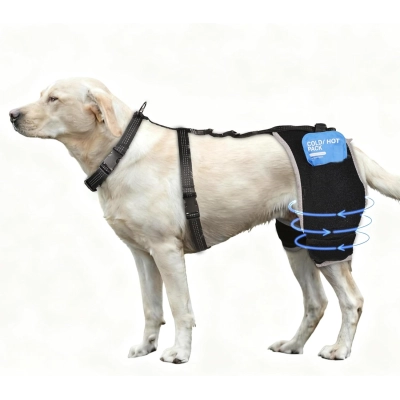
No. A brace addresses instability — where the hock moves through a range the surrounding soft tissue cannot control. If the issue is purely arthritic stiffness without laxity, a wrap providing compression and warmth may serve the need better, with fewer fit variables to manage.
How tight should a hock brace be?
Tight enough that the hinge stays centered on the lateral malleolus through 20 walking strides. Tightness is a proxy variable. Hinge tracking is the real one. If the brace stays aligned while strapped loosely, cranking it tighter will not improve function and will increase skin pressure for no gain.
Can a hock brace prevent injury in a healthy dog?
A brace limits range of motion. On a healthy joint, limiting range means limiting function — the dog sacrifices full stride extension and push-off power. Braces are designed for joints that need motion control, not for joints that already control motion normally. The product is mismatched to the use case.
Why does the hock angle matter more than the dog's weight for brace fit?
Weight affects the magnitude of force through the joint. But the joint's angle determines the direction of force — and direction is what the brace hinge must match. A lightweight dog with an atypical hock angle presents a harder alignment problem than a heavy dog with a standard angle, because the brace's pivot axis and the joint's pivot axis intersect rather than overlap.

0 Comments