
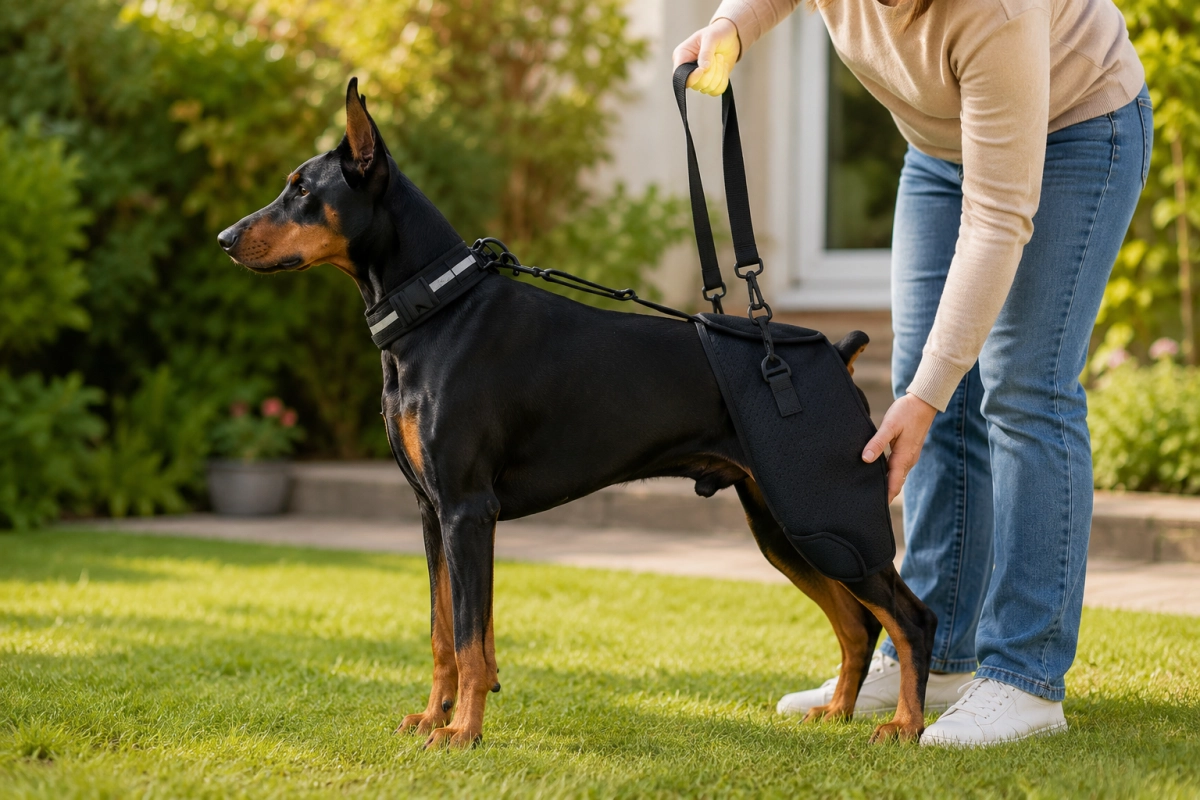
A soft hip brace does one job well: it holds the hip joint in better alignment while a dog moves under its own power. It does not lift body weight. That distinction decides whether you bring home the right hip support for dogs or a product that cannot do the job.
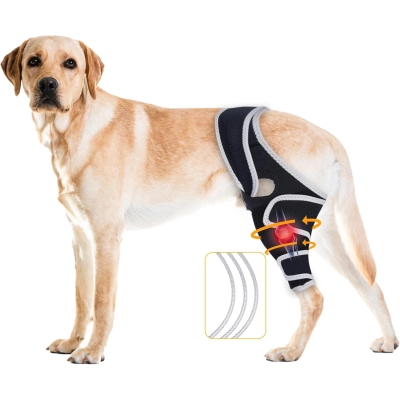
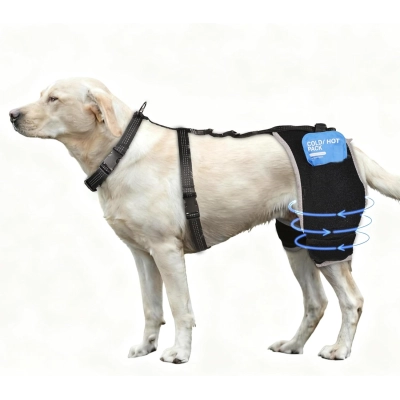
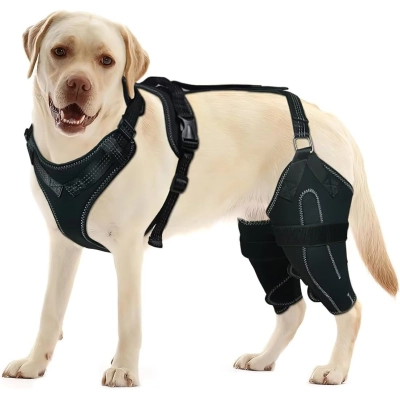
The parts tell the story. A compression dog hip brace wraps the upper hind legs in flexible neoprene panels and ties them to a chest anchor and pelvic wrap. Compression reduces fluid pooling and nudges the leg toward a neutral track. Not one of those parts generates upward force. The brace leans on muscle the dog still has — and folds the moment that muscle is gone.
What a Soft Hip Brace Does and Does Not Do
Joint Stabilization Is Not Lifting
Compression panels, a chest anchor, and pelvic straps stabilize. Stabilization means the joint stays in a working position while the dog moves. It is not the same as lift, and the difference is structural.
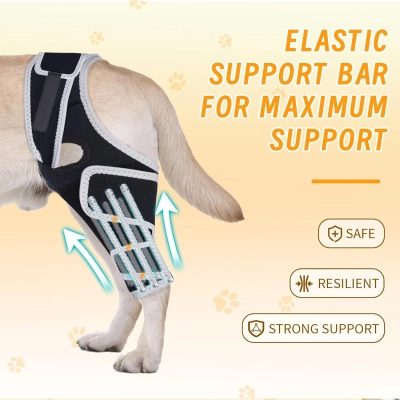
A soft brace has no top handles and no rigid frame. Every part of it flexes. Flex lets the wrap follow the leg — exactly what you want when the dog generates its own movement. Flex also means the brace cannot push back against the ground hard enough to hold a body up. A dog that cannot stand has nothing to push against.
Why Soft Support Depends on Active Muscle
Here is the causal chain that decides whether the brace works. Compression steadies a joint only while the muscles around the hip are firing. Muscle contraction keeps the leg column rigid; the brace's flexible panels reduce the slack those muscles have to fight. Remove the contraction and the flexible material has no rigid core to brace against, so it folds as the dog goes down. No amount of strap-tightening fixes that. It adds pressure without adding support.
If the dog stands and walks on its own and only needs help keeping the hip stable, a soft brace matches that need. If the dog cannot bear weight at all, the brace is the wrong mechanism — not a weaker version of the right one.
Struggling to Stand Is Not the Same as Cannot Stand
The two conditions look similar at a glance and call for completely different gear. Watch what happens in the seconds after the dog rises. That observation tells you which mechanism fits.
| Functional Level | What You Observe | Matching Mechanism |
|---|---|---|
| Rises with a small boost, then walks alone | Dog bears its own weight after a quick assist | Soft brace — stabilizes the joint during self-generated movement |
| Stands only while you support the hindquarters | Legs stay under the dog only because you hold part of the load | Lifting harness — top handles and multi-point straps share the weight |
| Collapses the moment weight lands | Back legs give way instantly | Wheelchair — rigid frame and pelvic cradle carry the load |
A quick pass signal: after rising, does the dog hold its own weight for a full minute without your hands? A yes puts a brace in the conversation. A no points you toward a lift or frame solution. Sudden rear-leg weakness can have a neurologic cause, so confirm it with a veterinarian before choosing any support gear.
Where a Soft Brace Ends and a Harness or Wheelchair Begins
What a Lifting Harness Adds
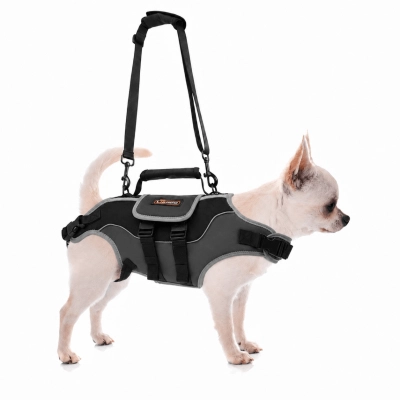
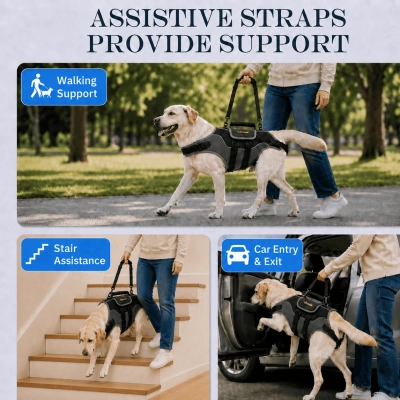
A dog lifting harness solves the problem a brace structurally cannot. Top handles sit above the spine, and straps wrap the hind legs and chest as separate load points. Lift through the handles and the dog's weight moves off the hip joint and into your arms. That is mechanical weight redistribution — a job the brace has no parts to perform.
The tradeoff is worth naming. A harness takes load but does not stabilize a joint on its own; the legs still need to track straight. Harnesses and braces solve adjacent problems rather than competing.
When a Wheelchair Becomes the Right Mechanism
Total rear-leg function loss changes the requirement again. A dog wheelchair uses a rigid frame and a pelvic cradle to hold the dog's weight without asking the hind legs to contribute. Once the legs have lost functional strength, this is the option that restores independent movement. A harness stays useful as a bridge for short transfers while you work with a veterinarian on whether strength will return.
Relying on a soft brace for a dog that cannot stand does not just fail; it can speed muscle loss. Every collapse through the wrap teaches the body to do less. Matching the mechanism to the dog's actual function — not the label on the product — is what protects the muscle that remains.
Disclaimer: these checks assume a dog with typical hind-limb conformation for its breed. Angular limb deformities, very deep chests, or double coats can hide pressure points, so hand-check strap placement and skin condition instead of relying on visual inspection alone.
Fit Checks That Decide Real-World Performance
A brace only stabilizes when it stays put, and it only stays put when the measurements match the limb. Owners new to hip bracing often trust the size label and skip the numbers. Three measurements decide most of the result.
| Required Measurement | How to Measure / Fit Purpose |
|---|---|
| Skin-Level Chest Girth | Behind the front legs around the widest part of the ribcage; sets where the chest anchor sits. |
| Waist Circumference | Around the belly panel location above the hips; sets how the pelvic wrap lands. |
| Body Length | Along the spine from the front harness base to the tail base; sets slack between anchor and wrap. |
Get these wrong and two things happen: fabric bunches where it should lie flat, and straps drift under movement. A brace shifted half an inch off the joint is no longer stabilizing the joint. It is compressing the wrong tissue.
Two Checks Before You Trust a Fit
Verify a fit in about a minute, no tools needed. First, slide two fingers flat under each strap after the brace is on. It should be snug enough not to rotate, loose enough that the fingers pass without forcing. Second, walk the dog for five minutes and look at where the brace sits. Has the top edge drifted more than half an inch from where you set it? Drift means the anchor or limb measurement is off, and the stabilization is now uneven.
Press through a double coat when measuring. Record skin-level dimensions, not fur-level, or the brace runs large and shifts.
FAQ
Can a soft hip brace help my dog get up from lying down?
A soft brace stabilizes the hip during movement, but the dog still needs enough strength to rise on its own. If rising is the hard part, a manual lifting harness fills that gap better.
What should I do if my dog cannot bear weight on its hind legs?
Schedule a veterinary evaluation first. Sudden rear-leg weakness has causes a brace cannot address, and the right gear depends on that diagnosis. A support harness or wheelchair usually fits this level better than a soft wrap.
When does a dog need a wheelchair instead of a brace?
When the hind legs have lost functional strength. A brace cannot hold up a dog that cannot stand, so a wheelchair's frame and pelvic cradle become the mechanism that restores movement.

0 Comments