
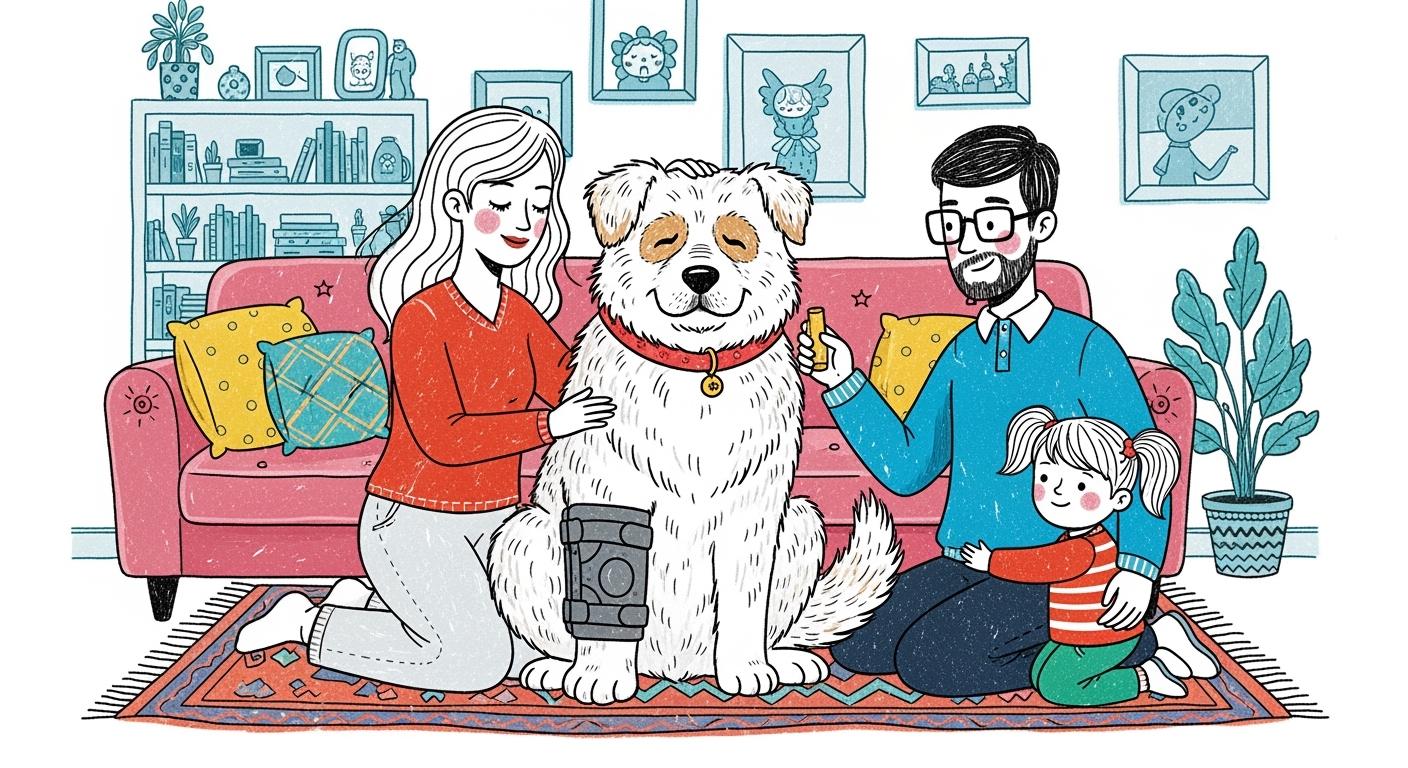
A knee brace on a 90-pound dog faces forces that a brace on a 15-pound dog never sees. That single fact changes which design details matter. On a small dog, a poorly aligned brace might still kind of work because the loads are low enough to forgive the mismatch. On a large breed, the same design flaw means the brace rotates within minutes, rubs skin raw, and ends up in a drawer.
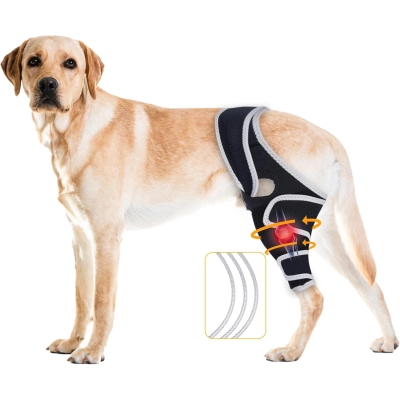
Two design decisions separate a CCL brace that holds position under load from one that does not: where the hinge sits relative to the joint, and how the straps spread force across the leg. Everything else — material, padding, adjustability — matters only after those two get solved.
Hinge Alignment: Why a Few Millimeters Decide Whether the Brace Works
A stifle joint does not move like a door hinge. As the knee flexes, the instantaneous center of rotation shifts — the femur rolls and slides across the tibial plateau. A brace hinge that pivots on a single fixed point cannot replicate this motion perfectly. But it can get close. And close matters.
When the hinge axis sits within a few millimeters of the joint's functional axis, the brace transfers the dog's ground reaction force straight through the mechanical column of the leg. The joint surfaces stay evenly loaded. The brace does not fight the dog's natural motion, so it stays in place without needing to be cranked tight. That is the physics that matters: aligned force vectors mean the brace becomes part of the limb's load path rather than a foreign object strapped to it.
When the hinge is off — even by half an inch — the mismatch creates a moment arm. Every step applies torque that tries to rotate the brace around the leg. The straps fight this torque. They lose. The brace migrates distally, the hinge presses into the tibial crest, and within a few minutes of walking the whole setup has shifted enough that the joint is no longer framed by the support structure. The dog compensates by altering its gait, which loads the intact medial meniscus and the opposite leg.
This is not about "better engineering" in the abstract. It is about whether the knee brace hinge center lands on the joint's mechanical axis often enough to matter during a 20-minute walk. A hinge that aligns on the bench but drifts under dynamic loading is a hinge that was not designed for large-breed forces. The observable test is straightforward: put the brace on, walk the dog on level ground for ten minutes, then check whether the hinge pivot has migrated relative to the bony landmark you lined it up with at the start. More than a quarter-inch of drift means the alignment is not holding.
Hinge design also sets the flexion-extension envelope. Some braces use locking hinges that limit range to protect a healing ligament. Others use free-moving hinges for post-rehab maintenance. The distinction matters less than whether the hinge stays where it belongs. A locking hinge that has drifted below the joint line locks the wrong angle. A free hinge that has rotated is guiding motion around the wrong center. Both produce the same outcome: the brace stops being a brace.
Strap Width and the Force-Distribution Problem
Force equals pressure times area. That equation runs the show when a CCL brace sits on a large dog's leg. A narrow strap concentrates the entire retention force onto a band of skin maybe an inch wide. Under a heavy dog's weight, that band sees pressure high enough to collapse capillaries — which is why narrow-strap braces leave red stripes that take hours to fade. A wide strap, or better yet a multi-strap cradle that wraps the thigh and calf across several inches of contact surface, cuts the same force into a fraction of the pressure. Skin survives. The brace stays on because the dog stops trying to rub it off.
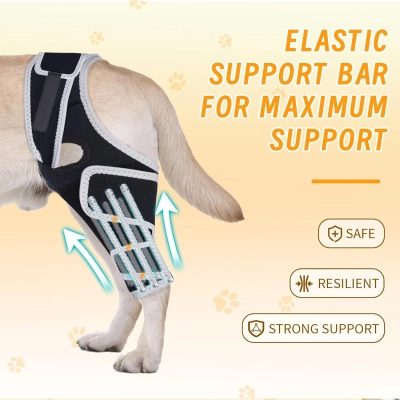
Strap count and anchor geometry matter just as much. A single strap above and below the knee creates a two-point fixation that pivots freely around the axis connecting those two points. The brace can rotate. Add a third anchor — a thigh wrap that engages the quadriceps contour, or a lower strap that locks onto the calcaneal tendon groove — and you break that rotation axis. Three non-collinear anchor points define a plane. The brace cannot rotate without stretching at least one strap, and if the straps are chosen with low-stretch materials, it cannot rotate meaningfully at all.
The pass/fail check for strap configuration is simpler than most fitting guides suggest. Walk the dog for ten minutes at a normal pace on pavement. Then run your finger along the edge of each strap. If any strap edge has moved more than half an inch from its starting position, the anchor system is not distributing force evenly — one strap is taking more load than the others and creeping. If all straps hold their lines, the multi-point system is doing its job.
Strap material also shapes the outcome. Elastic straps feel forgiving during fitting but store and return energy during walking — they let the brace oscillate relative to the leg with each stride. Low-stretch woven nylon or TPU-coated webbing locks the brace position. The tradeoff is that a low-stretch strap system demands more precision in initial adjustment. Get it right once, and it stays right. Get it wrong, and the error persists until corrected. That is the design tension: forgiveness versus positional stability. For a large dog where forces are high, stability tends to be the more useful side of that trade.
When a CCL Brace Makes Sense — and When It Does Not
A CCL brace is a mechanical support device, not a ligament replacement. It redistributes load around an injured but partially intact cranial cruciate ligament. That means it works within a specific window of injury severity.
Partial tears with some remaining ligament fibers. Mild to moderate instability where the tibial thrust is present but not dramatic. Post-surgical protection where the repair needs external reinforcement during the first months of rehab. Degenerative CCL disease in older dogs where surgery carries unacceptable risk relative to the dog's activity expectations. These are the scenarios where a well-designed brace changes the daily reality for the dog.
A complete rupture with gross instability — the tibia translating forward freely on every step — is a different problem. No external brace can replicate the structural role of an intact CCL under those conditions. The forces simply bypass the brace through the joint. A stifle support device designed for patellar tracking issues will not stabilize a CCL-deficient knee any more than a CCL brace will fix a luxating patella — different joint problems, different force vectors, different design requirements. Meniscal tears create their own mechanical complications that a brace cannot address because the damage is inside the joint capsule where external support cannot reach.
Open wounds, active skin infections, or documented material allergies make any brace unsafe regardless of the ligament status. A brace that traps bacteria against broken skin turns a mechanical problem into a septic one.
Disclaimer: The fit observations described here assume a dog with standard leg conformation — straight limb axis, proportional thigh-to-calf ratios, no angular deformity. Large breeds with substantial deviation from breed-typical conformation, particularly dogs with genu varum or valgum, may distribute brace pressure in ways these checks cannot predict. In those cases, pressure mapping during a supervised fitting session is the only reliable way to verify that no single point is taking excessive load.
Material and Adjustment Details That Shape Daily Use
Once the hinge is aligned and the strap system holds, the materials determine whether the dog tolerates the brace for hours at a time. Two material properties dominate: breathability and liner compression set.
Neoprene is the default brace body material for good reason. It conforms to irregular surfaces, provides uniform compression, and resists tearing. But closed-cell neoprene traps heat. On a large dog with a thick coat, the skin under a neoprene panel can become damp within twenty minutes. That moisture softens the stratum corneum, lowers the skin's mechanical threshold for friction damage, and creates the conditions for hot spots. Open-cell or perforated neoprene panels, or liners with a moisture-wicking face fabric bonded to the foam, change this equation. The observable check: after twenty minutes of indoor wear, lift the proximal edge of the brace and press a finger against the skin underneath. Dry and cool means the liner is managing moisture. Damp and warm means it is not — and extended wear in that condition will produce skin breakdown.
Liner compression set is less visible but equally consequential. Foam liners compress under sustained pressure and do not fully recover. A liner that starts at 5mm thick and compresses to 2mm after two weeks of daily wear has lost its ability to fill the gap between the brace shell and the leg contour. The brace becomes looser. The owner tightens the straps to compensate. That increases point pressure. The cycle accelerates. A liner material with low compression set — typically higher-density closed-cell foams or silicone gel pads in load-bearing zones — maintains the original fit geometry longer, which means fewer adjustment cycles and less user-introduced error.
Adjustment hardware matters too. Hook-and-loop straps are the standard, but not all hook-and-loop is the same. Industrial-grade fasteners hold shear strength under repeated cycles; consumer-grade fasteners lose grip after weeks of daily unfastening and refastening. On a large, active dog, a strap that lets go mid-stride turns the brace into a hazard. The fitting process for a CCL brace should confirm not just the initial strap tension but also that the fastener holds under dynamic loading — tug the strap laterally once set and verify it does not peel.
FAQ
How long can a large dog wear a CCL brace continuously?
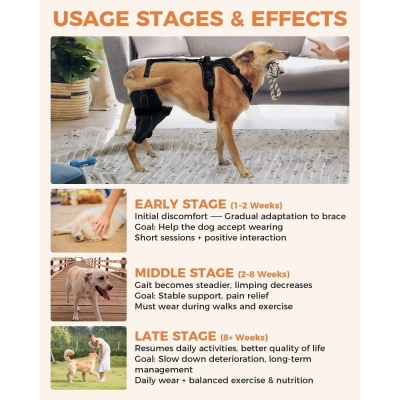
Most dogs acclimate to full-day wear over roughly two weeks, starting with 30-minute sessions. Continuous wear beyond seven hours is generally not recommended — not because the brace fails, but because skin needs unloaded time to recover from sustained contact pressure, even with well-distributed straps. Remove the brace at night.
What is the first sign that a brace is not fitting correctly?
Brace rotation is the earliest and most reliable signal. If the hinge pivot has visibly shifted relative to the joint within the first five minutes of walking, the strap system is not holding position. Skin redness without rotation usually means a strap is too tight; rotation without redness means the anchor geometry is wrong. Rotation plus redness means both problems exist and need separate corrections.
Can a CCL brace be used on both legs at the same time?
Yes, but bilateral bracing changes the dog's gait mechanics more than a single brace does. Each brace must be fitted and assessed independently — the fit on the left leg has no bearing on the fit on the right. Double braces also add weight and may alter proprioceptive feedback. Start with the more affected leg, let the dog adapt, then introduce the second brace in a separate fitting session.
Does a CCL brace prevent the other knee from getting injured?
No. A high percentage of dogs that tear one CCL go on to tear the contralateral side — this reflects underlying conformational and degenerative factors, not a failure of bracing. A brace on the injured leg cannot change the load distribution or ligament health on the uninjured leg. What it can do is support more symmetrical weight-bearing during recovery, which may reduce the compensatory overload that accelerates contralateral degeneration. The distinction matters: support, not prevention.
0 Comments