
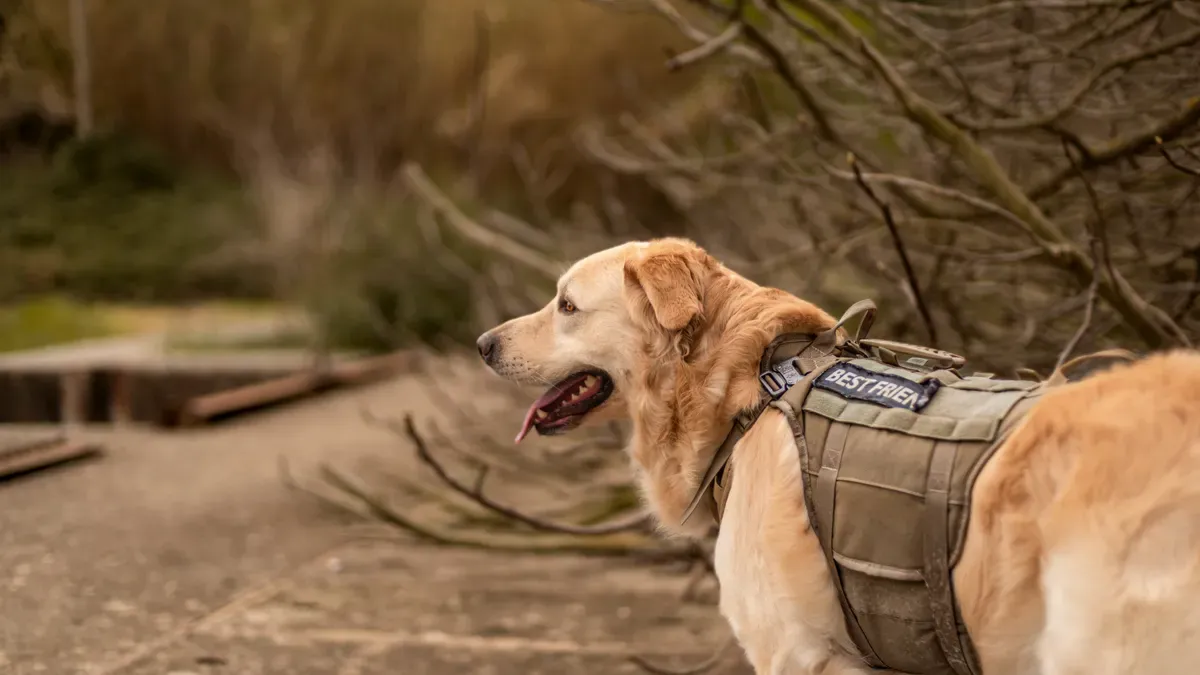
A dog drops onto a tile floor. The elbow hits first — a small point of bone taking the weight of the body behind it. Repeat that a hundred times a day, every day, and the skin over the olecranon thickens into a callus. Sometimes a fluid-filled pocket forms underneath. A sleeve can interrupt that cycle. But not all sleeves interrupt it the same way.
What separates a sleeve that actually protects the elbow from one that just covers it comes down to two design choices: where the padding sits and whether the straps keep it there. Get both right, and the sleeve cushions the point of impact. Get either wrong, and it becomes fabric sliding up and down the leg. Canine elbow braces work through a simple mechanical principle — but the execution of that principle is where the real differences live.
Note: If your dog's elbow discomfort persists, worsens, or comes with swelling that does not respond to rest, stop using the sleeve and consult your veterinarian.
How the Pad Targets the Olecranon — and Why That Matters
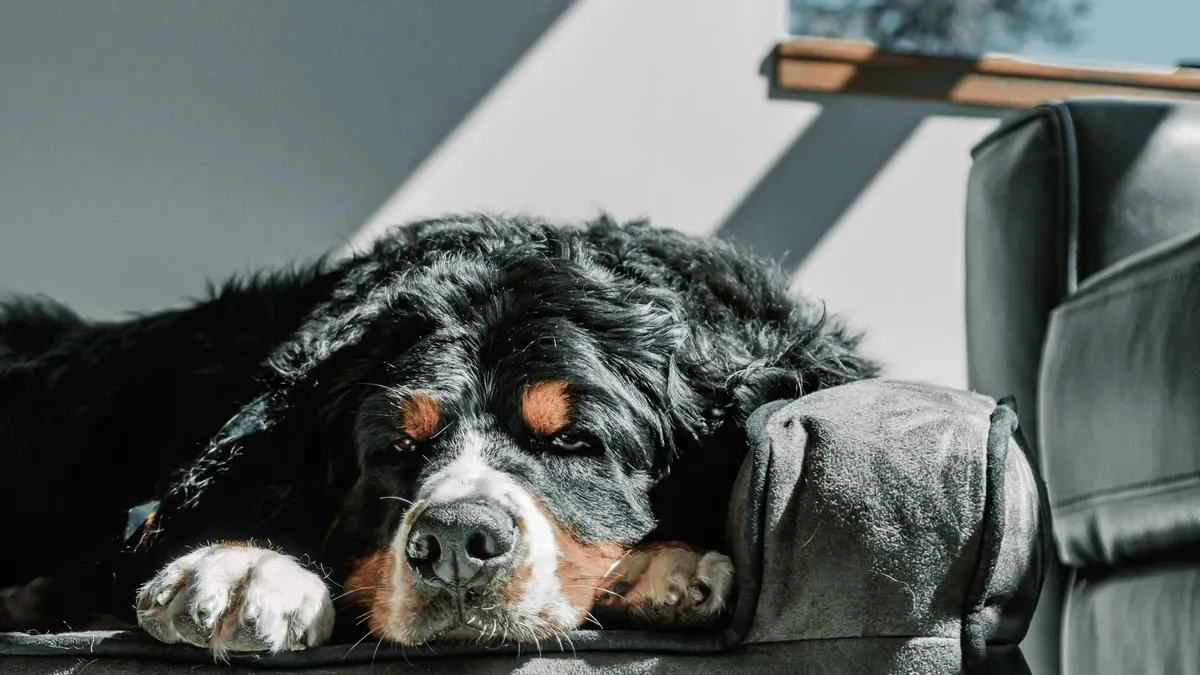
The olecranon is the bony point of the elbow. It is where nearly all the impact concentrates when a dog lies down. No fat pad. No muscle belly. Just bone under a thin layer of skin, pressing into whatever surface is underneath.
A well-designed elbow sleeve puts its thickest padding directly over that point. This is not a comfort feature. It is a force-distribution mechanism. When the pad sits centered over the olecranon, the dog's body weight spreads across the full surface area of the padding instead of focusing on a single point of bone. Peak pressure drops. The skin and the bursa underneath take less of a beating each time the dog settles onto a hard floor.
That chain — pad centered over bone → force spread across pad surface → lower peak pressure at any single point → reduced mechanical stress on skin and bursa — is what determines whether a sleeve cushions or just decorates. Shift the pad half an inch off-center, and the olecranon punches through the thin edge of the padding straight into the floor. The sleeve is still on the leg. It is doing nothing useful.
Some sleeves add a donut-shaped insert — a ring of padding with a hollow center — positioned directly over the olecranon. This creates a pressure-free zone. The bony point sits in the hollow while the surrounding ring bears the load, which is useful for existing hygromas that need relief from direct contact. Without the donut, even thick padding still transmits some pressure through the material to the fluid pocket underneath.
In practice: After 20 minutes of the dog resting on a hard floor, slide a finger under the pad and feel the skin over the olecranon. Warm is normal. Damp with sweat means the material is not breathing enough. If the pad has shifted and the bony point is no longer centered under the thickest section, the sleeve is not doing its job regardless of how tight the straps are.
The material itself matters here. Breathable four-way stretch fabric — the kind used in well-constructed dog elbow support braces — allows moisture to evaporate rather than trapping it against the skin. Occluded skin softens and breaks down faster. A sleeve that does not breathe turns a pressure-protection device into a skin-maceration device within hours. Fleece-faced variations add surface softness but trade away some moisture-wicking speed. Neither is universally better. The tradeoff depends on whether the dog runs hot or tends to lie still for long stretches.
Strap Design and the Problem of Sleeve Migration
Padding that stays put needs straps that stay put. The two problems are connected.
When a dog stands up from a down position, the elbow flexes. The leg changes shape. If the straps cannot accommodate that shape change without slipping, the sleeve migrates — usually downward, away from the joint. The next time the dog lies down, the pad is no longer where it needs to be.
Strap width is the first variable that determines migration resistance. A narrow strap concentrates tension into a thin band of pressure around the leg. Under load — say, the dog pushes off to stand — that band acts like a ring being squeezed off a tapered cylinder. It slides. A wider strap distributes the same tension across more skin surface area. Lower peak pressure per square inch means less tendency for the strap to dig in and then slip as the leg muscles flex and relax. The wider strap also reduces the risk of circulation restriction during extended wear.
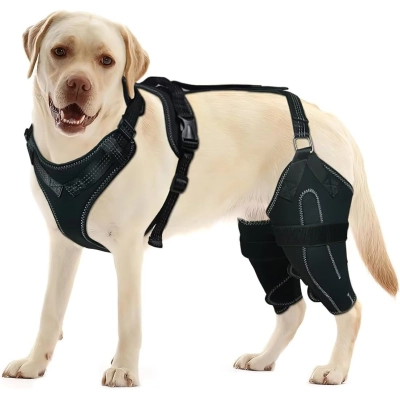
Strap placement matters just as much as width. A single strap positioned above the elbow joint can act as a pivot point — the sleeve rotates around it when the leg moves. Two straps, one above and one below the elbow, create a mechanical couple that resists rotation. The sleeve is anchored at both ends of the joint, so flexion at the elbow does not translate into rotation of the sleeve.
Tip: After a ten-minute walk — not just standing, but actual movement — check whether either strap has drifted more than half an inch from its starting position. If the upper strap has crept toward the elbow or the lower strap has dropped toward the paw, the sleeve is migrating. The padding will follow.
For dogs that spend time on rougher ground or move between different surfaces throughout the day, activity-level considerations affect strap choice. A dog that sprints across a yard then crashes onto a deck puts different demands on strap hold than a senior dog that shifts between bed and carpet. The same sleeve design may perform well in one scenario and poorly in the other — not because the sleeve is bad, but because the use case stresses different parts of the design.
Where Elbow Sleeves Work — and Where They Do Not
A sleeve is a soft cushion. That is its design category. It has no rigid frame, no mechanical hinge, no structural reinforcement. Understanding what this means in practice is more useful than reading a list of conditions it "treats."
Elbow sleeves perform best under these conditions:
- The problem is mechanical pressure — calluses from hard floors, early-stage hygromas, or skin irritation from repeated contact with rough surfaces.
- The joint itself is structurally sound. No instability. No grinding. No diagnosed ligament damage.
- The dog tolerates something on the leg and the owner can check the skin daily.
- Mild stiffness that responds to warmth — the sleeve's insulation keeps the joint warm, which can ease that first-step stiffness after rest.
They do not perform well under these conditions:
- Diagnosed elbow dysplasia — the sleeve cannot change bone shape or joint congruence.
- Torn or partially torn ligaments — a soft sleeve provides no structural restraint against abnormal joint motion.
- Moderate to severe arthritis with visible joint thickening — at this stage, the mechanical demands exceed what fabric and padding can address. A structured dog elbow brace with rigid support elements may be more appropriate for these cases.
- Open wounds or active infections under the sleeve — occlusion traps bacteria and moisture.
This is not about the sleeve being "good" or "bad." It is about the design category matching the mechanical problem. A cushion solves a pressure problem. It does not solve a stability problem. Confusing the two is how dogs end up in the wrong product and owners conclude that sleeves do not work.
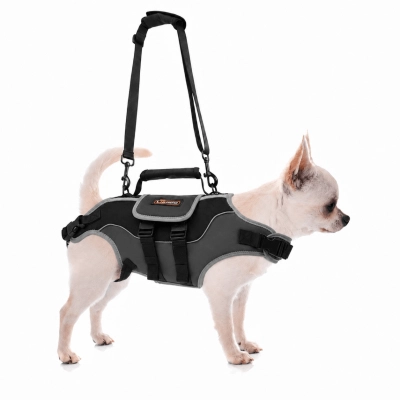
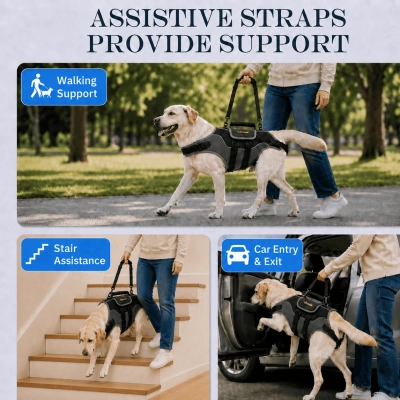
For dogs with broader mobility challenges that extend beyond elbow cushioning, different support systems address different mechanical needs. A dog with elbow calluses and hind-end weakness may need both a sleeve and a separate mobility aid — the sleeve does not become ineffective because another problem exists elsewhere. Each device solves its own mechanical challenge.
Disclaimer: The fit and pressure checks described here assume a short-coated dog where the skin is visible and the pad position can be verified by sight or touch. Double-coated breeds may show subtler rub marks that need hand-checking rather than visual inspection — run your fingers along the skin under the pad edge after removal, feeling for warmth concentrations or texture changes rather than relying on visible redness. If the dog's leg conformation falls outside the breed norms this sleeve pattern was designed for — particularly dogs with angular limb deformities or very deep chests that change elbow loading angle — the standard pad placement may not align correctly with the olecranon.
| Condition | Sleeve Helps | Main Limitation |
|---|---|---|
| Calluses from hard floors | Yes — padding absorbs contact pressure | Does not reverse existing thickened skin |
| Small, early hygroma | Yes — donut insert relieves direct pressure | Large or infected hygromas need veterinary drainage |
| Mild stiffness after rest | Yes — retained warmth eases movement | Does not address underlying joint degeneration |
| Elbow dysplasia | No | Sleeve cannot alter bone structure or joint fit |
| Ligament tear or instability | No | Soft sleeve provides zero structural restraint |
When elbow discomfort is tied to arthritis rather than pressure alone, arthritis-specific support products offer design features — such as multi-point strap systems and reinforced joint cradles — that a simple sleeve does not include. The design category shifts from cushioning to stabilization. Recognizing that shift is the difference between a product that helps and one that frustrates.
For dogs with front-leg weakness or stiffness that extends beyond the elbow into the shoulder, front-leg bracing that addresses the full limb chain may close gaps that an elbow-only sleeve leaves open. A sleeve protects one point on the leg. A brace stabilizes the segment. The boundary between them is defined by how much mechanical control the joint actually needs.
Daily Use: What Keeps a Sleeve Performing
A sleeve is a textile product in contact with a living animal. It gets dirty. It stretches. Skin underneath changes day to day. The design can be sound and the fit can be right on day one — and both can degrade quietly if nobody is checking.
Cleaning is not about hygiene in the abstract. Dried sweat and skin oils stiffen fabric fibers over time, which reduces stretch and changes how the sleeve conforms to the leg. A sleeve that moved with the joint on Monday may resist that movement by Friday simply because the material has stiffened. Hand-washing with mild detergent and warm water — then air-drying completely before reuse — preserves the fiber elasticity that the fit depends on. Machine drying with heat accelerates fiber breakdown. So does leaving the sleeve bunched up and damp between uses.
Regular inspection routines catch fit degradation before it causes problems. The same principles that apply to structured braces — checking strap integrity, verifying pad positioning, monitoring skin condition — apply to sleeves, even though sleeves have fewer components to fail. Simplicity does not mean the checks are optional.
The sleeve should come off every few hours for a skin check. Redness that fades within ten minutes of removal is usually just pressure marking — the same thing that happens under a snug sock. Redness that persists, or any broken skin, or swelling in the paw below the sleeve, means the fit needs adjustment or the wear schedule needs shortening. These are mechanical feedback signals, not reasons to abandon the product.
Getting the fit right from the start determines how much of this daily management is routine versus struggle. Accurate leg measurement — circumference above and below the elbow, plus the distance between those two points — is the difference between a sleeve that the dog forgets it is wearing and one it tries to remove. A sleeve that fits properly centers its pad over the olecranon and its straps lie flat without bunching, with enough tension to hold position through a full stand-lie-stand cycle but not so much that the fabric puckers at the strap edges.
Across the range of support products for dogs, the products that last longest and cause the fewest problems share one trait: the owner treats fit as something to verify, not something to set and forget. Sleeves are the simplest product in that range. They still follow the same rule.
A sleeve is a simple product. Two pieces of fabric, some padding, a couple of straps. The simplicity is not a weakness. It means fewer things can go wrong — but it also means that when something does go wrong, the margin for error is small. A pad that shifts a quarter inch. A strap that loosens one notch. These are small failures with outsized consequences. Catching them early is what makes the difference between a sleeve that protects the elbow for months and one that ends up in a drawer.
FAQ
How do you know if your dog would benefit from an elbow sleeve?
Look for callus formation on the elbow point, especially if the dog habitually rests on hard floors. A small, soft fluid pocket (early hygroma) or mild stiffness that eases after the dog moves around also suggests a sleeve may help. The sleeve addresses mechanical pressure — if the problem is pressure-driven, the sleeve is a relevant tool. If the elbow is painful to touch, hot, or the dog limps, the problem is likely beyond what cushioning alone can address.
Can a dog wear an elbow sleeve all day?
Most dogs tolerate a sleeve for several hours at a time, but continuous 24-hour wear is not recommended. The skin needs periodic exposure to air, and the fit needs regular verification. A practical schedule is on during active hours and rest periods on hard surfaces, off at night and during supervised rest on soft bedding. Remove the sleeve every three to four hours, check the skin, and give at least thirty minutes of uncovered time before reapplying.
How do you clean a canine elbow sleeve without damaging it?
Hand-wash in warm water with a mild detergent. Soak for five minutes, gently work the fabric to release dirt, rinse until the water runs clear, and air-dry completely. Avoid machine washing — the agitation degrades strap elasticity and can shift internal padding layers out of position. Avoid heat drying, which breaks down the elastic fibers that the sleeve's fit depends on. A sleeve that has lost its stretch will not hold the pad where it belongs, regardless of how tight the straps are pulled.
Will an elbow sleeve prevent elbow dysplasia?
No. Elbow dysplasia is a developmental condition determined by bone growth and joint congruence — it is not caused by or prevented by external padding. A sleeve may cushion the joint and reduce mechanical stress on the skin and bursa, which can help a dog with existing mild dysplasia feel more comfortable on hard surfaces. But it does not change the underlying joint structure, slow the progression of the condition, or replace veterinary management of a diagnosed case.
0 Comments