
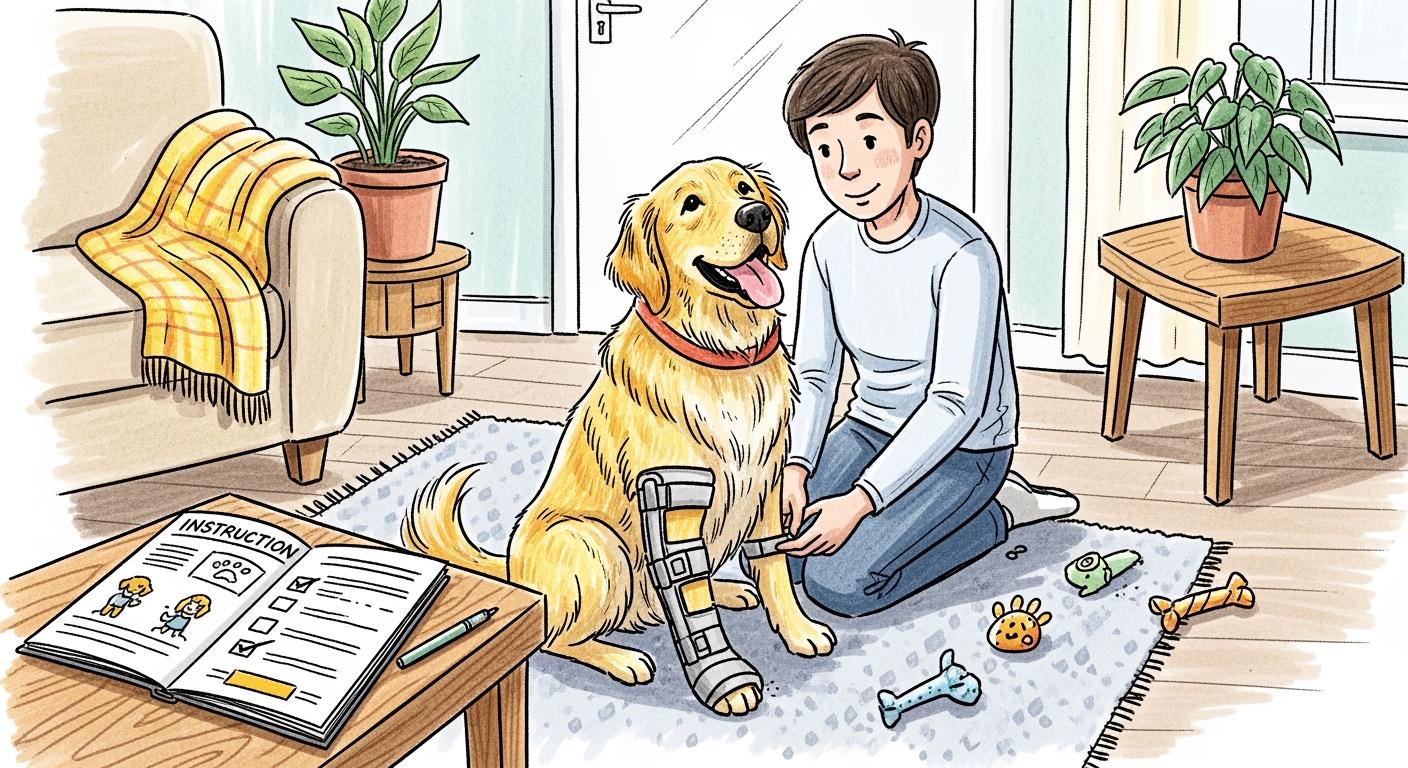
A dog brace either works with the joint it sits over, or it fights it. The difference shows up in how the hinge lines up, not in how tight the straps are pulled. Two braces can look nearly identical on a product page and perform completely differently on a dog that walks, turns, and lies down. That gap comes down to design decisions most owners never think to check.
This article walks through the design details that separate a brace that supports from one that is just a wrap. It covers what to look for, why those details matter at the physical level, and how to tell whether a brace is doing its job after it goes on.
What Makes a Dog Brace Work — Hinge Alignment Matters More Than Tightness
Most people judge a brace by how snug it feels. That instinct is backwards. A brace can be cinched tight and still fail at the one thing it is supposed to do: stabilize a joint without fighting the dog's natural movement.
The hinge is the deciding piece. A dog brace works by placing a mechanical pivot next to a biological one. When the hinge sits centered over the joint axis, force travels along the bone's natural load line. The joint surfaces stay evenly loaded. The surrounding soft tissue does not get yanked at an odd angle with every step. The brace becomes part of the limb's movement pattern instead of an obstacle to it.
When the hinge sits even a half-inch off, that chain breaks. The pivot point no longer matches the joint's rotation center. Every step creates a lever arm between the brace hinge and the actual joint. The brace pulls the leg slightly out of its natural track. The dog compensates by altering its gait, which shifts load to other joints. The brace that was supposed to help now creates a new movement problem while partially addressing the old one.
This is why hinge position matters more than how firmly the brace grips the leg. A loose brace with a perfectly aligned hinge does more for joint stability than a tight one with the hinge in the wrong place.
| Design Feature | Performance Difference | Why It Matters |
|---|---|---|
| Hinge aligned with joint axis | Force travels along natural load line; joint surfaces loaded evenly | Dog maintains near-normal gait; brace resists migration because it moves with the limb |
| Hinge offset from joint axis | Lever arm created between pivot and joint; compensatory gait changes | Strap slippage increases; dog shifts weight to other legs; brace becomes a movement disruptor |
| Fixed hinge (non-adjustable) | One pivot position for all dogs within a size range | Works only for dogs whose joint geometry happens to match the factory placement |
| Adjustable hinge stop | Range of motion can be limited to protect healing tissue | Useful for post-surgical or partial-tear scenarios where hyperextension is the main risk |
Checking Alignment in Daily Use
You do not need a measurement tool. Walk the dog for 15 minutes with the brace on. Stop and look at the hinge relative to the joint. Has it drifted up or down? Forward or back? If the hinge no longer sits where the joint bends, the brace is fighting the dog's mechanics. It will keep migrating no matter how often you reposition it because the underlying alignment is wrong.
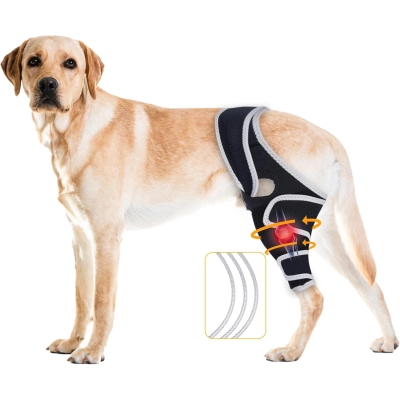
This same check applies to knee braces for dogs. The stifle joint has a complex rolling-and-sliding motion. A hinge that only swings open and closed — without accounting for that translation — will drift during activity. The best designs place the hinge at the anatomic center of rotation and allow enough strap flexibility to accommodate the joint's natural translation during a stride. Braces built for ACL injuries depend on this alignment more than any other factor: a misaligned hinge on a partially torn CCL creates shear across the injury site with every step.
The differences between knee brace designs often trace back to how precisely the hinge can be positioned and whether it stays there over hours of wear.
Strap Configuration — How Force Distribution Changes Support Quality
A strap is not just a fastener. It is a force path. Every strap transfers load between the brace frame and the dog's leg. How that load is spread — across a wide band or a narrow line, through one anchor point or three — determines whether the brace stabilizes or just squeezes.
Wide straps distribute force over more square inches of skin and muscle. Lower pressure per square inch means less tissue compression, less circulation interruption, and less sensory irritation. The dog tolerates the brace longer. Narrow straps concentrate the same load into a thin band. The skin under that band gets compressed harder. The dog fidgets. The brace shifts. The owner tightens it more, which makes the pressure worse. That is the cycle a well-designed strap system breaks.
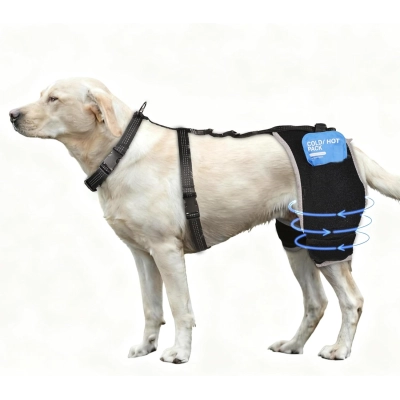
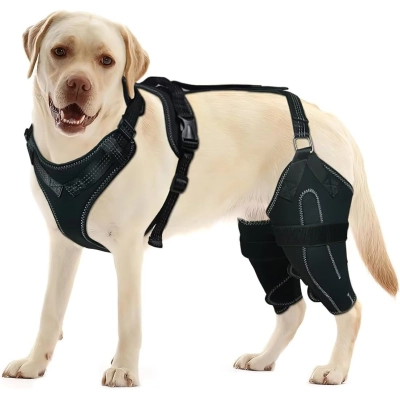
Multi-point strap systems add a second layer. Instead of one cinch point above and below the joint, a three-strap configuration creates a triangular force pattern. The brace resists rotation around the limb. It stays oriented the same way through standing, walking, and lying down. A rear leg brace with a well-distributed strap layout does not need to be overtightened to stay in place — the geometry of the strap paths handles that.
| Strap Design | Performance Difference | Main Limitation | Pass Signal |
|---|---|---|---|
| Wide (1.5+ inch) padded straps | Force spread over larger area; lower tissue compression; less migration from discomfort | Can trap heat in hot weather; may bunch behind the knee on very short-legged breeds | After 10 min of walking, strap edges leave no sharp indentations in the fur or skin |
| Narrow unpadded straps | Concentrated pressure line; higher risk of rubbing and circulatory discomfort | Dog tolerates shorter wear sessions; brace shifts as dog tries to relieve pressure points | Red marks or fur creasing visible at strap lines after removal |
| Three-point triangular layout | Resists rotation; brace stays oriented through gait cycle; less need for tightness | More steps to put on correctly; incorrect strap order changes the fit geometry | Strap positions relative to each other unchanged after a 20-min walk |
The Observable Check
Mark one strap edge with a piece of tape on the fur before a walk. After 10 minutes, check whether that mark has moved more than half an inch. If it has, the strap system is not distributing force evenly — something is pulling unevenly and causing the brace to drift. This is not a tightness problem. It is a strap-path geometry problem. Tightening it further will not fix it and may create skin issues.
The same principle applies across joint types. Hip braces that use a broad pelvic band paired with thigh cuffs spread load across the largest possible surface area. A narrow single-band design concentrates the same support force into a much smaller contact patch. The difference shows up in how long the dog can wear it before showing signs of irritation.
Material Choices — Skin Tolerance, Breathability, and All-Day Wear
The material a brace is made from determines whether the dog can wear it for 30 minutes or 8 hours. It is a physics equation: body heat plus trapped moisture plus friction equals skin breakdown. Materials that pull moisture away from the skin and allow airflow slow that equation down.
Neoprene provides consistent compression and warmth, but it traps moisture. After 20 to 30 minutes of activity, the skin under neoprene becomes damp. For a dog that needs a brace during short walks, that is acceptable. For a dog that needs support throughout the day, neoprene alone creates a skin environment that breaks down over hours. Open-cell foam laminated with a moisture-wicking liner handles this better — it breathes through the foam structure while maintaining compression. The tradeoff is less warmth, which matters for dogs using the brace partly for arthritis-related heat retention.
| Material Strategy | Performance Difference | Where It Works Best | Observable Pass Signal |
|---|---|---|---|
| Neoprene with perforations | Moderate breathability; retains therapeutic warmth; durable through machine washing | Short wear sessions (under 2 hours); cold-weather use; dogs needing compression warmth | Lift liner after 20 min — skin feels warm but not tacky or wet |
| Open-cell foam + wicking liner | High breathability; moisture moves away from skin; less heat buildup | All-day wear; hot climates; dogs with sensitive or thin skin | Liner feels dry to the touch after a 30-min walk; no steam or condensation when brace is removed |
| Mesh outer + padded inner | Maximum airflow; lowest heat retention; lighter overall weight | Active dogs in warm weather; mild support needs where compression is secondary | Dog's skin temperature under brace matches uncovered leg within 5 min of removal |
Padding Depth and Seam Placement
Padding depth is not about softness. It is about gap-filling. A dog's leg is not a cylinder — it tapers, it has bony prominences, it changes shape as muscles contract. Padding bridges the gaps between the flat brace shell and the curved leg. Too little padding, and the shell edges create pressure points at the ankle bones and knee. Too much padding, and the brace compresses unevenly as the padding bottoms out under load, creating the same pressure points it was meant to prevent.
Seam placement matters just as much. A seam running directly over a bony prominence — the lateral malleolus of the hock, the tibial crest below the knee — rubs with every flexion cycle. A flat-seam construction or offset seam placement keeps friction off those high points. Braces designed for arthritis support often prioritize this because arthritic dogs tend to have less muscle mass padding those bony landmarks, making seam friction more consequential.
Wrist braces face a particularly tight version of this problem — the carpal joint has little soft tissue covering it, so padding depth and seam placement directly determine whether the dog tolerates the brace or chews at it.
Cleaning and Material Longevity
Materials that hold moisture also hold bacteria. A brace worn daily collects fur, skin oils, and outdoor debris. Regular cleaning preserves the material properties that make breathability work. A liner clogged with dried sweat and dirt stops wicking moisture — it traps it against the skin instead. Velcro clogged with fur loses holding strength, which changes the effective strap tension even if the owner tightens to the same visual position.
Inspecting brace edges and seams after each use catches material breakdown before it causes skin damage. A frayed edge that was smooth last week will abrade skin this week. A stitch that has pulled slightly loose changes how the shell sits against the padding underneath it.
Soft, Hinged, and Semi-Rigid — Where Each Material Strategy Fits
The three broad construction types are not "good, better, best." Each solves a different design problem:
Soft Braces
Soft braces use flexible materials — typically neoprene or elastic knit — to provide compression and mild proprioceptive feedback. They do not mechanically limit joint range. They work by giving the dog sensory input that encourages guarded movement and by retaining warmth that keeps stiff joints looser during activity. The design limitation is structural: they cannot resist forces that exceed the fabric's tensile strength. For a dog with significant joint instability, a soft brace provides sensation, not stabilization.
- Best for mild arthritis stiffness and minor sprain support during low-intensity activity.
- Limitation: offers no mechanical resistance to joint hyperextension or collapse.
Hinged Braces
Hinged braces add a mechanical pivot — typically aluminum or reinforced polymer — that controls the joint's range of motion. The hinge can be set to limit extension, flexion, or both. This is the only brace type that provides active mechanical stabilization against forces that would overextend or collapse the joint. The design challenge is alignment precision: the hinge must match the individual dog's joint axis, not just the average for the breed and size.
- Best for partial ligament tears, post-surgical protected weight-bearing, and moderate instability where the joint needs both support and controlled motion.
- Limitation: a misaligned hinge creates shear forces at the injury site; fit precision determines effectiveness.
Semi-Rigid Braces
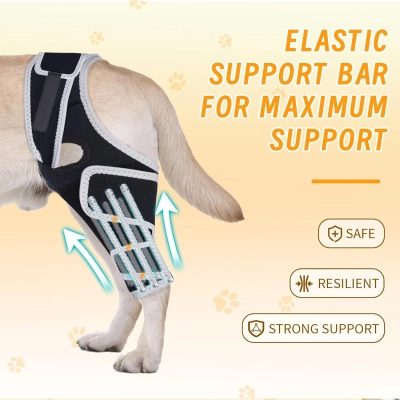
Semi-rigid braces combine a padded sleeve with flexible stays or panels that provide shape but not rigid locking. They sit between soft and hinged: more structural resistance than neoprene alone, less motion control than a hinge. The stays help the brace hold its shape against the leg, which improves strap effectiveness by giving the straps a stable anchor surface.
- Best for moderate arthritis, general joint weakness, and dogs that need more structure than a soft brace but do not require a hinge's motion-limiting precision.
- Limitation: stays can bend or fatigue with heavy use; the brace loses structural integrity gradually rather than failing visibly.
| Type | What It Provides | Main Limitation | Where It Fits |
|---|---|---|---|
| Soft | Compression, warmth, proprioceptive feedback | No mechanical stabilization against joint collapse | Mild stiffness, minor sprains, cold-weather support |
| Hinged | Mechanical range-of-motion control, active stabilization | Alignment precision critical; misalignment creates shear | Partial tears, post-surgery, moderate-to-severe instability |
| Semi-Rigid | Structural shape retention, moderate resistance | Stays fatigue over time; gradual support loss | Moderate arthritis, general weakness, daily wear |
Where a Brace Helps and Where It Reaches Its Limit
A brace is a mechanical support tool. It works by controlling joint position and motion — nothing more. Understanding that boundary is what separates effective use from frustration.
A well-designed brace tends to help most when:
- The joint has partial structural integrity remaining — a partial ligament tear where some fibers still connect, not a complete rupture where the joint surfaces separate freely.
- The dog's leg conformation falls within the range the brace was patterned for. Breed extremes — very straight stifles in some lines, very deep chests that change hindlimb angles — can shift the effective hinge position enough to reduce support quality.
- The primary problem is mechanical instability, not neurological. A brace cannot restore proprioception or correct a dog that knuckles because it cannot feel where its foot is.
- The brace can be worn consistently during weight-bearing activity. A brace that sits in a drawer during walks provides no support during the movements that need it.
A brace tends to reach its design limits when:
- The joint is fully unstable — a complete cruciate rupture with drawer motion, or a dislocating patella that does not stay reduced. In these cases, the brace may reduce symptom severity but cannot restore mechanical integrity that is completely absent.
- The dog's leg shape falls outside typical breed norms — angular limb deformities, very deep or very shallow chests that alter joint loading angles. Fit checks for back leg braces depend on the brace pattern matching the dog's actual geometry, not just its labeled size.
- Skin integrity is already compromised — open wounds, active infections, or severe dermatitis under the brace area. A brace worn over damaged skin accelerates the damage.
- The dog cannot tolerate any external device due to temperament or sensory sensitivity. No design feature overcomes a dog that panics when something wraps around its leg.
Disclaimer: This check assumes a short-coated dog where visual inspection catches rub marks and pressure points. Double-coated breeds may show subtler signs — the fur can mask early skin irritation. For these dogs, hand-check the skin by running fingers under the brace edges after removal rather than relying on visual inspection alone. If the dog's leg conformation falls outside the breed norms this brace was patterned for — particularly dogs with angular limb deformities or very deep chests — the fit checks described here may not catch every pressure point.
Choosing a brace that matches the dog's specific joint problem means matching the brace's mechanical design limits to the condition's demands. Accurate measurements matter because the hinge-to-joint relationship depends on where the brace sits on the limb — a measurement error of half an inch changes the hinge position enough to reduce support effectiveness.
Other Support Tools for Different Needs
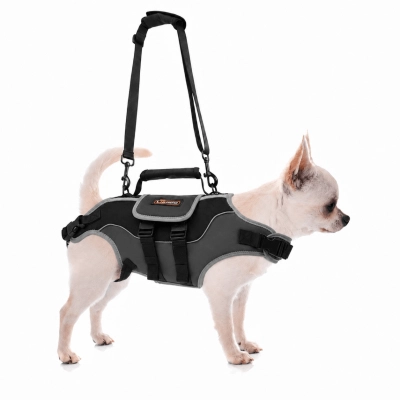
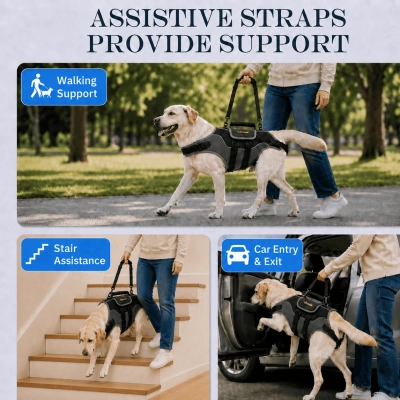
When a brace is not the right tool, other support categories fill different gaps. Lift harnesses address weight-bearing assistance rather than joint stabilization — they help a dog stand and walk when leg strength is the limiting factor, not joint integrity. Wheelchairs offload weight entirely from affected limbs. Each tool solves a different mechanical problem, and confusing those categories leads to using the wrong one.
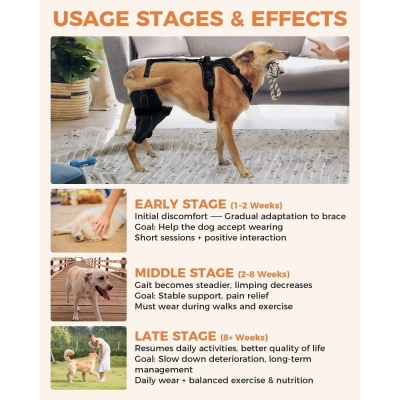
For dogs that resist any device at first, short acclimation sessions paired with calm rewards — treats given while the brace is on but not yet tightened — can shift the association from restraint to routine. The goal is not to bribe the dog into compliance. It is to let the dog learn that the brace does not prevent movement before asking it to move in the brace.
What owners typically observe over weeks of consistent brace use is gradual, not dramatic — more weight on the affected leg, less hesitation on stairs, longer walks before fatigue. The brace does not heal tissue. It changes the mechanical environment the tissue lives in, and tissue adapts to that environment over time.
FAQ
How long should a dog wear a brace each day?
Start with 20 to 30 minutes and extend gradually as the dog's skin tolerance allows. The limiting factor is usually the skin under the brace, not the joint. Most dogs build up to wearing a brace during all active hours within one to two weeks. Remove it during rest and overnight — the joint does not need stabilization when the dog is not loading it.
Can a dog run or play hard while wearing a brace?
Controlled activity on predictable surfaces — leash walks, gentle play on grass — works within most brace designs. Sudden directional changes, jumping, and rough play with other dogs can exceed what the hinge and straps are designed to manage. The brace stabilizes the joint against normal gait forces. It is not a crash structure for impact loads.
How do I know if the brace fits correctly?
The hinge should stay centered over the joint after 15 minutes of walking. Straps should not leave sharp indentations in the fur or skin. The brace should not rotate around the leg during normal movement. If any of these fail, the fit — not the tightness — needs adjustment.
Will a dog need a brace permanently?
It depends on what is driving the instability. Some dogs use a brace during a healing window — a partial ligament tear that scars and tightens over 8 to 12 weeks — and then phase it out. Dogs with chronic degenerative conditions like advanced arthritis may wear a brace indefinitely during activity. The condition's trajectory, not the brace, determines the timeline.
What if the dog chews or fights the brace?
Chewing at the brace during wear is usually a fit or material problem — a pressure point, a rubbing edge, or trapped heat. Check the skin under the area the dog targets. If the skin is clean and the dog still resists, shorten sessions and build tolerance gradually. A dog that panics at the sight of the brace may need a different support approach entirely.
0 Comments