
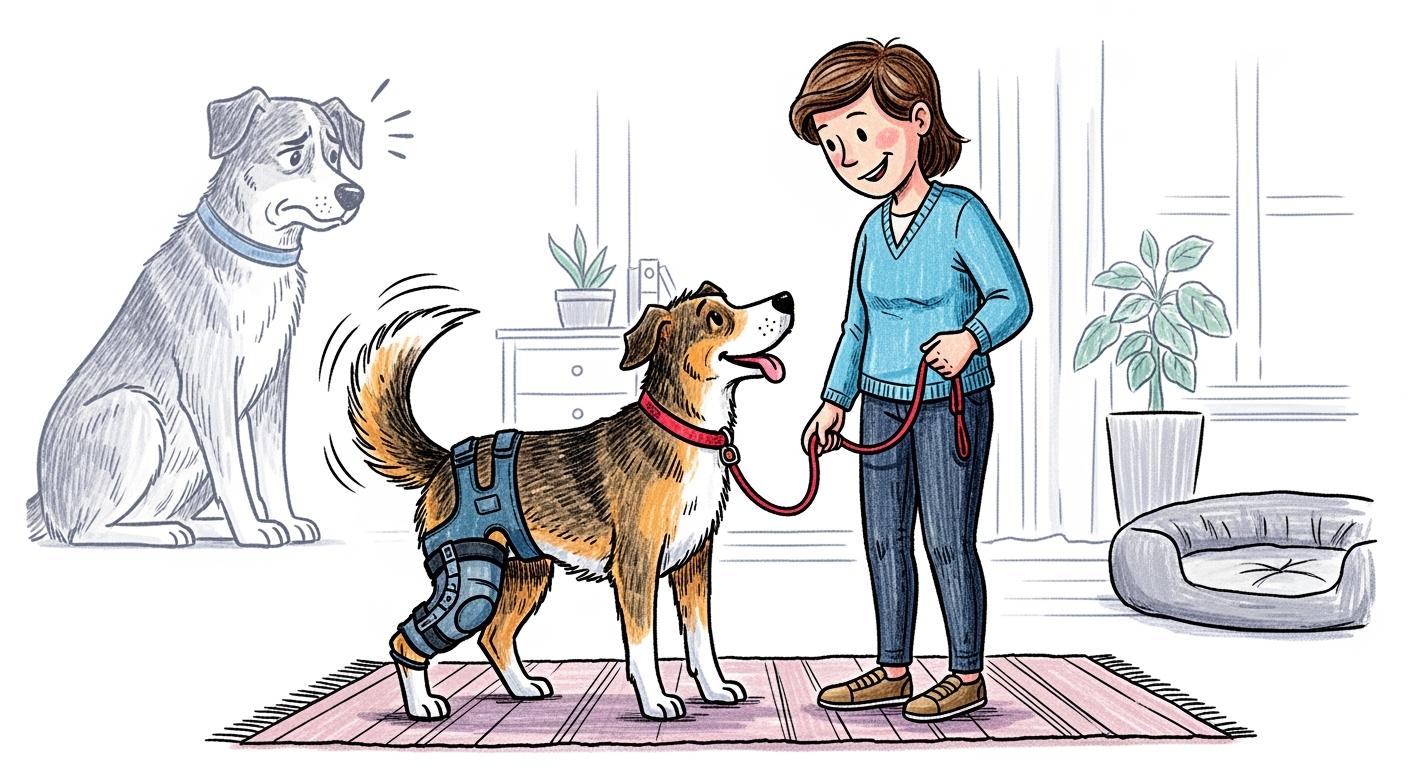
A knee brace does not stabilize an arthritic joint by squeezing it. It stabilizes by controlling the path the joint takes during movement. And the design detail that determines whether that control is real or cosmetic is not strap tightness. It is hinge placement.
Why Hinge Alignment Matters More Than Strap Tightness
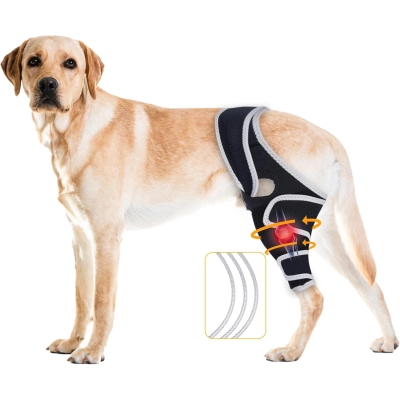
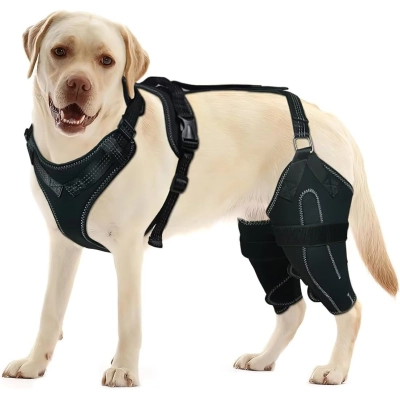
The stifle joint in a dog's hind leg is a hinge joint. It bends and straightens along a single axis. A dog knee brace with bilateral hinges aims to mirror that axis. When the hinge pivot sits directly over the joint's center of rotation, force travels in a straight line through the mechanical axis of the leg. The joint surfaces stay evenly loaded. The dog moves with a natural stride. The brace stays in place because it is working with the joint, not fighting it.
When the hinge sits even half an inch forward or back of the joint line, the mechanics break. The hinge pulls the leg into a slightly different arc than the joint wants to follow. This creates shear at the interface between brace and leg. The brace slides. The owner tightens the straps. The tighter straps create pressure points. The dog resists wearing the brace. The whole cycle feeds itself.
This is why a brace that looks secure on a standing dog can fail within minutes of walking. The hinge is not aligned. No amount of strap tension fixes a geometry problem.
Observable check: after 10 minutes of walking, mark the brace position against the dog's leg with a piece of tape at the top edge. Walk another 10 minutes. If the brace has shifted more than half an inch relative to the tape mark, the hinge alignment—not the strap tension—is the likely culprit. Tightening the straps further will not solve it.
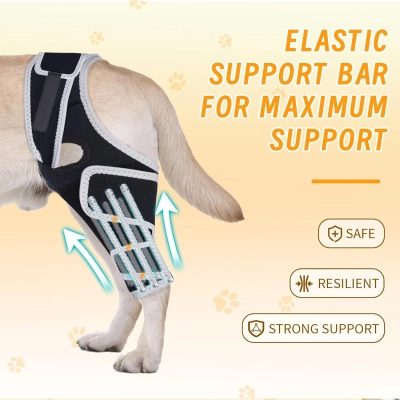
Braces designed with this problem in mind separate hinge positioning from strap tension. The hinge is set first, by palpating the joint line and locking the pivot at that point. Only then are the straps secured. This two-step fitting sequence is not a convenience feature. It is the structural difference between a brace that stabilizes and a leg wrap that squeezes. The protective mechanism of an arthritis brace hinges on getting this alignment right before anything else.
Strap Force Distribution: What Actually Keeps a Brace in Place
A strap that runs straight around the leg concentrates force into a narrow band. All the pressure lands in one line. On a dog's leg, that line becomes a hot spot. Skin reddens. The brace shifts because the contact patch is too small to resist the leg's movement forces.
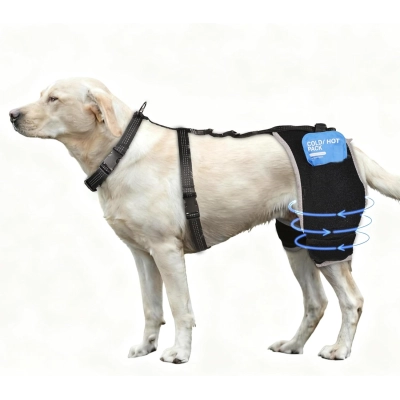
Wider strap systems change the physics. A 2-inch strap distributes the same tension over roughly twice the surface area of a 1-inch strap, halving the pressure at any single point. Multi-strap configurations—typically a three-point or four-point layout with straps above and below the joint—create a triangulated force envelope. The brace grips the leg not by squeezing harder but by spreading the holding force across a larger, more stable contact area. This same principle applies to dog ACL and CCL braces, where controlling tibial thrust demands even more precise force distribution.
The material behind the strap matters just as much. A firm outer shell transfers tension efficiently. But the inner liner determines whether that tension reaches the skin as distributed pressure or as focused friction. Neoprene liners with a brushed inner face create enough surface grip to hold position without requiring the straps to be cinched tight. The liner does part of the work, so the straps do less.
This matters for arthritic dogs in a specific way. Many older dogs have lost muscle mass in the affected leg. A brace that relies entirely on strap compression to stay put is fighting a tapered limb—it wants to slide toward the narrower end. A brace that uses liner friction and wide force distribution can hold position on a leg with reduced muscle bulk.
Observable check: after removing the brace, examine the pattern of indentations on the dog's leg. A single deep groove from one narrow strap signals concentrated pressure. Faint, even marks spread across a wider area signal distributed force. The second pattern is what you want to see.
The interplay between hinge alignment and strap configuration is where most of the real-world performance difference between braces lives. A well-aligned hinge reduces the forces the straps need to resist. Well-designed straps reduce the precision demanded of the hinge. When both are right, the brace disappears into the dog's movement. When either is wrong, the owner ends up in a cycle of tightening, loosening, and repositioning without ever reaching a stable fit.
When a Knee Brace Helps—and When It Does Not
A knee brace for arthritis works best under specific conditions. Recognizing those conditions is not about lowering expectations. It is about matching the tool to the job.
Where a brace tends to help most: arthritic dogs with mild to moderate stifle instability, where the joint can still bear weight but wobbles or collapses under load. Dogs that limp after rest but warm into a better gait. Dogs where the goal is extending comfortable walking time rather than returning to high-impact activity. In these scenarios, arthritis support braces provide external constraint that limits side-to-side play and prevents hyperextension through the gait cycle. For a dog whose arthritis has created laxity in the joint capsule, this can be the difference between a 10-minute walk and a 30-minute walk.
Where a brace is less likely to help: dogs with end-stage arthritis where the joint space has essentially collapsed and bone contacts bone. In these cases, the pain originates from the joint surfaces themselves, not from instability. No amount of external bracing changes what is happening inside the joint.
Dogs with angular limb deformities that make the leg shape significantly different from the pattern a stock brace was built around. A brace designed for a straight-legged breed will not align correctly on a dog with a bowed leg conformation—the hinge axis will be off regardless of adjustment.
Dogs that cannot tolerate anything on their leg due to skin conditions, nerve sensitivity, or behavioral resistance that does not resolve with gradual introduction. A brace requires physical contact. There is no design workaround for that.
Disclaimer: The fit checks described here assume a dog with typical straight-legged conformation and a short to medium coat. Double-coated breeds may show subtler rub marks under the brace that need hand-checking rather than visual inspection. If the dog's leg shape falls outside the breed norms this brace was patterned for—particularly dogs with angular limb deformities or very deep chests that alter standing angles—the fit checks described may not catch every pressure point. In those cases, a custom-molded brace built from a cast of the dog's leg is the more reliable path.
Design Details That Change Daily Use
Beyond hinge alignment and strap configuration, several smaller design choices determine whether a brace gets used or ends up in a drawer.
Liner material and moisture. A dog's leg inside a brace generates heat and sweat. If the liner traps moisture against the skin, the skin macerates. The dog gets irritated. The brace comes off. Liners made from open-cell foams with a moisture-wicking face fabric let sweat evaporate rather than pool. This is not a comfort luxury—it determines whether the brace can be worn for hours at a time or only minutes.
Strap hardware that holds its setting. Hook-and-loop straps that get peeled open and re-closed multiple times a day lose hook engagement over weeks. A strap that drifts loose during a walk undoes the hinge alignment set at the start. Higher-cycle materials with a denser hook pattern maintain their hold rating through repeated adjustment. The difference is visible: straps that stay at exactly the mark you set versus straps that need an extra click of tightening halfway through every walk.
Sizing granularity. A brace offered in three sizes—small, medium, large—covers a wide range of leg shapes with each size. The straps must compensate for the gaps between sizes. A brace offered in sizes based on actual leg circumference measurements, with half-inch increments between sizes, starts much closer to the dog's actual dimensions. Less adjustment needed means less opportunity for the fit to drift during movement.
Washability. A brace that cannot be cleaned develops odor and bacteria. A removable, machine-washable liner or a brace body that can be wiped down keeps the brace in rotation. This sounds trivial, but a brace that smells bad after two weeks stops being used—regardless of how well it stabilizes the joint.
None of these details outweighs hinge alignment or strap force distribution. But each one can be the reason a technically sound brace fails in daily use. The best hinge in the world cannot stabilize a joint if the liner is too uncomfortable to wear, the straps have lost their grip, or the brace no longer fits because it was the closest size rather than the right size.
FAQ
Does a knee brace cure arthritis?
No. Arthritis is a degenerative joint condition—it cannot be reversed by bracing. What a knee brace can do is reduce the mechanical stress that worsens symptoms, which often translates to less visible lameness and longer comfortable walking times.
How long does it take for a dog to adjust to wearing a knee brace?
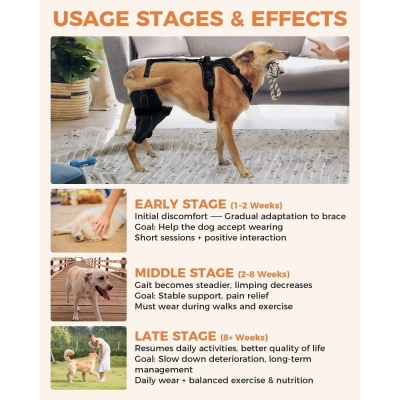
Most dogs adapt within 3 to 7 days when the brace is introduced in 15-minute sessions that gradually lengthen. A dog that resists beyond a week is often reacting to a fit problem—check hinge alignment and strap pressure patterns before assuming it is a behavioral issue.
Can a dog wear a knee brace outdoors?
Yes, provided the brace is properly fitted and the activity is controlled. Check brace position before and after each outdoor session. Wet conditions demand a liner that does not absorb water—saturated foam changes the fit and can cause skin problems within a single long walk.

0 Comments