
A knee brace looks simple. Straps. Hinges. Fabric. But where the support actually comes from is not what most people assume. It is not the straps. It is not how tight you cinch them. It is the hinge — and whether it lines up with the joint it is supposed to stabilize.
Miss that alignment by half an inch and the brace works against the dog. The straps fight the leg. The hinge pushes where it should not. The dog compensates, and the compensation creates new problems. Get the alignment right, and the brace becomes nearly invisible to the dog's movement — support without resistance.
This is what separates a dog knee brace that stays in place from one that needs constant readjustment. It is not about tighter straps. It is about where the hinge sits.
The Hinge Is the Support — Everything Else Just Keeps It in Place
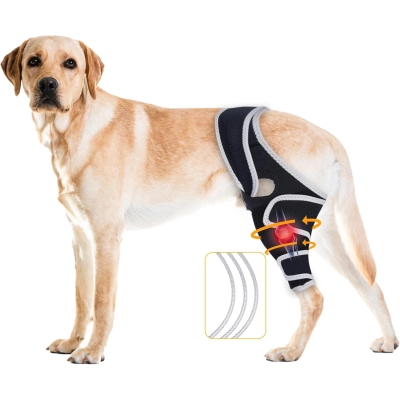
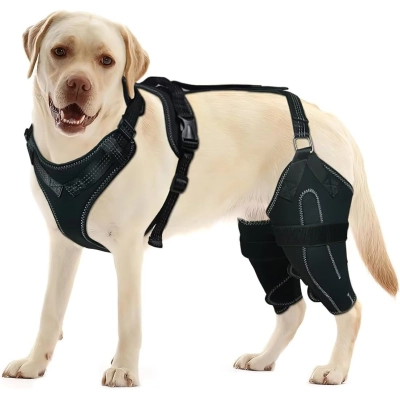
A knee brace stabilizes by controlling the path the joint takes during movement. The hinge is the control point. If the hinge center sits directly over the knee's natural axis of rotation, force travels in a straight line through the joint. The load distributes evenly across the joint surfaces. The dog flexes and extends the leg the way the joint was built to move.
If the hinge sits even slightly above or below that axis, the story changes. Force bends around the misalignment. Instead of a clean line through the joint, you get a lever — the hinge pushing at an angle the knee was never meant to take. The dog feels resistance at certain points in the stride. It shortens the step. It shifts weight to the other leg. The brace begins to migrate — sliding down or rotating — because the dog's natural movement is fighting the hinge position.
This is the causal chain that determines whether a brace supports or merely wraps: hinge aligned with joint axis → force travels straight → even joint loading → natural gait → brace stays in place because it moves with the dog. Hinge misaligned → force bends → uneven joint loading → altered gait → brace fights the leg → brace migrates → straps get over-tightened to compensate → skin problems begin.
You can see this in real time. After the dog walks ten steps on a flat surface, look at the brace from the side. If the hinge has drifted forward or backward from the center of the knee, the alignment is off. Tightening the straps will not fix it. The hinge position needs to be reset — loosen, reposition so the hinge center matches the bony prominence on the outer side of the knee, then re-secure.
In practice: Most brace migration is blamed on loose straps. In most cases, the root cause is hinge misalignment. The straps were never the problem.
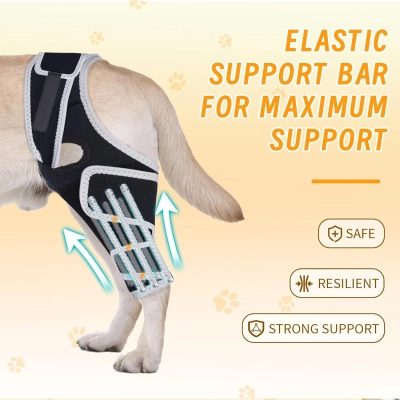
The hinge also sets the range of motion. A well-designed brace limits extension and flexion to a range that keeps the joint stable without freezing it. Too much restriction and the muscles weaken from disuse. Too little and the brace does not protect against the specific movements that stress an unstable knee — sudden hyperextension or twisting. The hinge stops are the design detail that balances stability with muscle maintenance. On braces with adjustable stops, an dog ACL knee brace configuration typically limits the last few degrees of extension — the range where the ligament is under the most tension — while allowing normal walking flexion.
Straps Are a Pressure Distribution System, Not a Tightness Scale
The two-finger rule is the standard advice: you should be able to slide two fingers under each strap. It is a starting point. It is not the whole story.
What matters more is strap width and where the strap lands on the leg. A narrow strap concentrates the same amount of force into a smaller area. That means higher pressure per square inch on the skin directly under the strap. A wide strap spreads the force over more surface area — same total tension, lower local pressure, less chance of irritation. This is basic physics, but it is the difference between a brace a dog tolerates for hours and one the dog starts chewing off after twenty minutes.
Strap placement matters just as much. A strap that sits over a muscle belly has a different effect than one that crosses a bony prominence. Muscle tissue compresses and rebounds — the strap gets some natural cushion. Bone directly under the skin has no give. The pressure concentrates. Over the course of a walk, that concentrated pressure point becomes a hot spot, then a rub mark, then a sore.
The best strap configurations follow a simple design logic: the widest strap goes where the most force is needed — across the thigh, above the knee, where the muscle mass is largest. A medium-width strap crosses below the knee for secondary stabilization. Narrower straps, if present, handle positioning rather than load-bearing.
Fit is not a one-time check. Muscle tone changes during activity. A leg that measures one way at rest fills out differently after exercise. The strap that felt snug before the walk may feel different after. The practical check: after twenty minutes of wear, open each strap and look at the skin beneath. Red lines that precisely trace the strap edges indicate pressure concentration. That means the strap is too narrow for the tension it carries, or it was tensioned unevenly — tighter on one edge than the other. Diffuse pinkness that fades within two or three minutes is normal post-wear circulation response.
Tip: If red lines appear only on one edge of a strap, the strap was pulled unevenly during fastening. Loosen and re-tension, applying even pressure across the full width.
Strap material also shapes the experience. Neoprene-backed straps grip the coat and resist sliding but trap moisture. Nylon webbing breathes better but can slip on short-coated dogs. The dog brace designs that balance this best use a neoprene contact surface with perforations — grip where it is needed, ventilation where moisture builds up. After a walk in wet conditions, pull the straps off and check whether the inner surface feels damp. Moisture trapped against the skin for hours is what turns a minor rub into a skin breakdown.
Measurements That Predict Fit — and Measurements That Do Not
Three measurements determine most of whether a knee brace will fit: thigh circumference two to three inches above the knee center, calf circumference two to three inches below the knee center, and the length from mid-thigh to mid-calf crossing the knee joint. These are the numbers that map to the brace's sizing chart.
But there is a measurement the sizing chart cannot capture: the angle of the leg at rest. A dog that stands with the stifle slightly flexed — common in dogs guarding a sore joint — gives a different thigh contour than the same dog standing square. Measure the leg in the position the dog naturally holds, not the position you want it to hold. A brace sized to a forcefully straightened leg will be too loose when the dog returns to its natural stance.
Measure after the dog has been walking, not before. A relaxed dog gives a truer leg shape. A tense dog holds muscle tension that changes the circumference. And measure the injured leg — do not assume symmetry. Muscle atrophy on the affected side can create a half-inch or more difference in circumference from the sound leg. Basing the size on the healthy leg produces a brace that fits loosely on the leg that actually needs support.
Recording matters. Write down each measurement immediately. Repeat each one twice. If the two readings differ by more than a quarter inch, take a third and use the average. Photos help — a side-view photo of the dog standing, taken at leg level, captures the joint angle and leg contour in a way numbers alone cannot. This becomes useful if you need to consult the brace provider about fit questions later.
For a deeper walkthrough of the full sizing and adjustment sequence across brace types, the CCL brace sizing and adjustment process covers additional checks including joint-angle assessment and strap-tension sequencing.
When a Knee Brace Works — and When the Fit Cannot Compensate
A well-designed knee brace, correctly fitted, can redistribute load away from an unstable joint during walking and light activity. It can reduce the strain that comes from sudden shifts in direction. It can give a dog enough confidence in the leg to use it normally rather than carrying it.
It cannot fix a joint that is structurally unstable in ways the brace was not designed to address. It cannot prevent twisting injuries during high-speed direction changes, jumping, or rough play. It cannot restore muscle mass lost to weeks or months of disuse — that requires controlled exercise, with or without the brace. And it cannot compensate for a leg shape that falls far outside the conformation the brace was patterned for.
Disclaimer: This check assumes a short-coated dog where skin changes are visible. Double-coated breeds may show subtler rub marks that need hand-checking rather than visual inspection — run fingers under each strap edge after wear. If the dog's leg conformation falls outside typical breed norms — particularly dogs with angular limb deformities, very deep chests, or significant muscle wasting — the fit checks described here may not catch every pressure point. In those cases, a casting-based custom brace is more likely to match the individual leg geometry than any off-the-shelf sizing system.
Daily monitoring is not optional. Check the skin under the brace after every wear session for the first week. After that, a daily once-over is enough — look for redness, hair changes, or any spot the dog licks more than usual after the brace comes off. A dog licking a specific spot is often the first signal of a pressure point before visible skin changes appear.
The best dog knee braces come from matching the brace design to the specific use case — a dog that needs support for short leash walks has different requirements than one that wears a brace for post-operative controlled activity. The CCL brace fitting guidance covers the activity-modification side of the equation. For dogs with multiple joint issues, selecting braces by condition helps sort which support takes priority.
FAQ
How do I know if the hinge is positioned correctly?
Find the bony prominence on the outer side of the knee. The hinge center should sit directly over it. After the dog walks ten steps, the hinge should still be centered on that point. If it has drifted, the initial positioning was off or the brace is rotating during movement — usually a sign the thigh strap is not seated firmly enough against the muscle contour above the knee.
How long can a dog wear a knee brace continuously?
Most dogs adapt best to sessions of two to four hours with a break between. Skin needs time without pressure to maintain normal circulation and moisture balance. Remove the brace during rest periods unless a specific post-operative protocol says otherwise. A brace worn continuously without skin checks can turn a minor rub into a wound within a day.
What if the brace slides down during walks?
Sliding usually means the thigh strap is too loose or the hinge position is too low. Try repositioning the brace so the hinge sits higher on the knee, then re-secure the thigh strap first — it carries most of the anti-migration load. If sliding continues after repositioning, the thigh circumference measurement may be off, or the dog's leg taper from thigh to calf does not match the brace's internal contour well enough to create a natural stop.
Can a knee brace be used on either leg?
Most knee braces are leg-specific — the hinge is positioned for a left or right stifle. Using a left-leg brace on the right leg puts the hinge on the inner side of the knee, where it cannot align with the joint axis and may press against the other leg during walking. Check the product specifications for left/right designation before ordering.

0 Comments