
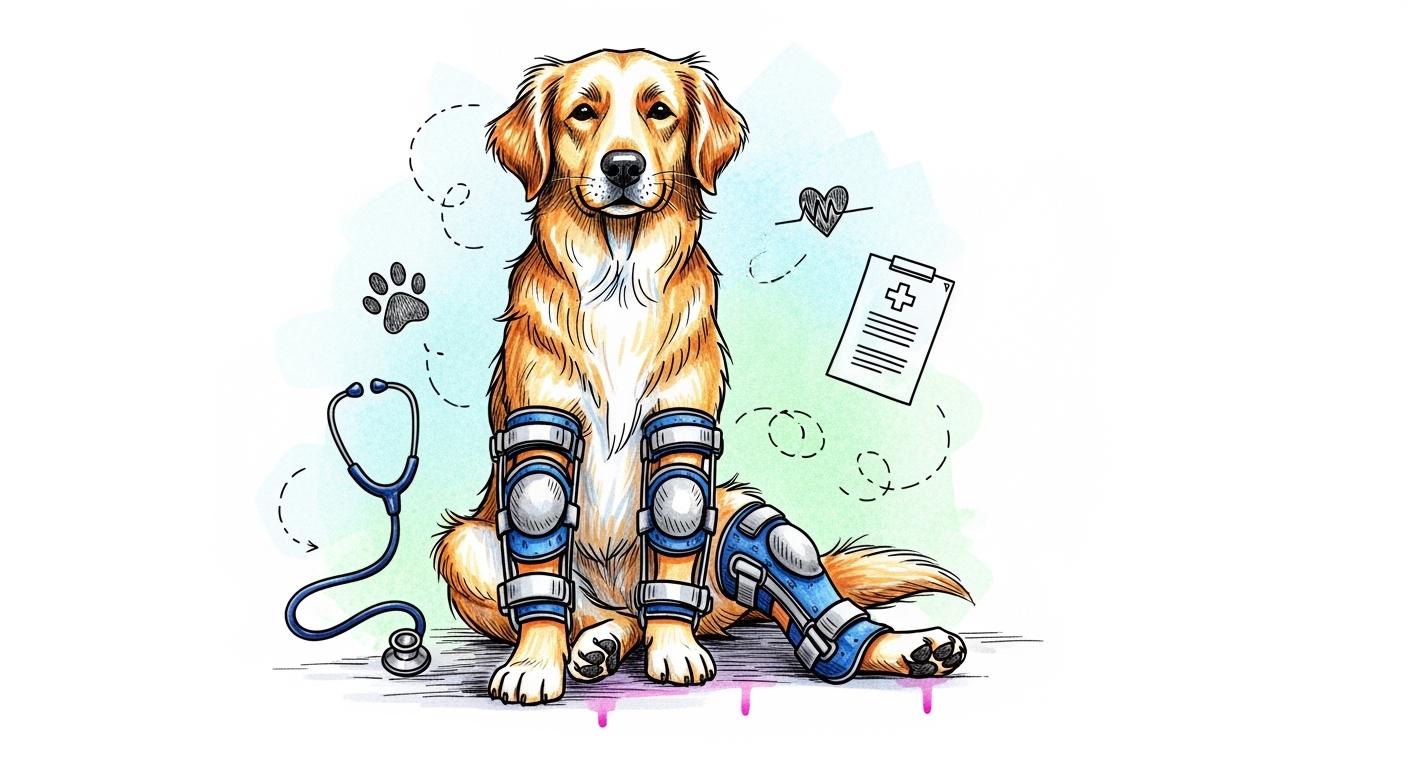
A dog putting weight on one bad knee shifts load to the other leg. That is not compensation. It is a load-path problem. When both stifles are compromised, two single braces leave a gap in the middle: the pelvis still tilts, the spine still twists, and the load still finds the weaker side. A double knee brace does not just add a second set of straps. It bridges the two joints into one support structure. That changes how force travels through the rear assembly.
How Bilateral Coupling Changes the Load Path
A single knee brace stabilizes one joint. The dog still decides which leg to trust. With two compromised stifles, the dog alternates — favoring the left on Monday, the right by Thursday — and each shift wears the "good" knee of the moment a little more.
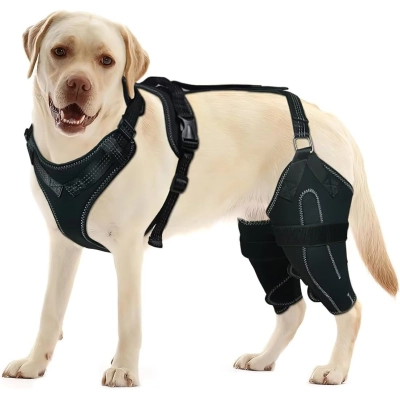
A double knee brace locks both joints into the same support frame. The mechanical difference is not "twice the coverage." It is coupling.
When both stifles are constrained within matched hinge geometry, ground reaction force has fewer degrees of freedom to escape. Instead of the pelvis rotating to offload the weaker side — a motion owners see as a hip hike during walks — the bilateral frame forces symmetry. Force that would rotate the pelvis instead travels straight up the limb axis. Joint cartilage tolerates axial compression far better than shear. This is the fundamental mechanical advantage: the brace does not just hold each knee. It prevents the dog from choosing which knee to protect.
Walk the dog on a flat surface for five minutes and watch the hip points from behind. With a single brace on one bad knee, the hip on the unbraced side often rises at each step — the dog shortens the stance phase on the painful leg. With a well-fitted double brace, the hip points should stay level. If they do not, the hinge height on one side likely needs adjustment.
Hinge Position: the Half-Inch That Decides Whether the Brace Works
Most discussion about knee bracing for ACL injuries starts with strap tightness. That is the wrong starting point.
A stifle brace works by sharing load with the joint, not by immobilizing it. For load-sharing to happen, the brace hinge must rotate around the same axis as the dog's knee. If the hinge sits half an inch above or below the joint line, every step forces the femur and tibia to move relative to each other in a way the brace does not track. The result is not neutral. It is actively counterproductive. The brace fights the dog's natural joint motion, and the dog fights back by altering gait to reduce the mismatch.
This is why hinge placement matters more than strap tension. Straps anchor the frame. The hinge determines whether that frame helps or hinders.
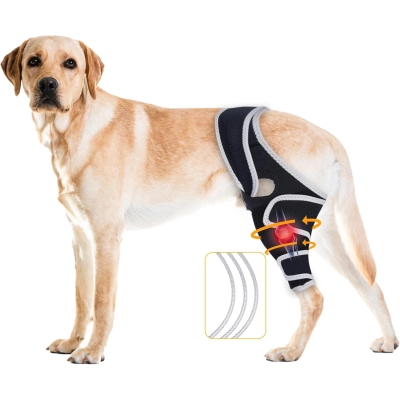
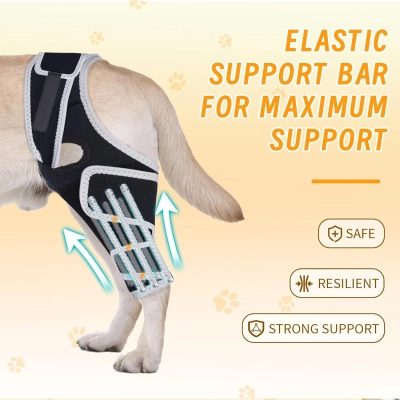
The hinge axis on a canine stifle is not a single fixed point. It shifts slightly through the range of motion because the stifle is not a pure hinge joint — the femoral condyles roll and glide across the tibial plateau. A well-designed bilateral brace accounts for this with enough axial play in the hinge post — typically a few millimeters of lateral float. Without that float, the brace binds at mid-flexion. The dog shortens its stride to avoid the pinch. Gait adaptation becomes the problem, not the solution.
After the dog has worn the brace for ten minutes of walking, run your finger along the inside of the brace hinge area. The skin under the hinge pivot should be no warmer than the surrounding tissue. A hot spot directly under the hinge means friction — the hinge axis and the joint axis are fighting each other. Heat is the mismatch made visible.
When a Double Brace Is the Right Call — and When It Is Not
A double knee brace makes the most sense when both stifles are contributing to the problem. Dogs with ACL injuries affecting both rear legs cannot offload to either side without worsening the other — bilateral support is not optional here, it is the only configuration that prevents the compensation cycle. The same applies to advanced osteoarthritis in both knees, where asymmetric gait accelerates cartilage loss on the more heavily loaded side. Post-surgical recovery on one knee with the contralateral knee already showing early laxity is another clear case — protecting the "good" leg while the surgical leg heals.
Where a double brace tends to underperform:
- A single-knee injury with a fully sound contralateral limb. The unbraced leg does not need support, and the double frame adds bulk and heat without benefit. A single well-fitted stifle brace is the better tool here.
- Dogs with significant angular limb deformities — valgus or varus conformation that shifts the joint line away from the breed-typical axis. Standard hinge geometry may not track correctly, and the bilateral coupling can amplify rather than correct the mismatch.
- Very small dogs under roughly 10 pounds, where the hardware bulk of a bilateral frame can outweigh the stabilization benefit. The mass of the brace relative to limb mass changes the swing-phase dynamics enough that gait may degrade rather than improve.
Disclaimer: The fit checks described here assume a short-coated dog where skin warmth and rub marks are visible on inspection. Double-coated breeds may show subtler friction signals — matting, broken guard hairs, or a greasy feel under the brace — that require hand-checking rather than visual inspection. If the dog's stifle conformation departs significantly from breed norms, particularly in dogs with bow-legged or cow-hocked stance, the hinge-axis checks above may not catch every pressure point.
Design Details That Shape Daily Use
Strap width and force distribution. The number of straps matters less than their width and anchor points. A two-strap-per-leg design with wide contact patches — roughly 1.5 inches or greater — spreads lateral force across more skin surface area than a three-strap design with narrow webbing. Wider straps lower the pressure per square inch at each anchor point. Lower pressure directly reduces the risk of friction irritation during extended wear. In arthritis support applications where the brace stays on through longer activity windows, this difference compounds — a narrow-strap brace may be tolerable at 20 minutes but cause visible rub marks by 45 minutes.
Inner liner and moisture tolerance. Neoprene outer shells provide structure, but the inner liner determines whether the dog tolerates the brace for hours. Closed-cell foam liners hold less moisture than open-cell alternatives. Water from rain, puddle splashes, or ambient humidity does not wick into the material. Damp liners soften skin and increase the friction coefficient against fur, which accelerates rub injuries. A liner that stays dry after a 20-minute walk in damp grass is performing. One that feels clammy is not. Owners can check this by pressing a dry paper towel against the inner liner after a walk — moisture transfer visible on the towel signals a liner that will cause problems with extended use.
Size coverage versus adjustability. A brace sized to a specific stifle circumference with fixed hinge placement tracks more accurately than a highly adjustable one-size-fits-many design. But production realities mean offering discrete sizes — typically S through XL in roughly 1.5-inch circumference increments. The gap between sizes is where adjustability earns its place: straps and padding take up the slack within a size bracket. They cannot compensate for choosing a size whose hinge placement lands outside the joint axis tolerance. Owners who measure between two sizes should pick the smaller size and use the adjustability to accommodate — an oversized brace lets the hinge migrate during movement, while an undersized one can be padded out.
Proper fit also depends on understanding knee brace design before measuring. A brace that matches the stifle circumference on paper can still fail if the hinge-to-joint relationship is off. The measurement that matters most is the distance from the tibial plateau to the femoral condyle — the vertical span the hinge must track — and this dimension varies more across breeds than circumference does.
Common Questions
Does a double knee brace restrict movement more than a single brace?
Not inherently. A double brace constrains both stifles to move within matched ranges, but it does not reduce the range itself — unless the hinge stops are set too aggressively. The restriction that owners sometimes observe comes from poor hinge alignment, not from having two braces. A well-aligned bilateral frame lets the dog move through its natural stifle flexion while preventing the side-to-side shear that damaged ligaments cannot control.
Can a dog wear a double knee brace all day?
Most dogs tolerate a properly fitted double brace for activity periods — walks, supervised yard time, indoor movement — but not for continuous 24-hour wear. The reason is not just comfort. Skin under any brace needs periodic ventilation to prevent moisture buildup, and the stifle joint benefits from unbraced rest periods where surrounding muscles activate without external support. A common pattern is brace-on during active hours, brace-off during crate rest or sleep. After removing the brace, running a hand over the stifle area to check for warmth or tenderness takes seconds and catches friction issues before they become visible.
How is a double brace different from using two separate single braces?
The coupling. Two independent braces let each leg move on its own terms — the dog can still shift weight asymmetrically, hike one hip, and shorten stance on the more painful side. A true double brace connects both sides into one frame, either through a rigid bridge or through matched bilateral hinge geometry that forces symmetry. That connection is the entire point: it removes the dog's ability to cheat the load path by offloading to the less painful leg.
How long does it take a dog to adjust to wearing a double brace?
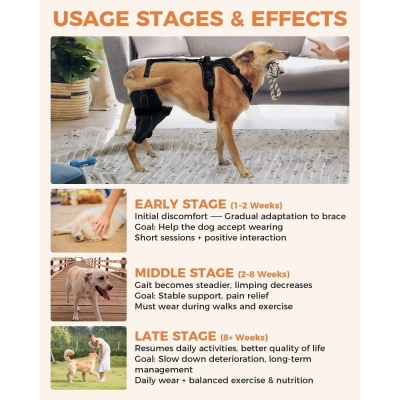
Most dogs accommodate within three to seven days when introduced in short, positive sessions. The adjustment curve has less to do with the brace itself and more to do with the dog unlearning the compensatory gait pattern it developed before bracing. The first few walks often look awkward — not because the brace hurts, but because the dog is trying to perform a movement strategy the brace no longer allows. ACL recovery support with a brace typically shows the most gait improvement between days five and ten, once the dog stops fighting the symmetry the brace enforces and starts trusting it.
0 Comments