
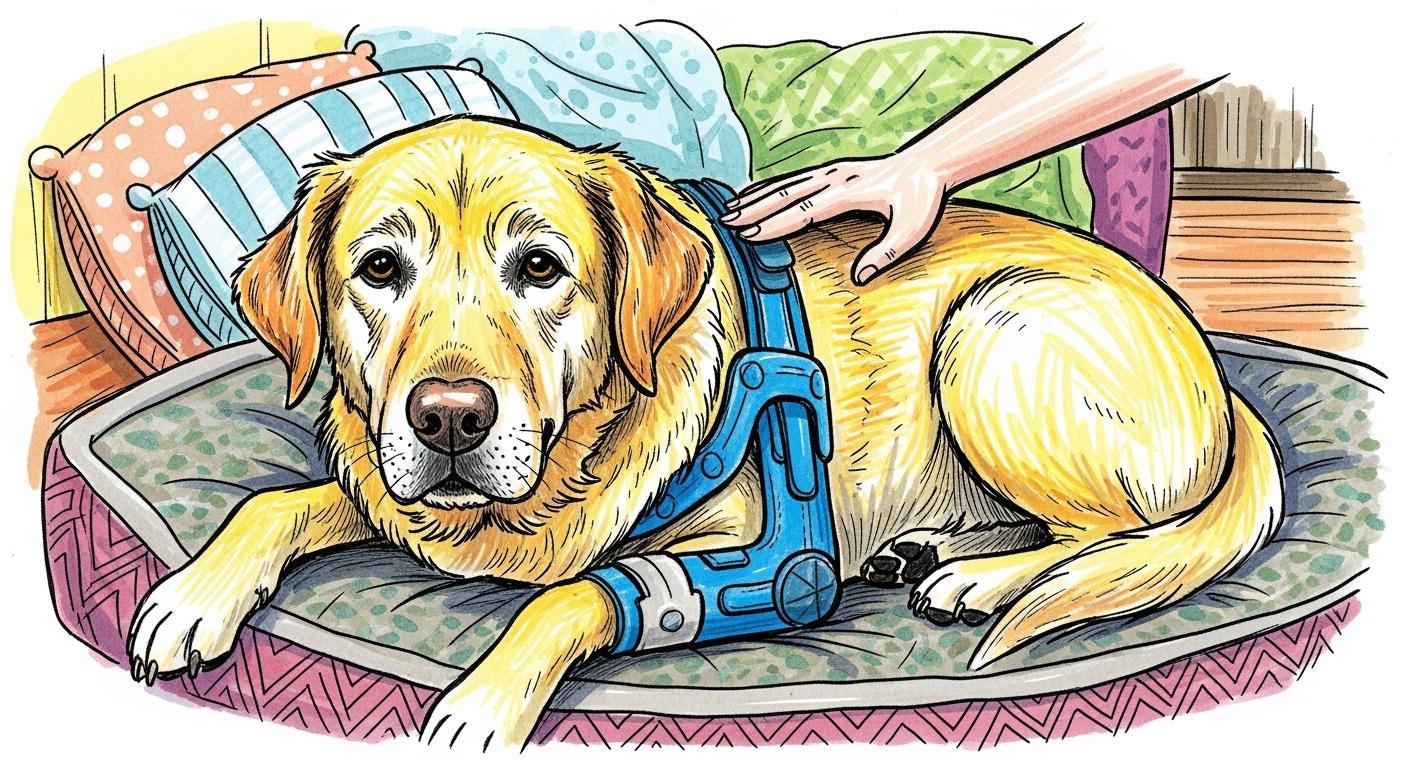
A dog favoring one front leg after a walk is not just limping — the shoulder joint is losing its ability to stay centered under load. A shoulder brace can intervene, but not by wrapping the joint tighter. The difference between a brace that steadies the shoulder and one that merely adds fabric to the dog's chest comes down to two design choices: where the straps pull from and whether the brace structure aligns with the joint's axis of rotation.
What Strap Routing and Chest Anchor Geometry Actually Decide
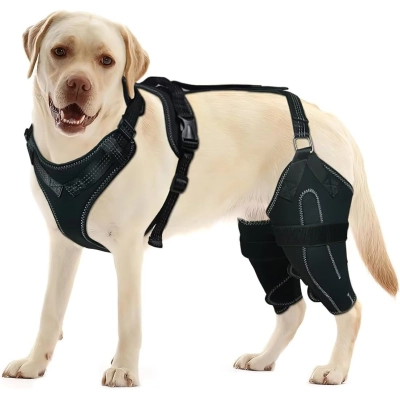
Most shoulder braces route straps across the chest and around the upper leg. What changes between designs is where those anchor points sit — and that geometry determines everything about how force moves through the brace to the joint.
Think of strap routing as a force map. A strap that anchors high on the chest and crosses diagonally toward the opposite side pulls the shoulder inward and upward. A strap that wraps horizontally around the torso pulls the shoulder backward. Neither is universally correct. The diagonal route tends to work better for dogs with medial instability — where the shoulder joint drifts outward — because it counteracts the drift direction. The horizontal route provides more general compression for dogs with arthritic stiffness, where warmth and mild circumferential pressure are the primary goals.
The causal chain runs like this: strap anchor position sets the force vector direction. That vector determines how pressure distributes across the joint surfaces. That distribution decides how evenly the humeral head seats in the glenoid. And that seating determines whether the dog compensates by shifting weight to the opposite leg. A strap anchored too low on the chest produces a downward force vector. That pulls the shoulder down and forward — exactly the position it drifts into during instability. The brace then reinforces the problem it was built to solve.
Chest anchor geometry matters for a second reason: the shape and surface area of the chest panel determine how much of the brace's total force reaches the shoulder versus dissipating into the ribcage. A broad, contoured chest panel spreads load across a larger surface area — lower pressure per square inch, less skin irritation over hours of wear. A narrow chest strap concentrates force into a thin line. That works for short sessions — 30 minutes of controlled walking — but tends to create hot spots and rub marks once wear extends past a few hours.
The load path in a shoulder brace differs fundamentally from what a dog elbow brace manages — the elbow primarily hinges in one plane, while the shoulder rotates, abducts, and extends, demanding a strap system that can resist force in multiple directions at once. When comparing how different dog brace categories handle force distribution, shoulder designs face a unique challenge: the joint moves in more planes than a knee or hock, so strap routing must manage multi-directional drift rather than single-axis stabilization.
In practice: after 20 minutes of walking, slide a finger under each anchor point. If the skin under a narrow strap feels warmer or shows a deeper indent compared to skin under a broader panel, the force concentration is uneven. That unevenness is not a fit problem — tightening will not fix it. It is a geometry problem.
Joint Alignment — Why Positioning Matters More Than Tightening Down
Tightening the straps feels like the obvious response when a brace seems loose. But shoulder brace performance hinges less on strap tension and more on whether the brace structure centers over the joint's axis of rotation.
The glenohumeral joint rotates around a point near where the scapular spine meets the top of the humerus. If the brace's reinforced panel or pivot point sits even half an inch forward or backward of that axis, the brace resists movement at an angle. The dog's shoulder pushes against the brace during stride. The brace pushes back along a slightly misaligned vector. Over hundreds of steps, that angular mismatch translates into altered gait — the dog shortens stride on the affected side or swings the leg outward to avoid the resistance.
A well-aligned brace guides movement rather than blocking it. The brace structure moves with the joint through its natural range, adding resistance only at the end ranges where instability occurs. That is the alignment advantage: the brace becomes a motion guide, not a motion blocker.
The material under the alignment panel matters too. A stiff panel positioned correctly gives the joint a mechanical reference point — the dog's proprioceptive system senses the panel's position and adjusts muscle activation around it. A soft, unstructured brace cannot provide that reference, even with the straps cinched down. The dog's body treats soft compression as background pressure, not as a positional signal. This is why two braces that look similar in product photos can produce completely different gait outcomes — the difference is not visible when the dog is standing still.
Joint alignment precision varies by limb segment. A dog wrist brace anchors against the carpus, where motion is more constrained — the designer solves fewer alignment variables. The shoulder's multi-axis movement demands tighter positional tolerances from the brace structure. Half an inch of misplacement at the wrist may go unnoticed; the same half-inch at the shoulder changes the dog's stride within minutes.
Tip: watch the brace panel from the side during a walk. If the panel shifts forward or backward relative to the shoulder point by more than half an inch across ten strides, the alignment is off. A stride-length asymmetry — one front leg reaching further than the other — tends to appear within the first two minutes when alignment is wrong.
Where a Shoulder Brace Delivers and Where It Falls Short
Shoulder braces perform best when the joint instability is positional — the shoulder drifts out of alignment under load but retains its structural integrity. Dogs with medial shoulder instability, mild to moderate arthritis, or post-surgical protection needs tend to respond because the brace addresses a mechanical problem mechanically.
A brace cannot restore ligament tension. If the medial glenohumeral ligament is fully ruptured, the shoulder will subluxate regardless of external compression — the internal restraint is absent. In those cases the brace may still reduce end-range motion enough to prevent painful episodes during controlled walks, but it will not stabilize the joint during anything beyond that.
Body conformation changes what a brace can do. A deep-chested breed — a Doberman or a Greyhound — has a narrow thoracic profile. The chest anchor geometry that distributes force evenly on a broad-chested Labrador may not find enough surface area to avoid pressure concentration on a deep-chested dog. The strap angles that produce a stabilizing inward pull on a square-built dog can translate to a downward pull on a narrow-built dog, simply because the anchor point sits at a different height relative to the shoulder joint.
Shorter-coated breeds tend to show brace-related skin changes earlier — redness and indent marks appear within the first few wear sessions and are visible to the eye. Double-coated breeds can wear the same brace for longer before marks become visible, but that also means pressure points can develop without detection. When shoulder support is part of a broader front-limb strategy, understanding how front leg bracing works as a system helps — the load path from paw to shoulder is continuous, and instability at one joint often shifts stress to the next.
Disclaimer: the fit verification methods described here assume a short-coated dog where skin changes are visible within 20 to 30 minutes of wear. For double-coated breeds — Huskies, Malamutes, Samoyeds, and similar — rub marks may remain hidden under dense fur. Hand-check under every strap contact point after the first 15 minutes, then again at 60 minutes. If the dog's chest conformation falls far outside the breed norms this brace design was patterned for — particularly dogs with angular limb deformities, very deep chests, or extremely narrow shoulders — the fit checks described here may not catch every pressure point.
Materials and Daily Wear — What Makes the Difference Over Hours, Not Minutes
A brace that feels fine during a 10-minute fitting can become intolerable by hour three. The material properties that determine long-wear tolerance are not the same as the ones that determine initial comfort.
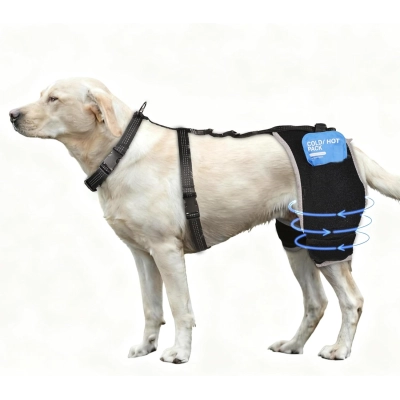
Neoprene is the most common brace material because it provides compression, retains body heat, and conforms to body contours. But neoprene does not breathe. Moisture builds up under the brace within 30 to 45 minutes of active movement. That moisture softens the outer skin layer, making it more vulnerable to friction damage from the brace's inner surface. A brace with a moisture-wicking inner liner — typically a polyester or nylon mesh bonded to the neoprene — moves sweat away from the skin surface. The outer skin layer stays dry and more resistant to friction. That is the difference between a brace a dog tolerates for two hours and one it tolerates all day.
Seam placement matters in ways that are invisible in product photos but obvious after weeks of use. A seam that runs perpendicular to the strap tension line becomes a stress concentrator — every pull cycle tugs at the same thread line. Over weeks of daily use, perpendicular seams tend to separate first. Seams that run parallel to the tension line distribute the cyclic load along the thread rather than across it, and they hold up longer. This is a manufacturing choice — parallel seams cost more to produce because they require repositioning the fabric during stitching — but it is the difference between a brace that lasts six months and one that frays at eight weeks.
Edge binding — the finished rim around the brace perimeter — determines whether the brace curls or lies flat after repeated use. A brace with no edge binding, or with thin binding that does not resist curling, develops rolled edges that concentrate pressure into a narrow line against the skin. Rolled edges are among the most common reasons dogs reject a brace they previously tolerated. The edge does not look different. It feels different — and the dog notices before the owner does.
Cleaning affects material lifespan in ways that are easy to underestimate. Neoprene degrades when exposed to hot water or harsh detergents — the foam cells collapse, the material loses its compression rebound, and the brace gradually becomes a loose sleeve rather than a compressive support. Hand-washing in cool water with mild soap, followed by complete air-drying, preserves the foam structure. A brace machine-washed weekly may lose meaningful compression within two months. The same brace hand-washed and air-dried can maintain its compression properties for a year or longer.
FAQ
Does a shoulder brace replace the need for rest or activity restriction?
A shoulder brace reduces end-range stress during controlled movement, but it does not turn an unstable joint into a stable one during high-load activities. A dog wearing a shoulder brace can typically manage longer walks on even ground than without the brace — the brace limits the joint positions where instability triggers pain. Running, jumping, and sharp turns still generate forces that exceed what external compression can manage. The brace extends the safe activity envelope. It does not remove it.
Can a shoulder brace fit under a walking harness or over a coat?
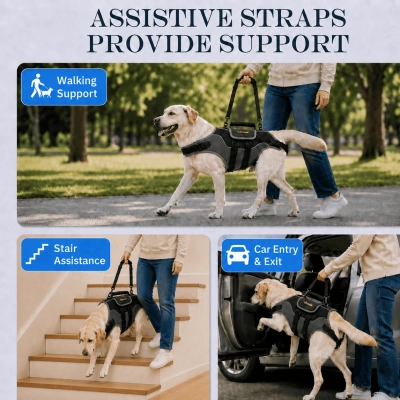
Most shoulder braces sit under a walking harness — the harness straps go over the brace's chest panel, which adds a layer of protection against harness rub. In cold weather, a thin coat can go over the brace as long as the coat does not compress the brace unevenly. A thick winter coat worn under the brace changes the geometry — it pushes the brace outward and creates slack in the strap system. That slack lets anchor points shift during movement, undoing the alignment advantages described above.
How long before a dog adapts to wearing a shoulder brace?
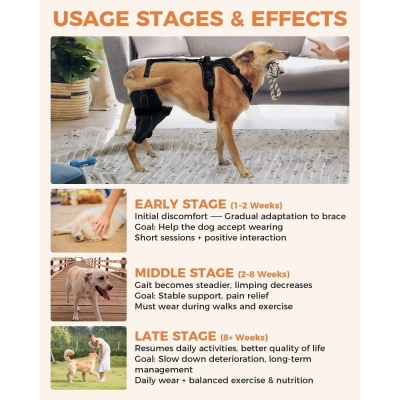
Most dogs adjust within three to five short sessions — 10 minutes each, with the brace on during calm activities like eating or light indoor walking. The pattern is predictable: session one, the dog may freeze or walk stiffly; session two, gait normalizes but the dog glances at the brace occasionally; by session three or four, the dog ignores it. A dog that has not normalized its gait by session five may be reacting to a specific pressure point rather than to the brace itself — check the fit before extending wear time.

0 Comments