
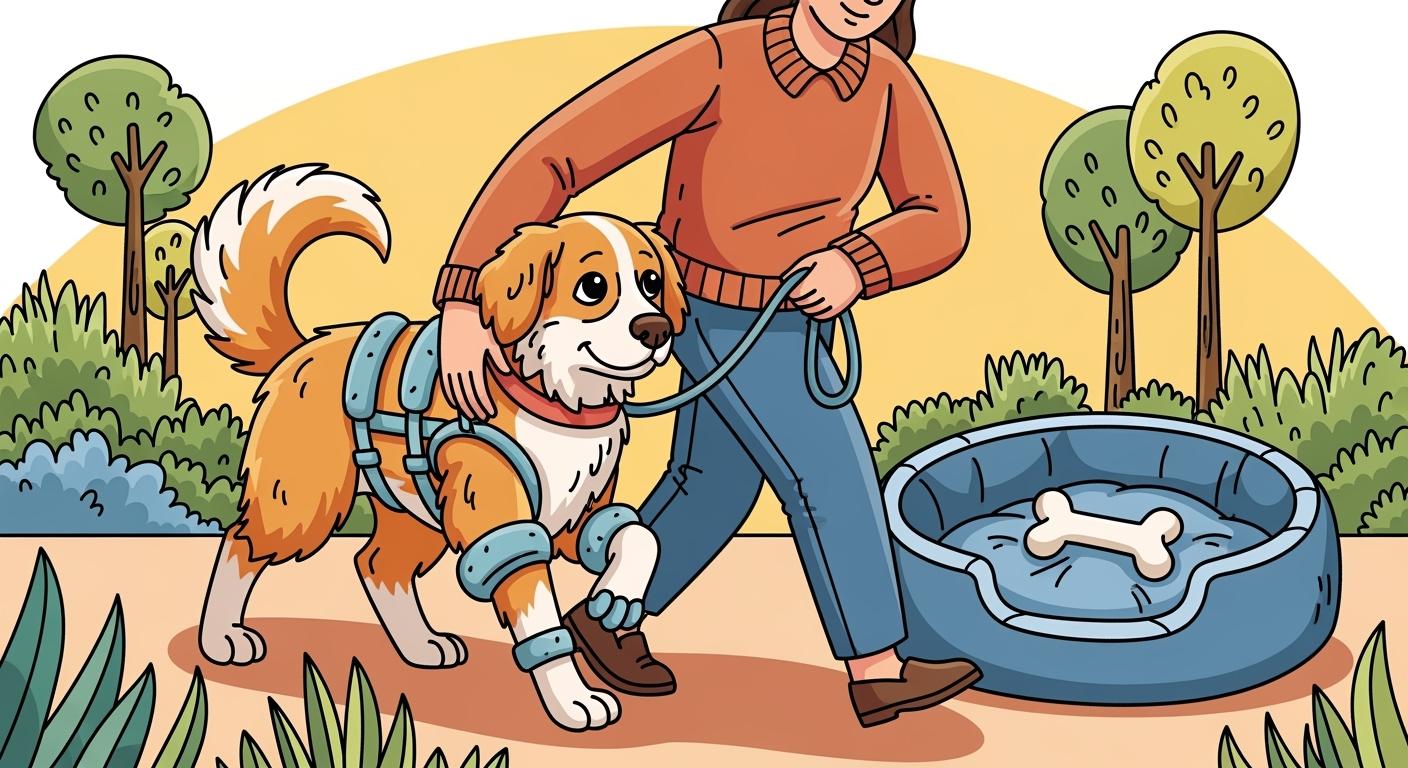
When a dog's paw folds under mid-stride, the scraping sound points to a proprioception problem — the brain is not receiving or sending the signal to place the paw pads-down. A no-knuckling brace does not immobilize the joint. It does not work like a splint. It corrects by pulling the paw into position through elastic tension timed to the gait cycle. Whether that correction holds depends on two design details most buyers overlook: the angle the elastic pulls from, and the number of anchor points holding that tension in place.
A foot brace for knuckling can shift paw placement measurably — or do almost nothing — based on how these two design elements interact. A brace that pulls from the wrong angle fights the dog's natural stride instead of working with it. One that anchors at a single point rotates under tension. Understanding why starts with the elastic mechanism itself.
Why Elastic Tension Corrects Paw Placement Where a Rigid Wrap Can't
A rigid wrap holds position. Elastic tension redirects it. The difference is the difference between bracing and correcting.
During a normal stride, the dog's paw lifts, swings forward, and lands pads-down. The lift-and-swing phase has two distinct moments: the paw comes off the ground — the flexion moment — and then extends forward before placement — the extension moment. Knuckling disrupts the extension moment. The paw stays flexed, lands on its dorsal surface, and scrapes.
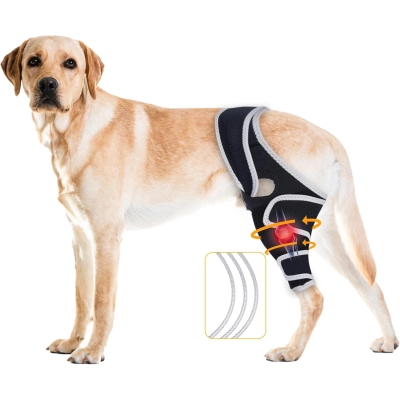
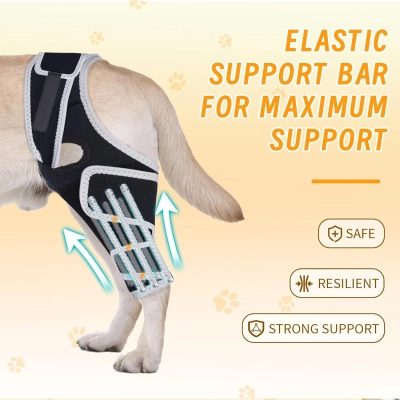
An elastic element placed between the lower leg and the paw creates a force vector that pulls the paw toward extension. Because the elastic stretches during the flexion moment — when the leg tucks under — and recoils during the extension moment — when the paw should straighten — it adds force precisely when the dog's own proprioceptive signal is absent or weak. This is the causal chain that separates elastic correction from static support: the material stores energy during one phase of the gait cycle and releases it during the next, applying directional pull at the exact window when the dog's nervous system fails to deliver the "straighten the paw" command.
The physics turns on two variables: the attachment point on the leg and the attachment point on the paw. The line between them is the tension line. If that line runs straight along the dorsal surface of the metacarpus to the top of the paw, the recoil force lifts the paw into extension with minimal wasted effort. If the tension line angles off to one side — say, because the upper anchor is positioned too far laterally — part of the force rotates the paw instead of lifting it. The dog compensates by twisting the leg outward, trading one gait irregularity for another.
A knuckling brace designed for gradual gait correction typically routes the elastic along a channel or sleeve that keeps it aligned with the center of the dorsal paw surface. The channel is not a decorative feature. Without one, tension line drift during a walk is nearly guaranteed. A half-inch lateral shift in the elastic's resting position changes the pull angle enough that by the end of a 10-minute walk, the paw lands differently than it did at the start.
In practice: After fitting the brace, watch the dog walk 20 strides on a hard surface. Mark where the paw lands relative to the opposite leg. Walk another 10 minutes and repeat. If the landing position has shifted more than half an inch, the tension line is drifting — the elastic is not staying in its channel, or the upper anchor is migrating.
How Strap Configuration Decides Between Correction and Constriction
Elastic tension corrects. Straps anchor. But anchoring is not binary — it is a question of how many points share the load and in what direction each one pulls back.
A single-strap anchor around the lower leg creates one force-bearing ring. Under tension from the elastic below, that ring becomes a pivot point. As the elastic pulls the paw upward, the strap at the leg resists. The result is a seesaw: tension at the paw end pushes the strap ring downward along the leg. After a few minutes of walking, the strap migrates toward the paw, the tension line shortens, and the correction diminishes. This is not a fit failure. It is a design failure — single-point anchoring cannot resist rotational force without migrating.
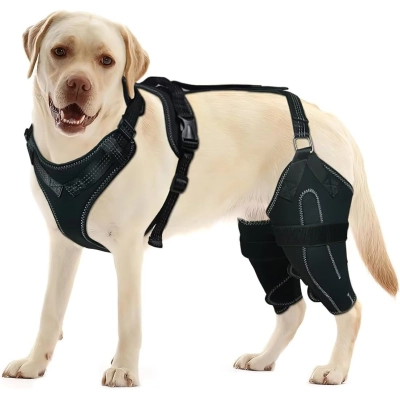
A multi-point anchor distributes the counter-force across at least two separate contact zones — typically one below the carpus or hock and one above. The lower anchor resists the direct pull of the elastic. The upper anchor resists the rotational force that would otherwise slide the lower anchor down. Together they create a stable base that holds the tension line constant. The dog can flex and extend the leg without shifting the brace's position.
This is why some dog braces stay put through a full walk and others need readjustment after two blocks. The difference is not strap material or how tightly the owner fastens them. It is the number of independent anchor zones. Two zones can resist rotation. One cannot. Tightening a single strap to compensate only concentrates pressure under a narrow band — the dog feels it as a hot spot, and within days the skin under that band tells the story.
Preventing rubbing with a foot brace starts with strap configuration, not padding thickness. A brace with poorly placed anchors will rub regardless of how much foam lines the interior, because the underlying problem is movement under load, not surface friction. Check the leg 20 minutes after removing the brace. If one side of the leg shows a defined pressure mark and the opposite side shows none, the load is concentrated under a single anchor zone. That is a design limitation, not a sizing error.
When a No-Knuckling Brace Works Best — and Where It Reaches Its Limit
An elastic-tension brace performs best under a specific set of conditions: the dog still has some voluntary leg movement, the knuckling is intermittent rather than constant, and the paw still responds — even weakly — to proprioceptive input. Under these conditions, the elastic provides a timed assist that fills the gap in the dog's own motor signal. The dog initiates the stride. The brace completes the paw-placement portion of it.
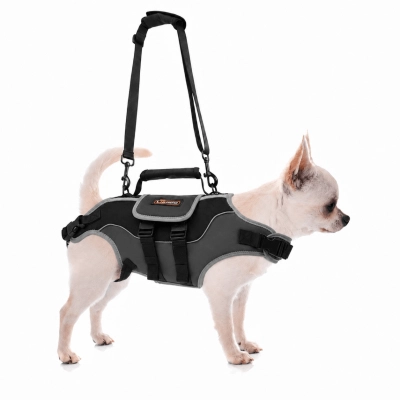
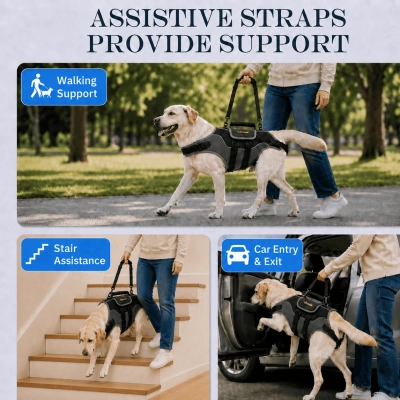
The design works less well when knuckling is constant and severe — for example, in advanced degenerative myelopathy where the dog drags the leg rather than attempting to step. Here the elastic still pulls the paw into extension, but without any voluntary lift from the dog, the paw extends while dragging. That trades dorsal scraping for a different friction pattern. A dog wheelchair that unweights the hind end may be the better mechanical solution in that scenario. Likewise, when a dog needs help rising from a lying position, a lift harness addresses a different mechanical need — vertical support — that a foot brace is not designed to provide. Understanding the differences between mobility aids matters because no single device solves every movement problem. Each targets a specific mechanical failure in the gait chain.
Dogs with very short coats and prominent leg bones present a separate challenge. The bony landmarks that help anchor a multi-point strap system are harder to stabilize because there is less soft tissue for the straps to grip without sliding. The same brace design that holds position reliably on a Labrador may migrate on a Greyhound with minimal subcutaneous padding. This is not a defect — it is a boundary condition inherent to strap-based anchoring on lean limb conformation.
Disclaimer: These fit assessments assume a dog with typical leg conformation for its breed. Dogs with angular limb deformities, very deep chests that alter forelimb loading angles, or significant muscle atrophy on one side may produce pressure patterns and brace migration that the checks described here will not predict. In those cases, the brace's tension line may need to be biased off-center to compensate for asymmetric loading — something a veterinarian or rehab therapist should evaluate before extended use.
Two Fit Checks That Reveal Whether the Brace Is Working
Performance claims about braces are easy to make and hard to verify at home. These two checks give you observable pass-fail signals that do not depend on anyone's marketing copy.
Check one — paw landing position after sustained walking. Walk the dog on a smooth, dry surface for 10 minutes at a normal pace. Stop. Observe five consecutive paw placements from the side. In a correctly tensioned brace, the paw should land pads-down or nearly pads-down on at least four of those five steps. If three or more land on the dorsal surface — knuckling through the brace — the elastic tension is either too weak for this dog's degree of deficit, or the tension line has drifted out of its channel. One more variable to check: repeat the walk on a different surface, such as carpet instead of tile. If the pass rate changes dramatically between surfaces, the brace's grip on the leg is surface-dependent. The anchoring system, not the elastic, is the weak link.
Check two — strap migration distance. Before a walk, mark the position of each strap edge against the dog's leg with a small piece of masking tape placed just above the strap border — not under it. Walk 10 minutes. Remove the brace and measure the distance between each tape marker and the corresponding strap mark left on the leg. Migration under a quarter-inch across all anchor points is typical and tolerable. Any single strap that has moved more than half an inch has lost its anchor. That strap is pivoting against a single contact zone, and the multi-point system has functionally collapsed to single-point loading.
Knuckling treatment outcomes depend on how consistently the corrective force reaches the paw — which is why these checks matter more than spec sheets. A brace that passes both checks during the first week tends to maintain its fit. One that fails either check will usually keep failing until the anchoring or tension-line issue is addressed.
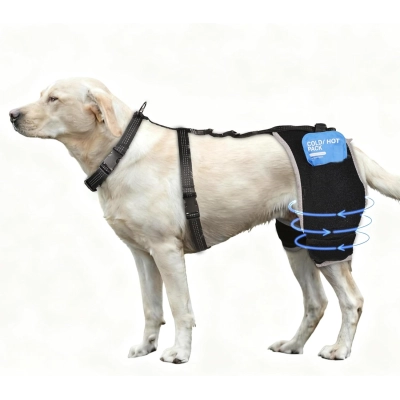
For dogs that also need support beyond the paw — whether due to knee instability or full-body lifting needs — the principles stay the same: anchor count determines stability, and tension direction determines what gets corrected. A wheelchair or harness adds support for a different part of the movement chain, but the design logic — matching the mechanical assist to the specific deficit — does not change.
FAQ
Can a no-knuckling brace be used on a hind leg and a front leg?
Yes, but the tension line geometry differs. On a front leg, the elastic pulls the paw dorsally — against gravity-assisted flexion during the swing phase. On a hind leg, the paw drags behind the hock, so the tension must pull forward as well as upward. A brace built for the front leg used on the hind leg pulls at the wrong angle. Check whether the brace is designed for forelimb or hindlimb use — the strap and elastic routing differ between the two.
How long can a dog wear a no-knuckling brace continuously?
Most dogs tolerate 2 to 4 hours of continuous wear before skin moisture and pressure accumulation become concerns. Remove the brace, check the skin for defined pressure marks, and let the leg air-dry for at least 30 minutes before reapplying. If the skin under any strap anchor shows persistent redness 15 minutes after removal, reduce the wear duration in the next session.
Does a thicker elastic band produce better correction?
Not necessarily. Correction force depends on the elastic material's tension rating — its resistance to stretch at a given elongation — not its width. A wider band distributes the same force across more skin surface, which can improve comfort, but if the material has a lower tension rating, the wider band may deliver less corrective pull than a narrower, higher-tension elastic. The relevant spec is pounds of tension at the working elongation percentage, not band width.
0 Comments