
A knee brace designed for a 60 lb Labrador and then shrunk to fit a 6 lb Chihuahua does not shrink the same way the dog's leg does. The strap that spread force across a broad thigh now concentrates it onto a leg the width of two fingers. The hinge that tracked a Labrador's joint axis now sits half an inch off a Chihuahua's pivot point. That half-inch is a mile at this scale.
Understanding which design details shift and which stay constant when a brace scales down is what separates a brace that supports from one that slips, rubs, or gets chewed off within the first ten minutes.
Why Standard Brace Proportions Break on Narrow Legs
Most knee braces are patterned on medium-to-large-dog anatomy. The hinge centers are placed relative to a leg circumference of roughly 8 to 14 inches around the stifle. Strap widths are chosen to distribute force across that surface area. Material stiffness is dialed in for limbs that generate corresponding leverage during movement.
Scale the same design to a 4-inch stifle circumference and none of those relationships hold.
A strap that is 1.5 inches wide on a Labrador covers roughly 12% of the thigh's circumference. On a Chihuahua, that same proportion calls for a strap barely 0.5 inches wide. But most scaled-down braces keep straps closer to 1 inch. The result: the strap covers a larger percentage of the leg, but the edges land closer to bone prominences where soft tissue is thinner. More coverage is not always more comfort — at small scale, it often means more pressure points.
Here is the causal chain: the hinge is placed to track the joint's axis of rotation. Even a 0.25-inch misalignment changes the lever arm through which force transmits. On a large dog, a 0.25-inch offset is roughly 2–3% of the limb's diameter — negligible. On a toy breed, the same offset is 6–8% of limb diameter. The brace's hinge arc no longer matches the joint's natural arc. Each step the dog takes applies shear instead of compression through the joint. Tightening does not fix misalignment. It just transfers the misalignment force into the skin.
Strap Width and Force Distribution at Toy-Breed Scale
Force from a strap follows a simple physical relationship: pressure equals force divided by contact area. Narrower strap, same tension, higher pressure on the skin underneath. That is the equation. What changes at small-dog scale is not the equation but the margin for error.
On a Lab, strap placement has a tolerance window of about an inch — the strap can sit slightly higher or lower without crossing into a problem zone. On a Chihuahua, that window shrinks to perhaps 0.25 inches. A strap placed half an inch too high lands on the thin skin over the tibial crest. Half an inch too low and it rides into the flexion crease behind the stifle. Both positions create friction, then irritation, then refusal to walk. Sizing and adjusting a CCL brace for legs this narrow demands a different approach than what works for broader limbs — the strap positions that succeed on medium-dog anatomy fail on toy breeds not because the brace is defective, but because the placement window is tighter than standard instructions account for.
Strap configuration — meaning the number of straps, their width, and their anchor points — matters more than strap tension. A two-strap design with a broad upper band and a narrow lower band spreads the stabilizing force across two zones with different tissue depths. A single wide strap tries to do both jobs from one position and typically fails one of them.
Observable check: put the brace on, walk the dog for ten minutes on a flat surface, then take it off and run your finger along the skin under each strap edge. A pink line that fades within 30 seconds is normal. A red mark that stays visible after two minutes means the strap edge is concentrating force — either it is too narrow, placed over a bony landmark, or tensioned unevenly. That mark is your pressure map. Adjust one variable at a time and recheck.
Material choice interacts with strap width here in a specific way. Neoprene-backed straps grip the fur and resist sliding but trap heat under the contact zone. Nylon-backed straps breathe better but rely entirely on friction against the outer brace shell to hold position — useful on short-coated breeds, less reliable on double-coated dogs where the strap sits on fur rather than fabric. Neither material is universally better. The decision turns on coat type and wear duration.
When a Knee Brace Helps and When It Does Not
A well-fitted knee brace changes the mechanical environment around the stifle. It limits the end range of extension and flexion, reduces the side-to-side play that stresses a compromised cruciate ligament, and in the case of patellar luxation, provides a medial barrier that discourages the kneecap from tracking laterally. Patella bracing mechanics differ from cruciate bracing mechanics — the former targets medial-lateral stability while the latter targets anterior-posterior control. A brace designed for one axis of instability will not reliably control the other.
What a brace does not do is regenerate tissue, reverse arthritis, or substitute for the neuromuscular control that keeps a joint stable during dynamic movement like jumping or sharp turns. Those functions come from muscle, not nylon and neoprene.
This distinction defines the boundary of what to expect. A brace can keep a stable-but-weak joint from wobbling into an injury zone during a leashed walk. It cannot brace a joint through a sprint, a stair jump, or a collision with furniture. Those are forces the brace was never built to manage, and expecting it to do so leads owners to blame the product for a mismatch in expectations.
The line is simple. Scenarios where a knee brace tends to perform well:
- Dogs with grade 1–2 patellar luxation where the kneecap slips intermittently but the joint is otherwise stable
- Partial CCL tears where some ligament fibers remain intact and the brace reduces anterior tibial translation during controlled activity
- Post-surgical support during the rehabilitation window when controlled movement is prescribed but full weight-bearing stability has not returned
- Senior dogs with mild-to-moderate stifle osteoarthritis where the goal is comfort during daily ambulation, not athletic performance
Scenarios where a knee brace is likely the wrong tool:
- Full-thickness CCL tears with gross instability — the tibial thrust is too large for external bracing to control. Knee bracing for ACL recovery works when residual ligament structure remains to share the load; without it, even a well-fitted brace cannot substitute for the primary restraint the ligament provides
- Grade 3–4 patellar luxation where the kneecap is permanently displaced — a brace cannot reposition a luxated patella, only resist further displacement
- Dogs under 3 lb — even the smallest mass-produced brace components exceed what the limb can tolerate in terms of weight and bulk relative to muscle mass
Disclaimer: these scenarios assume a dog with standard leg conformation for its breed. Dogs with angular limb deformities, very deep chests relative to leg length, or significant muscle atrophy on the affected limb may not achieve the same fit quality even with correctly sized braces. In those cases, the pressure-distribution checks described above become unreliable — what looks like a good strap placement on the outside may hide uneven contact underneath, and hand-checking under each strap edge becomes the only reliable verification method.
What to Check Before the Brace Touches Your Dog
Most size charts ask for one or two circumference measurements and return a size code. That is a starting point. It does not guarantee the hinge will align, the straps will land on soft tissue, or the brace length will match the limb segment it is supposed to cover.
Three checks matter more than the size on the tag:
Hinge-to-joint alignment. Hold the unstrapped brace against the side of the dog's leg. The hinge center should sit directly over the bony prominence on the outside of the stifle — the lateral femoral condyle. If the hinge sits above it, the brace will pull upward during flexion and the lower strap will dig into the top of the calf. If the hinge sits below it, the brace will ride down during extension and the upper strap will slide toward the hip. Neither position can be fixed by tightening straps.
Strap landing zones. With the brace positioned, mark mentally where each strap edge will contact the skin. The upper strap should land on the muscle belly of the quadriceps, at least 0.5 inches above the patella on a toy-breed dog. The lower strap should clear the tibial crest by the same margin. If either strap edge lands on bone, the brace is either the wrong length or the strap configuration does not match this dog's proportions.
Length relative to the limb segment. The brace should span from roughly the mid-thigh to the upper third of the calf. A brace that extends too far down the calf restricts hock movement, and the dog compensates by externally rotating the entire leg — a gait change that creates new stress patterns. A brace that is too short leaves the lower strap riding near the joint line, where every flexion cycle pushes against it.
Observable check after initial fit: walk the dog on a leash for five minutes on a hard surface, then stop and look at the brace position. Has either strap migrated more than 0.25 inches from its starting point? Has the hinge shifted relative to the stifle? If yes, the fit is not locked — strap tension or placement needs adjustment, not more tension. A custom versus off-the-shelf knee brace comparison turns on exactly these fit details: when off-the-shelf proportions cannot satisfy all three checks on a given dog's leg, custom-molded geometry becomes the variable that closes the gap.
Disclaimer: short-coated breeds like Chihuahuas and Miniature Pinschers typically show rub marks visibly within the first walk. Double-coated breeds like Pomeranians and Yorkshire Terriers may hide early friction under the coat. For double-coated dogs, the hand-check after removal is the only reliable test — visual inspection alone can miss a developing pressure sore until it is already raw.
Materials and construction details that affect daily use also repay attention. A brace shell made from a single piece of thermoformed plastic resists warping better through wash cycles than a multi-piece shell with riveted joints, where each junction is a potential failure point after repeated flexion. Neoprene liners with flatlock seams reduce the ridge height that contacts the skin compared to overlock seams — a difference measured in fractions of a millimeter, but on a 4 lb dog, a seam ridge is proportionally similar to wearing a braided rope under a knee sleeve. The design details that look identical in product photos diverge sharply in the second week of daily wear.
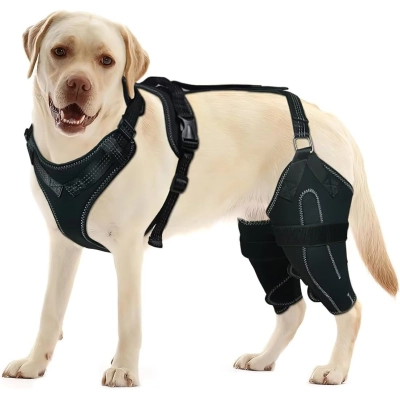
A dog knee brace built around these proportions — hinge placement matched to stifle anatomy, strap configuration that separates upper and lower anchoring zones, a shell length that respects the hock's range of motion — works differently from one that treats small-dog fitting as a scaled-down afterthought. The difference shows up in whether the brace stays in position through a full walk, whether the dog accepts wearing it for the prescribed duration, and whether the skin under the straps stays intact across weeks of use.
FAQ
How tight should the straps be on a small dog knee brace?
Tight enough that you can slide one finger between the strap and the skin with light resistance, but not so tight that the finger cannot pass. If the strap leaves a deep imprint immediately after removal, it is too tight — loosen by one notch and recheck after a five-minute wear test. The goal is contact, not compression. Over-tightening is the single most common fit error, and it usually happens because a misaligned brace feels loose and the owner tightens straps to compensate rather than repositioning the brace.
How long can a toy-breed dog wear a knee brace in one session?
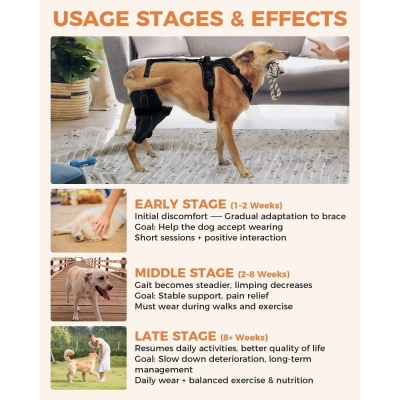
Start with 10–15 minutes and check the skin after removal. If there is no lasting redness, increase in 10-minute increments each day. Most small dogs plateau at 2–4 hours of continuous wear, after which moisture buildup under the liner becomes the limiting factor — not tolerance. On hot or humid days, cut the maximum session by roughly half. The brace comes off for any unsupervised period.
What is the difference between a knee brace for a luxating patella and one for a CCL tear?
A canine luxating patella brace prioritizes medial-lateral control — it resists the kneecap tracking to the inside or outside. It may include a patellar cutout or a medial buttress that physically blocks lateral displacement. A dog CCL brace prioritizes anterior-posterior control — it resists the tibia sliding forward relative to the femur. Hinges are typically stiffer and straps are configured to create a forward-stopping force vector. Some dogs have both conditions, but a brace optimized for one axis of instability rarely controls the other effectively.
Can a knee brace replace surgery for a torn CCL?
For partial tears where some ligament fibers remain intact, a brace can reduce instability enough for fibrotic scar tissue to form a functional bridge — this is the mechanism behind non-surgical management in select cases. For full-thickness tears, the tibial thrust is too large for external bracing to control during any weight-bearing activity. The decision between bracing and surgery turns on tear grade, dog size, activity demands, and concurrent joint pathology — not on brace quality alone.
My small dog keeps licking or chewing the brace. Is the fit wrong?
Not necessarily. Some dogs lick out of novelty, and the behavior fades after the first few sessions. But if licking persists past the third wear session, it is often a pressure signal — the dog is targeting a specific spot. Remove the brace and check the skin at the licked location. A hot spot, a rub mark, or even just warmth concentrated in one area means the brace is creating a pressure point there. Adjust strap placement or padding at that spot and recheck after the next session.
Does coat type affect which brace works?
Yes. Short-coated breeds get direct skin-to-liner contact, which makes liner texture and seam construction the dominant comfort variables. Double-coated breeds have a fur buffer that insulates against seam ridges but also reduces the grip between the brace and the leg, making strap migration more likely. For double-coated dogs, a brace with silicone grip strips on the inner liner or a broader upper strap that engages more fur surface area tends to stay in position better than a smooth-lined brace with narrow straps. The same brace that works perfectly on a short-coated Chihuahua may slide within minutes on a Pomeranian — the best knee brace for small dog is the one whose strap and liner configuration matches the dog's coat, not the one with the highest tension rating.
0 Comments