
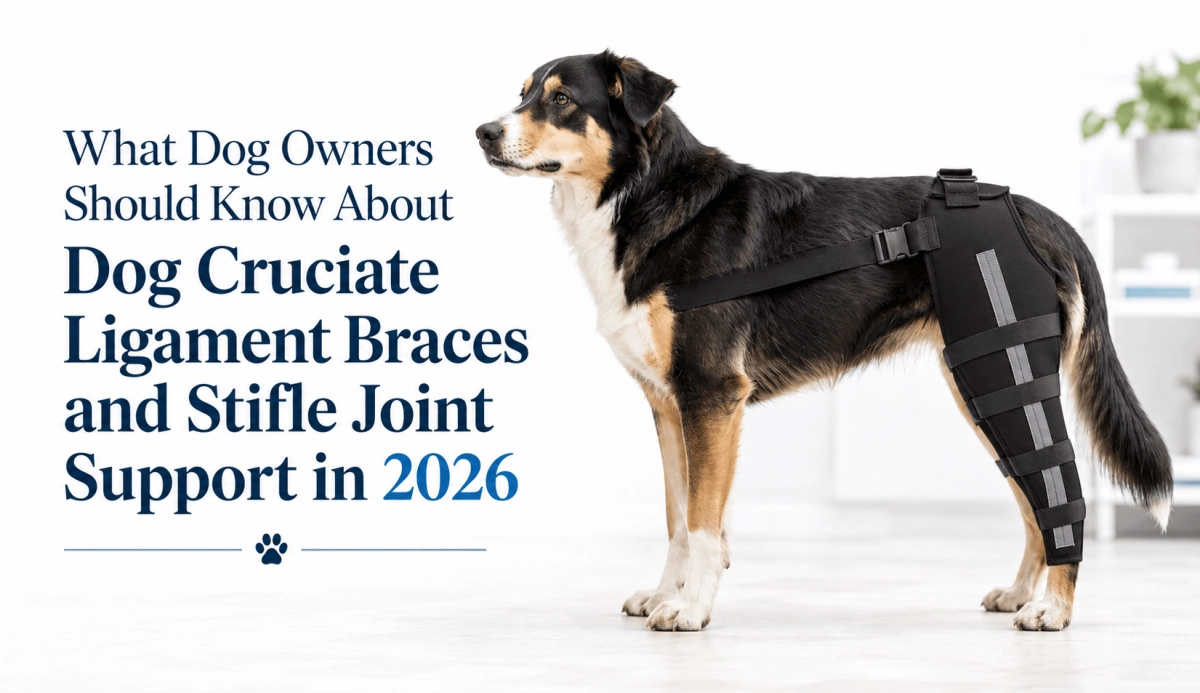
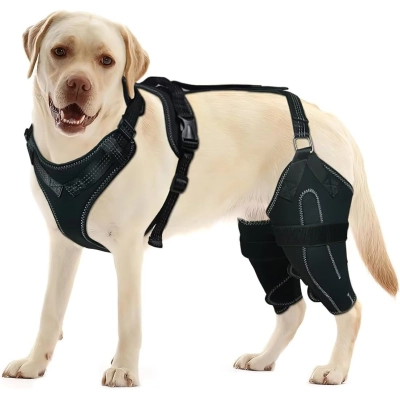
A stifle brace stabilizes the knee through two design details most owners never think about: where the hinge sits relative to the joint, and how the straps spread force across the leg. Neither has anything to do with how tight the brace is. A brace cranked down hard but misaligned by half an inch does less for the joint than a correctly positioned one worn at moderate tension.
How Hinge Placement and Strap Width Determine Stabilization
A stifle brace design stands or falls on two mechanical details. The first is hinge-axis alignment. The second is strap force distribution. Get the first wrong and the brace introduces shear instead of support. Get the second wrong and the brace migrates, chafes, or both.
Polycentric Hinges and Why Half an Inch Matters
The stifle joint does not open and close like a door hinge. As the knee flexes, the contact point between the femur and tibia rolls and slides — the center of rotation shifts through the range of motion. A single-pivot hinge cannot track this. A polycentric hinge can.
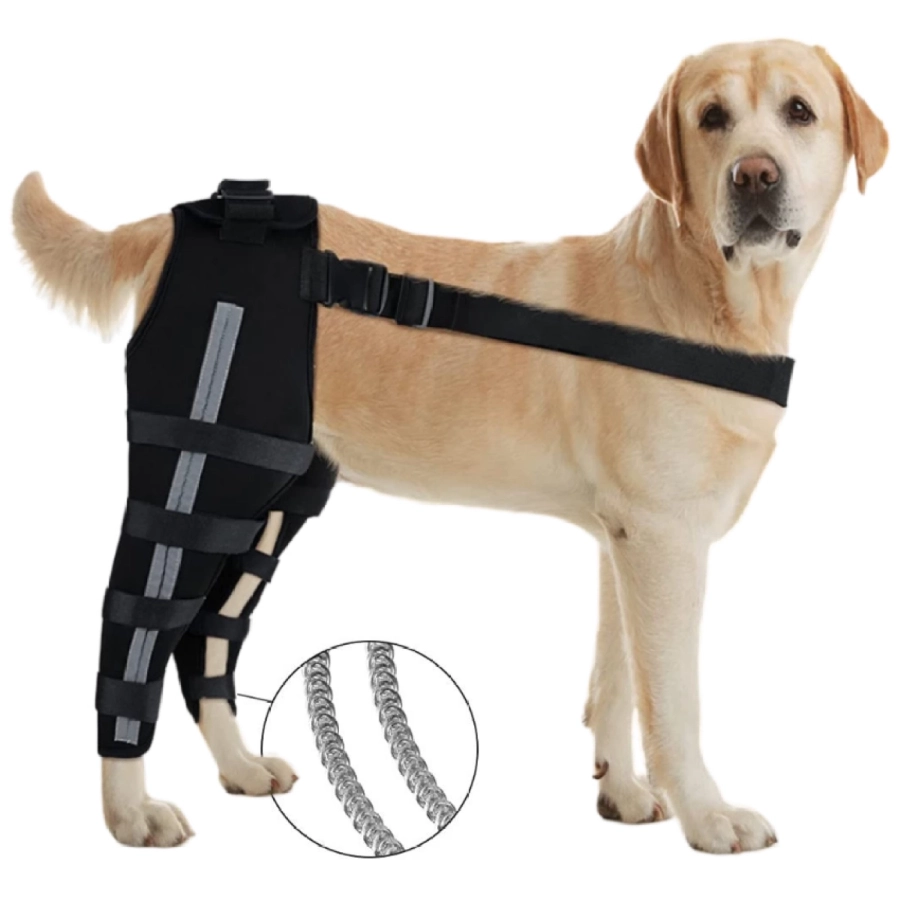
When a polycentric hinge is positioned so its moving axis aligns with the stifle joint's center of rotation, the force it transmits follows the joint's natural load path. The tibia stays centered under the femur through each step. The damaged ligament — whatever fibers remain intact — is not asked to handle loads it cannot manage. That is the causal chain: hinge alignment determines force-path accuracy, which determines joint-surface loading, which determines whether the dog moves naturally enough to tolerate the brace for hours at a time.
Misalign that hinge by even half an inch, and the geometry changes. The brace now pulls the tibia at a slight angle during flexion. Instead of pure compression along the joint axis, the dog gets a shear component. The remaining ligament fibers absorb that shear. Over hundreds of steps, micro-damage accumulates.
You can check this. Walk the dog on a leash for ten minutes, then find the bony prominence on the outside of the stifle. Place a finger on it. Now locate the hinge centerpoint. If the distance between them exceeds half an inch, the hinge has migrated. The brace is no longer tracking the joint.
Strap Width, Pressure, and Why the Brace Stays Put
Strap width is not about comfort. It is about pounds per square inch. A narrow strap concentrates bracing force into a thin band. High localized pressure collapses capillaries in the skin, irritates nerve endings, and after about twenty minutes, makes the dog want the thing off.
A wide strap spreads the same force across two or three times the surface area. The per-unit pressure drops proportionally. The skin tolerates it. The dog tolerates it. The brace stays on.
Multi-point anchoring adds a second layer of stability. A brace held by two straps — one above the stifle, one below — can pivot around those two anchor points. Add a third strap that wraps the thigh higher up or anchors lower on the tibia, and the brace resists rotation in multiple planes. It does not twist when the dog turns. It does not slide down when the dog walks downhill.
After twenty minutes of wear, run a finger under each strap edge. Damp, warm skin that exactly traces the strap outline signals trapped moisture — the liner material is not breathing. An indentation that stays visible longer than two minutes means the strap tension exceeds what that strap width can distribute safely. Dry skin with no lasting marks is the target.
Where a Stifle Brace Works — and Where the Design Reaches Its Limit
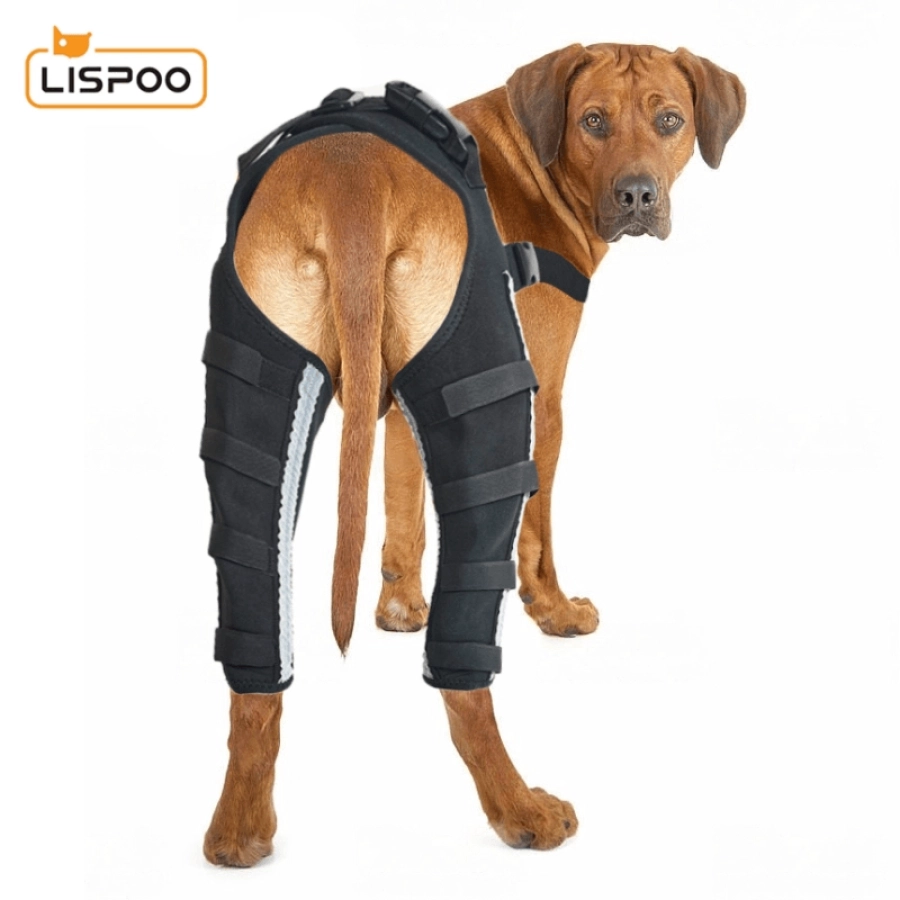
A dog CCL brace is an external stabilizer, not a ligament replacement. That distinction defines where the design works and where it does not. The same design tradeoffs that shape brace performance show up most clearly when you look at which injuries respond and which ones do not.
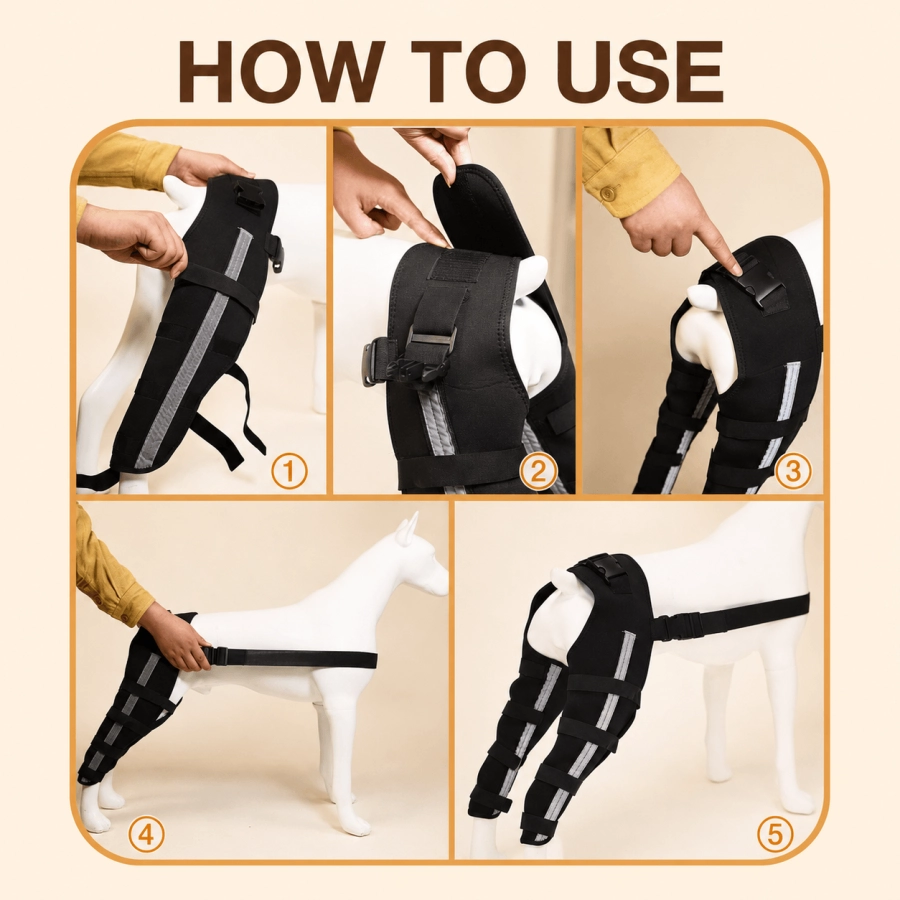
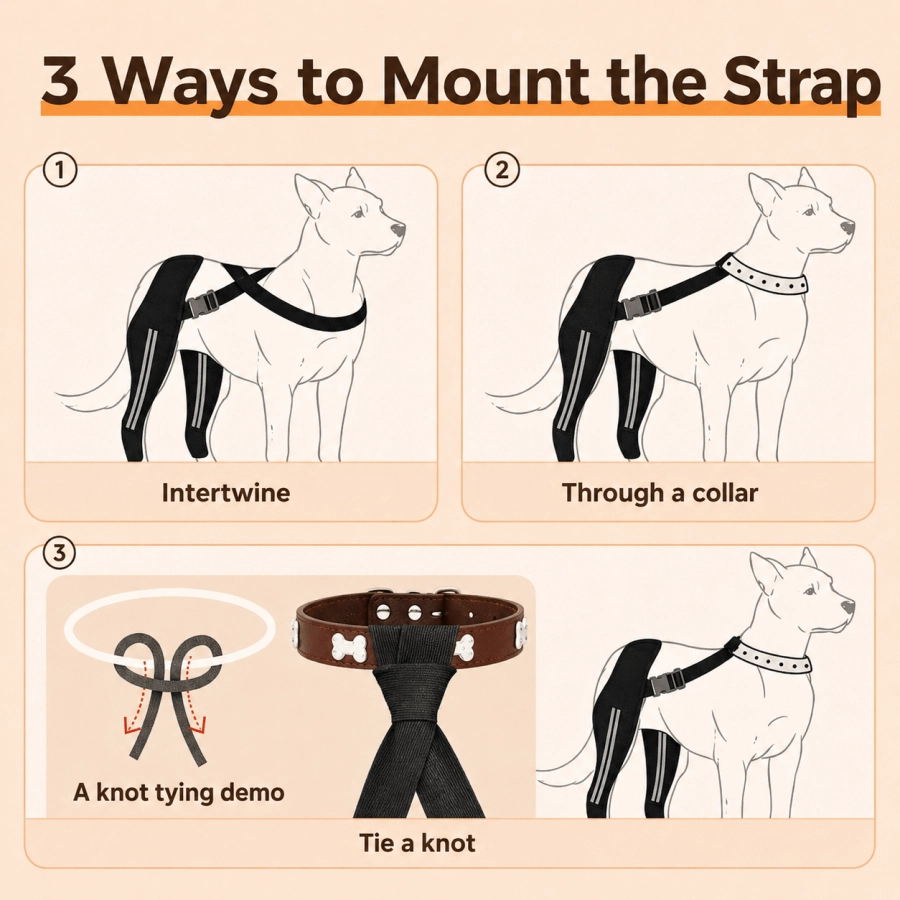
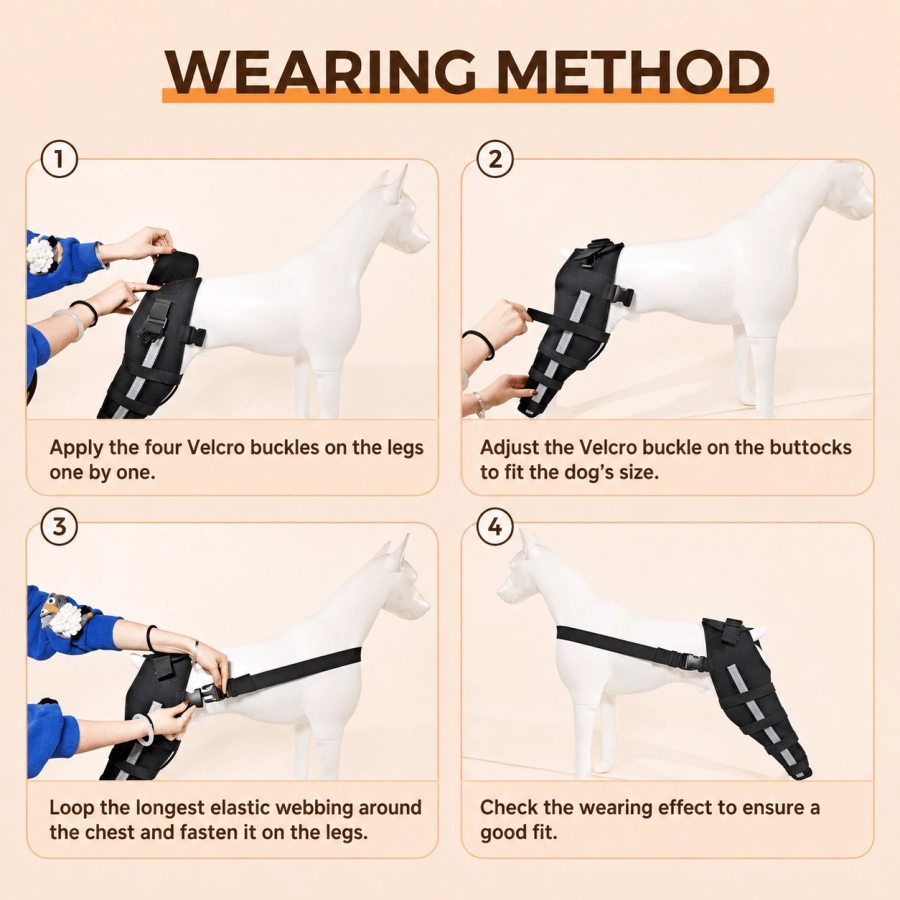
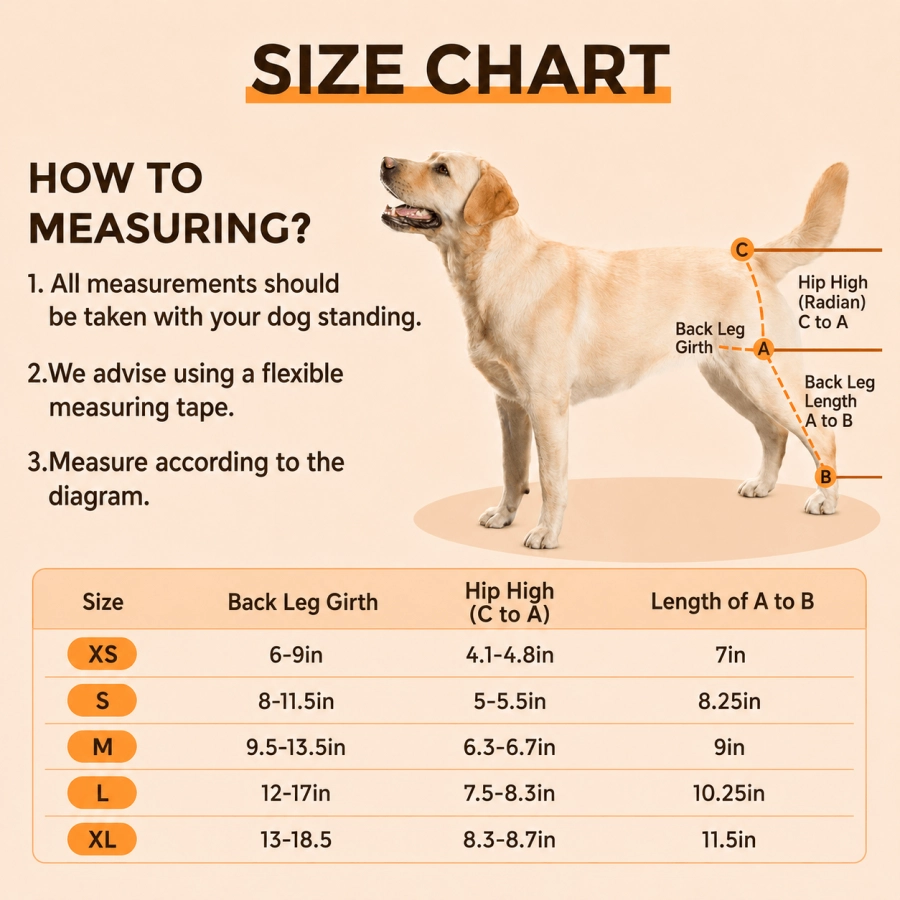
Conditions That Favor Bracing
Partial CCL tears with mild to moderate drawer motion. The ligament still has structural integrity — enough to contribute, but not enough to stabilize the joint alone. The brace reduces the load on surviving fibers during weight-bearing so they are not repeatedly overstretched.
Pre-surgical stabilization. When surgery is scheduled weeks out, the brace limits tibial translation during that waiting period. The same hinge alignment that supports natural motion during recovery also protects the joint during the pre-op window — it reduces the odds that a partial tear progresses to a complete rupture before the surgical date.
Dogs that are not surgical candidates. Age, heart conditions, or anesthesia risk can rule out a tibial plateau leveling osteotomy. For these dogs, a dog brace becomes the primary management tool — not because it outperforms surgery, but because it is the option that exists.
Where Bracing Falls Short
Complete ruptures with gross instability. When the cranial cruciate ligament is fully torn and the tibia translates forward under minimal load, no external brace can fully restore primary restraint. The brace reduces the translation. It cannot eliminate it. For a young, active dog with a complete rupture, surgical stabilization addresses the root problem in a way bracing alone cannot.
Breed conformations that fall far outside the norms the brace was patterned for. A very deep-chested dog or one with pronounced angular limb deformity may position the hinge axis where it cannot align with the joint center. The geometry simply does not cooperate.
High-drive dogs that will not accept activity restriction. A brace does its job during controlled, predictable movement. If the dog sprints, jumps, or twists hard enough, the external stabilizer is overwhelmed regardless of design quality.
| Design Dimension | Where It Works | Main Limitation |
|---|---|---|
| Polycentric hinge | Dogs with typical stifle geometry; hinges track the shifting center of rotation through flexion and extension | Misalignment beyond half an inch converts support into shear — the brace works against the joint instead of with it |
| Wide multi-point strapping | Most coat types and leg shapes; force spreads across a larger surface area, keeping the brace positioned through walks | Very short-coated dogs may need additional padding at strap edges to prevent friction marks during extended wear |
| Adjustable tension | Dogs whose muscle mass changes during recovery; tension adjusts incrementally as the leg rebuilds strength | User error in setting tension is the most common cause of poor fit — too loose loses stabilization, too tight causes skin damage |
Disclaimer: The fit checks described here assume a dog with typical hind-limb conformation. Dogs with pronounced angular limb deformities, significant muscle atrophy on the affected leg, or very deep chests may show subtler pressure signals — hand-checking along strap edges is more reliable than visual inspection in these cases. If the dog's leg shape falls far outside breed norms, a custom-molded shell may be necessary to achieve the hinge alignment described above.
Fit, Materials, and What to Watch During Daily Use
Fit Verification — What Correct Looks Like on the Leg
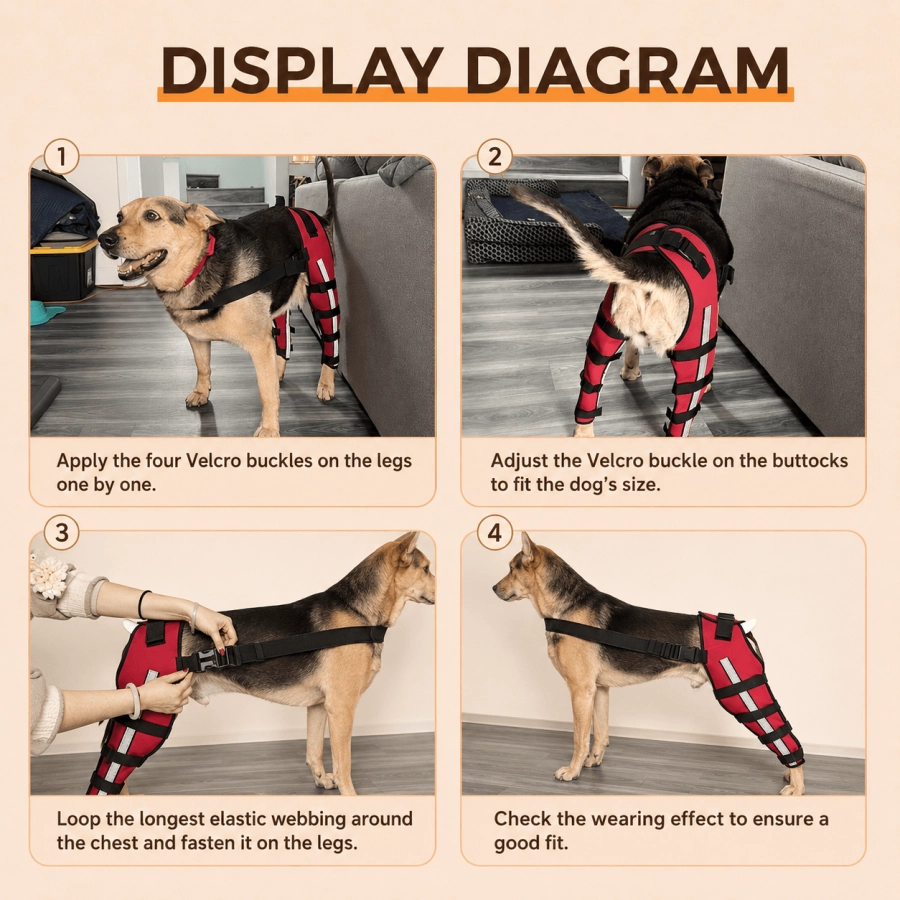
A well-fitted brace does three things you can observe without instruments. First, the dog places weight on the leg within the first few steps — hesitancy that lasts more than a minute suggests something is off. Second, the paw traces a smooth arc through the stride; the dog does not hitch the leg up early to avoid loading the joint. Third, after removing the brace, there are no hot spots, no broken skin, no areas the dog immediately licks.
Check the brace position before and after each wear session. Mark the strap holes you use with a small piece of tape. If you find yourself tightening to the next hole within the first week, the padding has likely compressed — that is normal. If you are tightening two or more holes, the brace shell may be deforming or the dog's leg may be losing muscle mass faster than expected. Either way, it warrants attention.
Walk the dog ten steps on a flat surface. Watch the affected leg from the side. Does the paw land and push off in a continuous motion, or does the dog hitch the leg up early? A smooth weight-transfer cycle — paw down, weight through, push off — suggests the brace is stabilizing the joint through the full stride. An interrupted cycle where the dog unweights the leg before the paw leaves the ground often signals hinge misalignment or strap pressure the dog is trying to avoid.
Material Choices and What They Change
Neoprene sleeves provide compression and light warmth. They offer almost no torsional rigidity. For a dog with mild instability where the goal is proprioceptive feedback — the dog sensing the sleeve and moderating its own movement — a neoprene wrap can be enough.
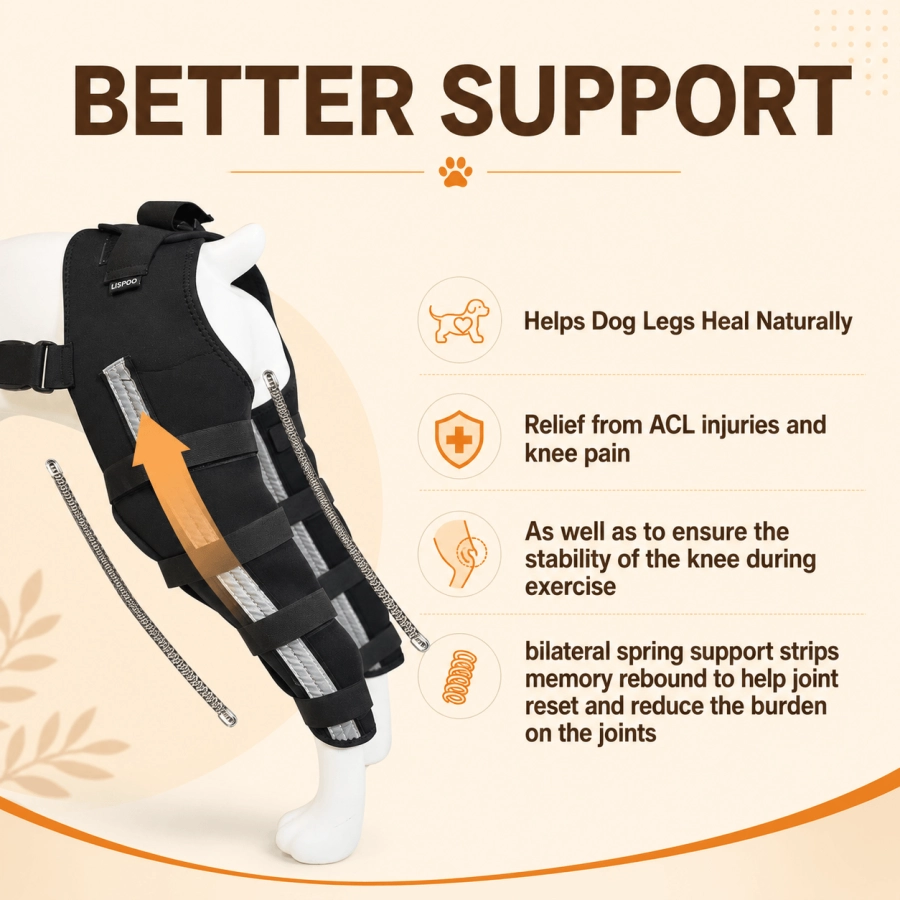
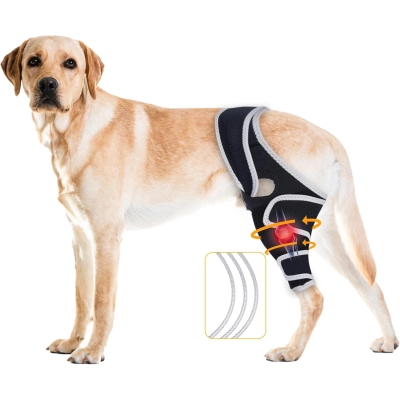
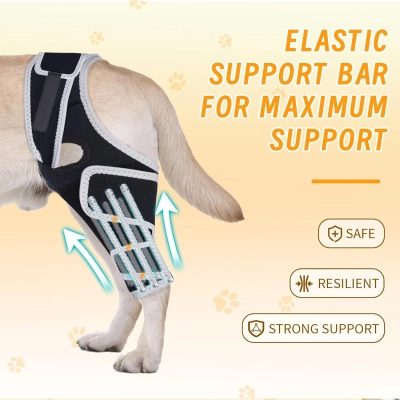
Orthotic-grade thermoplastic shells bonded to closed-cell foam liners provide actual structural resistance to tibial translation. The shell resists bending. The hinge resists rotation in the wrong plane. The foam conforms to the leg over the first few days of wear, creating a custom interface without the cost of a fully bespoke device. This material choice matters at the production level too — thermoplastic shells hold their geometry through repeated thermoforming cycles, which means consistency from unit to unit is higher than with sewn-fabric designs where stitch tension introduces variability.
The hinge material matters under repeated loading. An aluminum hinge holds its axis better than an injection-molded plastic one after thousands of flexion cycles. Aluminum adds weight — negligible for a 15-pound dog, more noticeable on a 90-pound dog taking five thousand steps a day. Either way, check the hinge rivets weekly. Lateral play or visible wobble means the hinge is beginning to yield, and consistent brace care starts with catching that early.
In practice: Moisture is the fastest path to skin breakdown under a brace. After a walk in wet grass, remove the brace, wipe the inner liner dry, and let it air out for at least fifteen minutes before reapplying. A brace that stays damp against the skin for hours causes irritation faster than one worn at slightly higher tension but kept dry.
FAQ
How long should a dog wear a cruciate ligament brace each day?
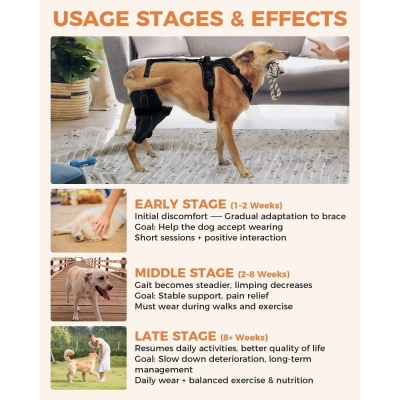
Start with 15 to 30 minutes and increase by 15-minute increments every two days as long as the skin check passes — no redness, no indentations lasting beyond two minutes after removal. Most dogs work up to full waking-hour wear within two weeks. Remove the brace at night unless a veterinarian instructs otherwise.
Can a dog go outside in the brace?
Controlled leash walks on flat ground, yes. Sprinting, jumping onto furniture, chasing squirrels, or navigating stairs unsupervised, no. The brace stabilizes during predictable loading. It cannot compensate for sudden high-force directional changes.
Does a stifle brace replace surgery?
For a partial tear managed with strict activity restriction, a brace can be the primary intervention — it offloads the damaged fibers enough that the body's scar-tissue formation has a chance to restore functional stability. For a complete rupture in an otherwise healthy, active dog, the brace buys time and comfort but does not restore the primary restraint an intact CCL provides. The decision turns on the degree of instability, not on whether a brace is available.
How do you know the brace is still working after weeks of use?
Repeat the hinge-position check: walk the dog ten minutes, then measure the distance between the hinge centerpoint and the stifle's bony landmark. Check hinge rivets for play. Compare the strap hole in use today to the one used on day one — a one-hole difference is normal padding compression, but two or more signals a change in brace geometry or the dog's leg that needs addressing.
What is the difference between a neoprene sleeve and a hinged brace?
A neoprene sleeve provides compression, warmth, and proprioceptive feedback — the dog feels the sleeve and may moderate its movement. It offers negligible resistance to tibial translation. A hinged brace with a rigid shell resists tibial drawer motion through structural rigidity. The hinge controls the plane of motion; the shell distributes loads the sleeve cannot. For mild instability, the sleeve may suffice. For measurable drawer motion, the hinged design addresses the mechanical problem the sleeve only signals.
0 Comments