
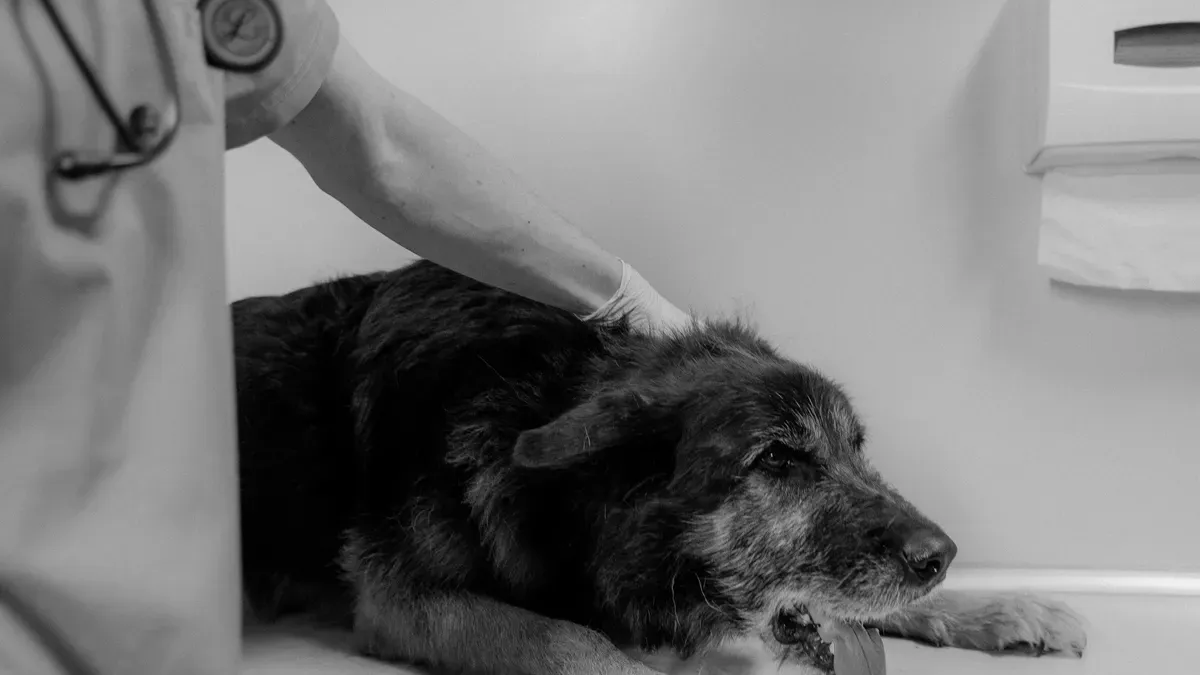
A dog that short-steps through a walk or holds up a hind leg is not just favoring a limb. The hock — the tarsal joint where the tibia meets the metatarsals — absorbs impact with every stride, and when something disrupts that joint, every step becomes a negotiation between stability and pain. A dog hock brace can change that equation. But not all braces change it the same way. Three design decisions — where the hinge sits relative to the joint axis, how the straps spread or concentrate force, and what the liner does after twenty minutes of contact — determine whether a brace stabilizes or just adds bulk.
Joint Alignment: What the Hinge Position Decides
A hock brace does not work by squeezing the joint. Circumferential compression on a damaged joint shifts load unpredictably and can redirect force into tissue not meant to bear it. What actually stabilizes is alignment: the brace hinge matching the tarsal joint's natural axis of rotation.
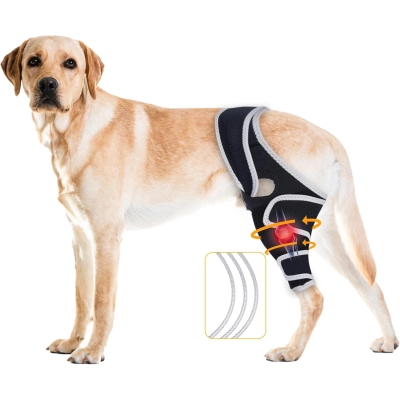
Here is the causal chain. The canine hock is a hinge joint — its primary motion is flexion and extension within a narrow sagittal plane. When a brace hinge sits directly over that anatomical axis, ground reaction force travels in a straight line from the paw through the joint and up the tibia. The joint surfaces stay evenly loaded. The surrounding ligaments are not asked to resist sideways shear because the brace frame is already resisting it. The dog moves more naturally because the mechanical pathway is predictable.
Move the hinge half an inch proximal or distal, and that pathway breaks. Force bends around the misaligned pivot. The joint no longer tracks in its natural plane. Soft tissue takes on torque the brace was supposed to absorb. The brace is not neutral anymore — it is introducing a new stress pattern into a system that is already compromised.
To check this in practice: after a ten-minute walk with the brace on, flex and extend the hock by hand. If the hinge moves in sync with the joint — no gap opening between brace and leg, no visible lag in either direction — alignment is close. If the brace shifts or the hinge visibly leads or trails the joint movement, the pivot point is off. A dog brace with adjustable hinge placement lets you tune this relationship; a fixed-position hinge works only for dogs whose joint geometry happens to match the template.
Strap Configuration and Liner Contact: The Two Interfaces That Shape Daily Wear
When a dog bears weight on a braced leg, the brace frame transfers some of that load to the limb above and below the joint. The straps are the interface that makes this transfer happen.
A wide strap — one that wraps at least a third of the way around the limb's circumference — distributes the transfer force across more skin and muscle. Lower pressure per square inch. Less chance of focal irritation. The brace holds its position because the friction surface is larger. A narrow strap does the opposite. It concentrates the same load onto a thin band of tissue. Over thirty minutes of walking, that band can become a pressure point. The dog may start licking at the strap edge — not because the brace is too tight, but because the force is concentrated instead of spread.
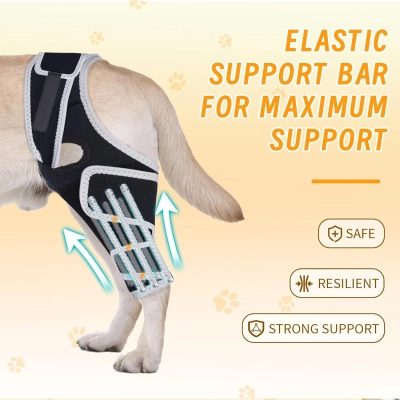
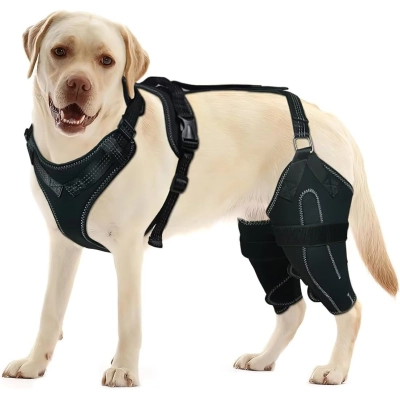
Multi-point strap configurations — two straps above the hock, one or two below — create a triangular force geometry that resists rotation better than a single upper-and-lower pair. Rotation is the failure mode that matters most: if the brace twists around the leg during movement, the hinge alignment is lost and the whole stabilization mechanism unravels.
Observable check: after a fifteen-minute walk, unbuckle the brace and run a finger along each strap line. A uniform, shallow imprint that fades within thirty seconds suggests even distribution. A deep red groove at one strap — especially the narrowest one — signals a pressure concentration. That strap needs repositioning or a different configuration.
Strap placement matters for minutes. The liner inside the brace matters for hours. Two material behaviors determine whether a liner holds up under real use. First, breathability — measured not by claims but by what you find when you open the brace after twenty minutes. A liner that traps heat leaves the skin underneath damp. Damp skin softens. Softened skin under repetitive pressure breaks down faster. Flip the liner back after a wear session: dry skin underneath means the liner is moving moisture out. Clammy skin means moisture is trapped, and longer sessions will compound the problem.
Second, compression memory. Foam and neoprene liners compress under load. A liner that stays flattened after the dog stands up has lost thickness exactly where it matters — at the bony prominences around the hock. Those prominences, now closer to the brace shell, receive more pressure on the next step. A liner with good rebound recovers its thickness between load cycles, keeping the protective layer consistent.
None of this matters if the brace does not fit. A brace that is too large lets the leg move inside it, generating friction no liner can fully absorb. Material choice is downstream of sizing accuracy and hinge alignment. When all three are right, the brace becomes something the dog tolerates through a full activity session. When one is off, the dog fights it after ten minutes.
For dogs recovering from hock injuries, the combination of aligned support and tolerable daily wear is what keeps a recovery plan on track — not rest alone, but protected movement that does not create new problems while solving the original one.
Where a Hock Brace Works — and Where It Reaches Its Limit
A hock brace is designed for a specific set of conditions. Its value is clearest when the primary problem is instability — a partial ligament tear, post-surgical protection, or chronic joint laxity where the joint needs external structural reinforcement to stay in a safe range of motion. In these cases, the brace frame and hinge carry the shear and rotational loads the damaged soft tissue cannot handle, while still allowing the flexion-extension movement the dog needs to walk and rebuild muscle. A properly aligned brace during recovery from a partial tarsal ligament tear can separate controlled rehabilitation from re-injury caused by an unexpected twist during a short-leash walk.
It performs poorly — or not at all — when the joint is already rigid. If a hock has fused or has severely restricted passive range of motion, an external hinge that tries to enforce a movement arc the joint cannot follow will transfer stress to the adjacent joints. The dog compensates by shifting load to the hip or stifle. The brace becomes a source of gait compensation rather than gait correction.
It also underperforms when limb geometry falls far outside the brace's sizing template. A dog with angular limb deformity, or a breed with unusually short metatarsals relative to tibia length, may lack enough flat contact area for the straps to anchor securely. Standard strap placements create pressure points at the brace edges because the limb profile does not match the shell curvature. For dogs whose early warning signs of knuckling suggest a neurological component alongside the hock issue, bracing alone addresses only the mechanical piece of a larger problem.
A mobility rehabilitation approach that pairs bracing with targeted exercise tends to produce better outcomes than bracing in isolation. The brace protects the joint during movement; controlled exercise rebuilds the muscle that long-term joint health depends on. Neither works as well without the other.
Disclaimer: The fit checks described above — hinge tracking, strap indentation fade time, and liner moisture assessment — assume a short-coated dog where skin and strap lines are visually accessible. Double-coated breeds may trap moisture deeper in the undercoat, making the liner-breathability check less reliable; hand-check the skin directly rather than relying on visual dampness alone. If the dog's leg conformation departs significantly from breed norms — particularly in dogs with angular limb deformities or unusually deep chests that alter hindlimb stance — the pressure-point checks described here may not catch every load concentration.
FAQ
Does a hock brace replace the need for rest?
No. A brace stabilizes the joint during controlled movement; it does not heal damaged tissue on its own. Rest reduces metabolic demand on injured structures. The brace and rest period serve different functions — the brace protects the joint during necessary movement, and rest lets tissue repair proceed without interruption.
How long can a dog wear a hock brace in one session?
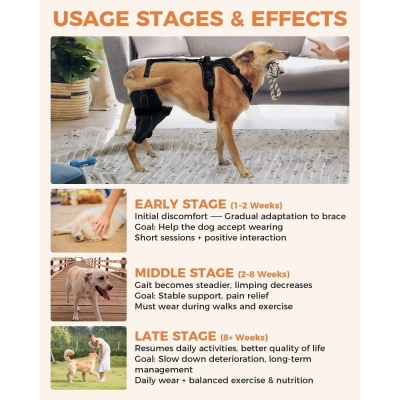
This depends on liner breathability and fit accuracy, not a universal time limit. Start with twenty-minute sessions and run the moisture and indentation checks described above. If skin stays dry and strap marks fade within thirty seconds, extend sessions in ten-minute increments. If dampness or persistent marks appear, shorten sessions and reassess fit. Most dogs with a well-fitted brace tolerate two to four hours of cumulative daily wear, broken into sessions.
Can a hock brace prevent injury in an active dog?
A brace is not a prophylactic device. It supports a joint that already has a diagnosed instability or is in post-injury recovery. Putting a brace on a healthy, active dog restricts natural proprioceptive feedback and may alter movement patterns in ways that create risk where none existed before. For dogs that need everyday support during activity, the design priorities shift toward lightweight materials and minimal restriction of the dog's natural gait — the same principles that apply to choosing a hock brace for post-surgery and everyday support.
When does a hock brace stop being useful?
When the joint has healed to the point where the dog's own soft tissue can handle everyday loads without external reinforcement — or when the joint has progressed to a rigid, end-stage condition where bracing adds no functional benefit. A veterinarian assesses this based on physical exam findings, not on a fixed timeline. The range of orthopedic solutions for canine health extends beyond bracing, and the right choice tracks the stage of the condition, not a single device category.
How do I know if the brace is fitted correctly?
Three checks, in order: the hinge moves in sync with the joint through a full flex-extend cycle; strap indentations fade evenly within thirty seconds of removal; the skin under the liner is dry, not damp, after a twenty-minute wear session. If any check fails, the fit needs adjustment. A hock brace with proper fit and orthopedic support is the difference between a device the dog tolerates and one that corrects the problem.
0 Comments