

A front leg brace does not work by squeezing harder. It works by guiding force along a predictable path. When the hinge sits half an inch off the joint axis, the brace becomes a lever working against the dog's natural movement. When it aligns, the dog loads the leg the same way it would without the brace — the support comes from keeping the joint in its functional arc, not from immobilizing it.
Joint Alignment — Why Hinge Position Decides Whether a Brace Actually Supports
The core mechanism of a front leg brace is constraint within a safe range of motion, not compression. A carpal brace that limits wrist extension past the standing angle prevents the hyperextension collapse that drops a dog's weight onto the accessory carpal pad. An elbow brace that tracks the humeroradial joint through flexion and extension keeps the articular surfaces in contact at the angles where load transfer is efficient.
Here is why alignment matters at the physical level. Hinge axis parallel to joint axis → the force vector travels along the natural load line of the radius and ulna → articular surfaces are loaded evenly across their contact area → no shear component develops at the cartilage interface → the dog recruits muscle patterns it already knows. Offset that hinge by a quarter inch and the brace introduces a moment arm. The dog compensates with altered gait. That is the opposite of support.
You can verify this without instruments. After 15 minutes of walking on a flat surface, watch the dog from the side. A braced leg that lands and pushes off with the same stride length as the unbraced leg signals that force is traveling cleanly through the joint. A shortened stride on the braced side — the paw landing closer to the body than the opposite paw — suggests the hinge position is fighting rather than guiding the dog's movement.
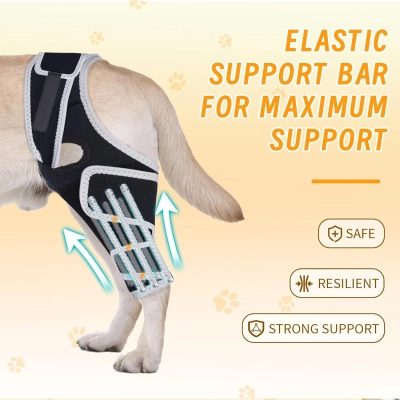
For carpal hyperextension specifically, what matters is the stop angle built into the brace. A design that arrests extension at the standing angle — roughly 10 to 15 degrees past vertical for most dogs — prevents collapse without blocking the flexion needed for stairs or uneven ground. A brace that locks the carpus at a fixed angle solves the collapse but creates a new problem: the dog cannot absorb shock through the wrist, so that force travels upward to the elbow and shoulder instead. The right design does not eliminate motion. It draws a line the joint is not allowed to cross.
The same logic holds for the elbow. The humeroradial joint rotates and glides — it is not a simple hinge. A single-axis hinge on an elbow brace approximates this compound motion. The closer the axis alignment, the less the brace resists the dog's natural elbow tracking during a stride. A poorly aligned elbow hinge forces the dog to either fight the brace or shorten its gait to reduce the mismatch — both of which increase energy cost per step and reduce the dog's willingness to move.
Strap Configuration — Force Distribution Over Force Concentration
A strap is not just a fastener. It is a force interface. Every strap on a front leg brace transfers load between the brace structure and the dog's limb. How that load lands — across a wide band or a narrow edge — determines whether the dog tolerates the brace for 30 minutes or 8 hours.
Wide straps spread the closing force across more square inches of skin and underlying soft tissue. This lowers pressure at any single point. It also reduces the shear that develops when the brace tries to migrate — a wide contact patch has more surface friction holding it in place than a narrow one. That physics works without overtightening. A narrow strap must be pulled tighter to achieve the same hold, which concentrates pressure under the strap edge and accelerates skin breakdown.
Here is the observable difference. After 20 minutes of normal activity, run a finger under each strap edge. Cool, dry skin signals even contact without trapped moisture. A ridge of compressed fur or a warm, damp patch directly under a strap edge means force is concentrating there. That concentration point will, over hours, become a rub mark. Over days, a pressure sore. This is not about "checking fit" in the abstract — it is about whether the strap is distributing force or dumping it all onto one narrow line of soft tissue.
Strap anchoring order changes how the brace behaves under load. A brace anchored first at the lowest point — the carpus for a full-limb brace, or just above the paw for a carpal-only brace — creates a stable base that the upper straps tension against. Reverse this order and the brace migrates upward as the dog moves, because the upper straps pull against an unanchored lower section. The fix is not "tighten it more." The fix is load-path order: distal anchor seated first, proximal tension applied second, the same principle that keeps a shoe on a foot.
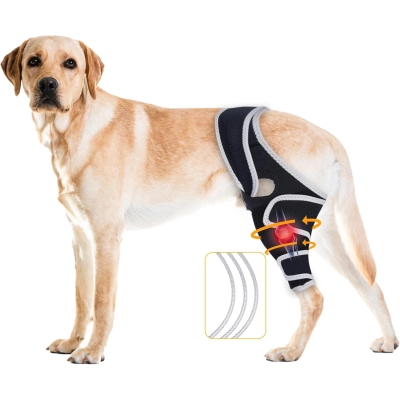
Material choice at the strap-limb interface shapes this further. Neoprene conforms to leg contour and provides even compression, but it traps heat and moisture — which matters for dogs wearing a brace beyond 2 hours. A perforated foam laminate with a moisture-wicking liner face keeps skin drier but may not deliver the same degree of conforming compression. Neither material is universally better. Neoprene wins for short-duration, high-stability needs where the dog is active. Perforated laminate wins for extended wear where skin tolerance becomes the limiting factor — common in older dogs with thinner skin and reduced tissue compliance.
Where Front Leg Braces Perform Well — and Where They Reach Their Limit
A front leg brace is most effective when the primary problem is mechanical instability within a predictable plane of motion. Carpal hyperextension, mild to moderate elbow joint laxity, and post-surgical protection where the fixation is already structural — these are the scenarios where a well-aligned brace adds meaningful support. The common thread: the joint can still move through a functional range, and the brace's job is to prevent it from exceeding that range.
The same dog brace design logic weakens when the dog's condition is primarily neurological rather than structural. A dog with radial nerve palsy that drags the dorsal paw surface needs a brace that protects skin from ground abrasion, not one that tries to enforce joint angles the dog cannot control. The design requirements shift: shell geometry, toe clearance, and ground-contact material become primary. Hinge alignment becomes secondary — because the brace is functioning as a protective shell, not a kinematic guide.
Arthritis presents a middle case. The joint is structurally intact but the cartilage surface is degraded. A brace helps by limiting end-range motion — the angles where damaged cartilage experiences peak stress — while still allowing mid-range movement that keeps the joint lubricated. The design challenge here is not rigidity. It is controlled endpoint: the brace must stop motion at a specific angle, repeatedly and consistently, without creeping or loosening across a wear session.
Severe angular limb deformity — where the bones themselves curve away from the expected load axis — sits outside what a standard brace can address. A brace patterned on breed-standard conformation cannot match a joint axis that does not follow the expected geometry. Fit checks that pass at rest may fail immediately under load, because the mismatch only appears when the dog weights the leg.
Disclaimer: The fit verification checks described here assume a short-coated dog where skin and fur changes are visible on inspection. Double-coated breeds may show subtler rub marks and moisture buildup beneath the undercoat that need hand-checking rather than visual inspection — run your fingers along the skin surface under the brace to feel for warmth or texture changes that the coat conceals. If the dog's leg conformation falls outside the breed norms the brace was patterned for — particularly dogs with angular limb deformities or very deep chests that alter shoulder mechanics — the strap-anchoring logic described above may not catch every pressure point.
Design Details That Shape Daily Wear Performance
Liner structure sets the baseline for how long a brace can stay on before skin tolerance becomes the limit. A liner that compresses unevenly — thicker over bony prominences, thinner over muscle bellies — creates a pressure map with hot spots at every contour transition. A multi-density liner that uses softer foam over the accessory carpal pad and the olecranon, with firmer padding elsewhere, smooths these transitions. The observable result: after 4 hours of wear, the dog has not started licking the brace edges. Licking is the first behavioral signal that a pressure distribution problem is developing under the brace.
Ventilation design interacts with wear duration in a way single-layer braces cannot escape. A brace with a single neoprene body has no path for moisture to exit other than through the top and bottom openings. A brace with a ventilated shell — mesh panels over non-structural zones, perforations through the outer layer — creates passive convection as the dog moves: warm air rises out the top, cooler air enters from below. The performance difference is testable. After a 30-minute walk, remove the brace and press a dry paper towel against the inner liner. A faint damp outline is normal. A soaked towel that leaves the liner visibly wet signals trapped moisture — and trapped moisture is the precursor to skin maceration within hours.
The sizing system itself is a design feature. A brace offered in 5 sizes with rigid 2-inch circumference boundaries leaves dogs stranded — the one whose measurement lands on the border fits neither size well. Overlapping size ranges with half-size increments, combined with adjustable strap throw that accommodates 1 to 1.5 inches of adjustment per anchor point, catches dogs that would otherwise fall between sizes. More important than the number on the sizing chart is the adjustment margin. If a strap bottoms out at its tightest or loosest setting on day one, the brace has zero room for the leg's natural volume changes — post-activity swelling, muscle atrophy during reduced use, seasonal coat thickness shifts.
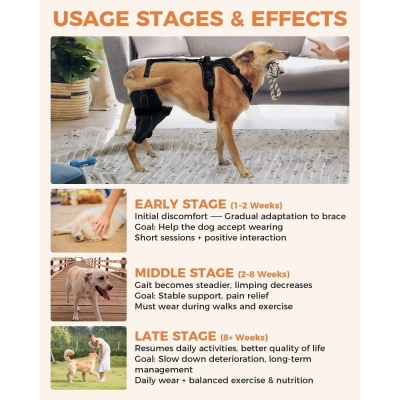
In practice: The wear-time schedule from front leg brace acclimation protocols matters less than whether the brace still fits the same on day 14 as it did on day 1. Leg volume changes during early use — swelling subsides, muscle tone shifts — can turn a well-fitted brace into a loose one within the first two weeks. Re-check strap tension at the same time each day, with the dog standing in the same posture, to catch drift before it affects support.
Conditions a Front Leg Brace Can Assist With
The specific conditions where front leg bracing provides mechanical benefit share a common characteristic: the joint's passive stabilizers — ligaments, joint capsule — are compromised, but the joint's geometry is still intact enough to accept guidance.
| Condition | What the Brace Does Mechanically | Main Limitation |
|---|---|---|
| Carpal hyperextension | Arrests extension at standing angle; prevents collapse into palmigrade stance | Cannot restore ligament tension; protects against worsening, does not reverse laxity |
| Elbow joint laxity | Constrains varus/valgus deviation; keeps joint surfaces aligned under load | Single-axis hinge approximates a joint that rotates and glides; alignment precision is size-dependent |
| Post-surgical protection | Limits range of motion to protect fixation; offloads stress from healing tissue | Support is supplementary to internal fixation, not a replacement for it |
| Arthritis | Limits end-range motion where damaged cartilage sees peak stress; provides proprioceptive feedback | Does not alter disease progression; comfort benefit varies by joint and severity |
The range of front leg support designs reflects how different these mechanical demands are. A carpal brace optimized for hyperextension has a different hinge geometry and strap layout than an elbow brace designed for post-surgical protection — different joints, different failure modes, different solutions.
FAQ
How does hinge position affect whether a front leg brace actually supports the joint?
Hinge position relative to the joint axis determines whether the brace guides motion or fights it. An aligned hinge lets force travel along the bone's natural load path. An offset hinge introduces a moment arm — the dog compensates with altered gait, which increases energy cost per step and reduces the mechanical benefit the brace is supposed to provide.
Why do some dogs tolerate a front leg brace for hours while others develop skin irritation within minutes?
The difference usually comes down to strap width and liner pressure distribution, not the dog's sensitivity. A narrow strap concentrates closing force onto a thin line of soft tissue. A wide strap spreads the same force across more surface area. A single-density liner creates hot spots at contour transitions between bone and muscle. A multi-density liner smooths those transitions. The dog's reaction — licking, chewing, restlessness — is often the first observable signal that a pressure problem exists.
Can a well-designed front leg brace replace surgical stabilization?
No. A brace constrains motion within a safe range and offloads stress from compromised passive stabilizers. It does not reattach torn ligaments, remodel bone, or restore joint surface congruence. Surgery and bracing address different mechanical problems — surgery restores structural integrity; bracing manages load while tissue heals or adapts. The two are often complementary, not alternatives.
0 Comments